

YFQ-44A CCA Starts Testing and the Sabre’s Supersonic Dive
From breaking the sound barrier to breaking the old model of air combat, America’s flight-test frontier keeps redefining how pilots, machines, and speed shape tomorrow.
“Operators are putting Collaborative Combat Aircraft to work faster—developing tactics through early experimentation & shaping how they’ll be used in the future fight.”
—U.S. Air Force Twitter Post
Mission Briefing
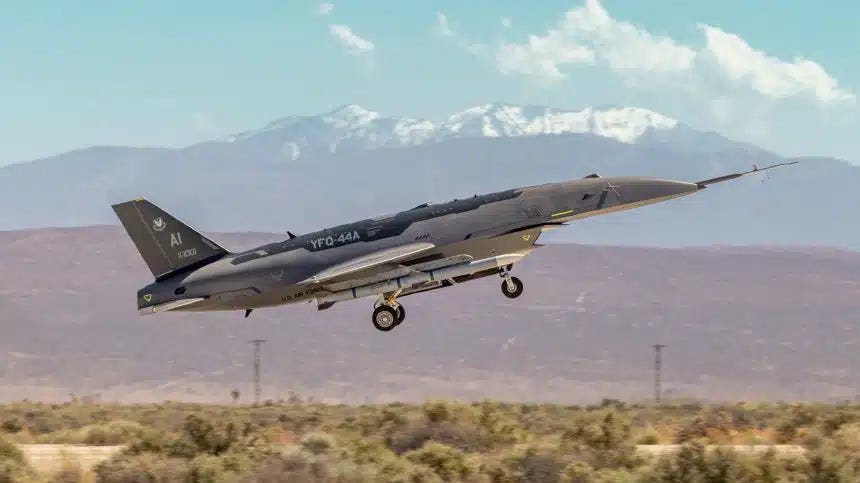
Under the wide California sky, the U.S. Air Force and Anduril kicked off the maiden tests of the trailblazing YFQ-44A at Edwards Air Force Base, where legends are born. In true aviator spirit, operators are taking the stick early, steering this futuristic bird through real-world trials and shaping the playbook as they go. It’s all part of the Air Force’s bold new approach—less red tape, more throttle—to fast-track game-changing tech straight into the hands of those who fly and fight.
What is Happening at the Edwards Air Base?
Under the endless blue canopy of Southern California, the YFQ-44A’s latest chapter unfolded: a cinematic tale of grit, innovation, and hands-on flying. Air Force personnel from the Experimental Operations Unit (EOU) and the 412th Test Wing weren’t just running drills; they were rewriting the rulebook for operating Collaborative Combat Aircraft (CCA) in the kind of hostile environments where every second counts.
The operation began with the YFQ-44A departing Anduril’s test site—most likely the Southern California Logistics Airport in Victorville, the same ground where it first touched the sky—and making its way to the legendary runways of Edwards Air Force Base.
Once there, EOU airmen took charge of the entire show: from meticulous pre- and post-flight checks to arming and disarming the bird, to commanding its every move during daily sorties. It was the operators, not engineers or test pilots, in the cockpit: real warfighters putting steel to the test.
Lt. Col. Matthew Jensen, commander of the EOU, summed it up: “Every sortie flown was done with a warfighter kicking the tires and controlling the prototypes.” This wasn’t a sterile lab exercise or a carefully staged display.
It was boots on the tarmac, sweat on brows, and a relentless drive to “learn by doing,” moving at a pace and risk level that had the blessing of the Air Force’s senior leadership. The mission: make sure CCAs are battle-ready for the toughest arenas, not just on paper but out in the wild, where it matters most.
Anduril’s secret weapon? Not a sprawling control center or racks of hardware, but a ruggedized Menace-T laptop—fit for a Hollywood close-up—acting as the heart of ground ops.
With just this device and a couple of trusty Pelican cases, the team uploaded mission plans, triggered autonomous taxi and takeoff, managed the bird in flight, and downloaded data for post-mission analysis.
The exercise proved just how lean operations could be, simulating a forward operating base with almost nothing but grit and tech. Even the maintainers, trained up in mere days, were testament to the system’s simplicity and adaptability.
But this wasn’t just about flying; it was about forging the playbook for the future. The EOU is now hammering out the tactics, techniques, and procedures that will embed CCAs as a frontline force, ready for any conflict.
This all happened thanks to a rare fusion of command muscle: Air Combat Command and Air Force Materiel Command joined forces, fast-tracking the experiment and letting real operators shape the future at breakneck speed.
Col. Timothy Helfrich, who oversees acquisition for fighters and advanced aircraft, nailed the spirit: “An 85% solution in the hands of a warfighter today beats a perfect one that never arrives.” It’s innovation on afterburner, where the sky’s not even the limit.
The EOU and the Features of the YFQ-44
June 2025, Nellis Air Force Base—cue the buzz of anticipation as the Experimental Operations Unit (EOU) officially takes flight, charged with fast-tracking the era of Collaborative Combat Aircraft.
Once just a detachment under Eglin’s 53rd Wing, the EOU now stands tall as a full-fledged squadron, a move the Air Force calls a “significant step forward” toward fielding real operational CCAs before the decade is out.
The timing couldn’t be more cinematic: Beale AFB in California is tapped to host the first CCA Aircraft Readiness Unit, while, back at Nellis, the ground shakes as the YFQ-42A and YFQ-44A fire up for their first ground tests in May 2025.
The EOU’s mission? Be the crucible where man and machine learn to fly as one. It’s not just about theory.
This unit will put human-machine teaming to the test in gritty, live-fly scenarios, making sure the tactics and techniques dreamed up in simulators actually hold water where it counts. Every sortie is a chance to refine what works, toss out what doesn’t, and push the edge of what’s possible.
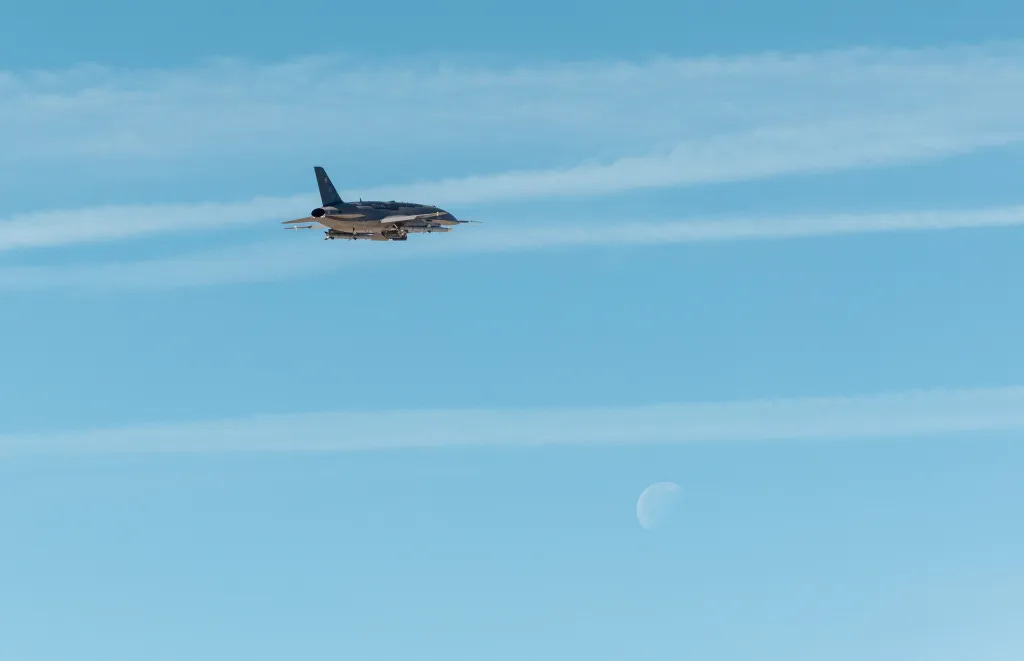
And at the pointy end of this revolution is the YFQ-44A Fury—a jet built for high-G showdowns, brushing up against Mach 1, its modular bay ready to host radar, IRST, or electronic warfare gadgets as the mission demands.
With a pair of AIM-120 AMRAAMs on its wings and the GA-ASI YFQ-42 flying as its partner, the Fury leads a new breed of unmanned wingmen, rewriting the playbook for air combat and locking in the future of the fight.
Writing the Loyal Wingman Playbook
This isn’t just another test flight. It’s a turning point for the U.S. and its allies. The Air Force is no longer treating Collaborative Combat Aircraft as a “someday” vision, but as a real capability, shaped in the here and now by the very operators who may one day fly into combat with these machines.
During the April 2026 exercise at Edwards Air Force Base, the YFQ-44A took flight with the Experimental Operations Unit, laying down the first building blocks for the tactics and procedures that will make CCAs more than just prototypes. They’ll be warfighters’ trusted partners in the battlespace.
The EOU’s mission is clear: get these next-gen aircraft into the field before the decade is out, and do it with a lean, fast-paced model that puts operators and rapid deployment front and center.
For the U.S., this means a future air force that can stretch its wings, spread risk, and keep humans safer by teaming pilots with tough, cost-effective uncrewed wingmen.
For American allies, it’s a sign that the playbook of air warfare is changing—human-machine teams, distributed operations, and quicker adaptation are becoming the new normal.
What matters most isn’t just the tech, but that the Air Force is learning to fight with it now, while the playbook is still being written.
This Week in Aviation History
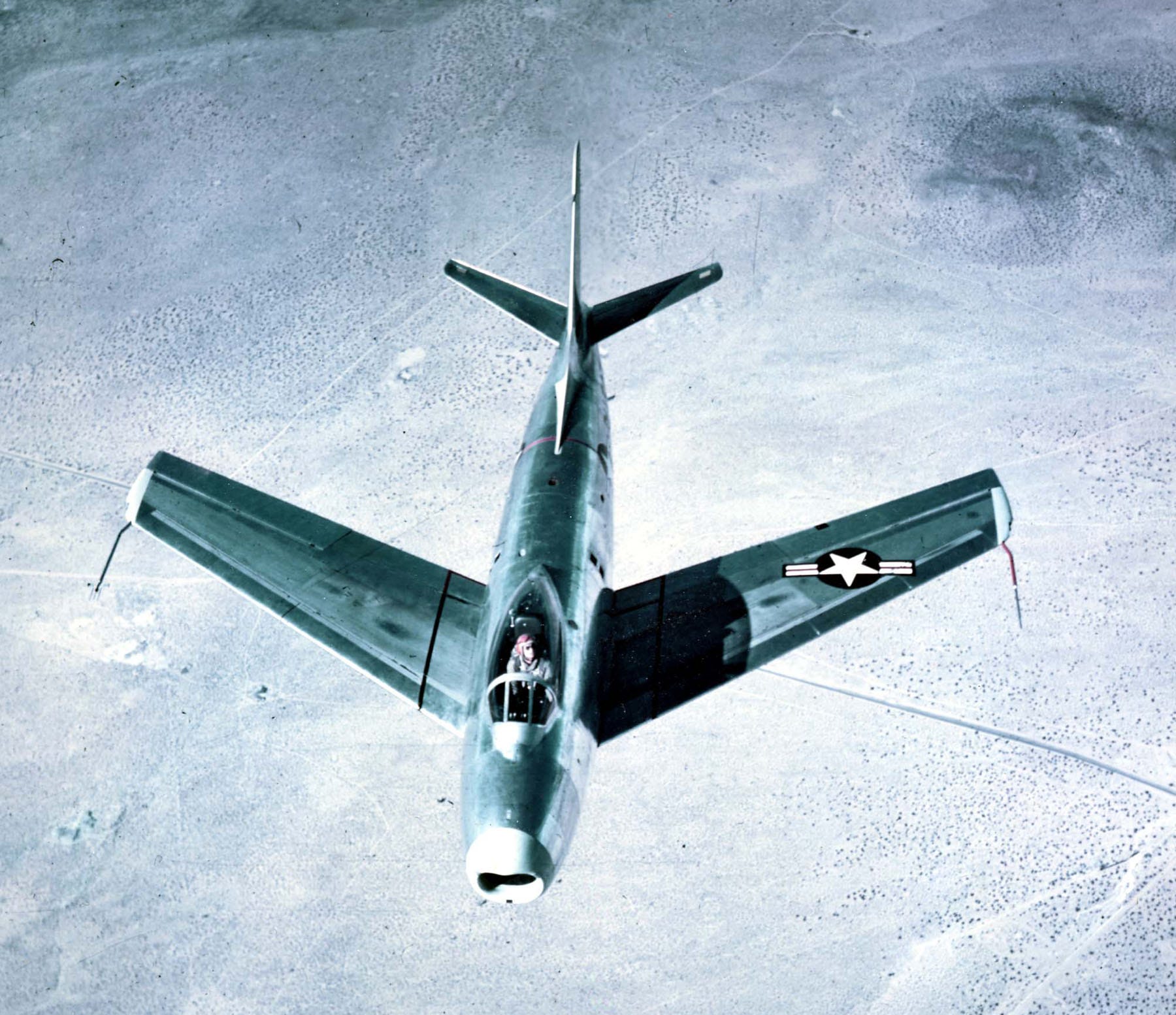
On 26 April 1948, out in the sun-bleached expanse of Southern California’s Muroc Field—today’s Edwards Air Force Base—test pilot George Welch took the prototype XP-86 Sabre on a legendary flight. He pointed the nose down at a gutsy 40-degree dive and blasted through the Sound Barrier, carving his place in history. That moment marked the Sabre as only the second American aircraft to ever go supersonic, chasing the thunder of those who came before.
Breaking the Sound Barrier
In the annals of high-speed flight, the story of George Welch and the XP-86 Sabre reads like something straight out of a Hollywood script.
According to Albert W. Blackburn, a fellow test pilot and author of “Aces Wild: The Race For Mach 1,” Welch may have been the true trailblazer, pushing the prototype Sabre past the sound barrier as early as its first flight on October 1, 1947, well before Chuck Yeager’s historic X-1 run.
Blackburn claims Welch broke Mach 1 not just once, but three times before Yeager’s red-letter day, citing radar runs recording Mach 1.02 and 1.04 on 13 November 1947. Yet, the world never heard a whisper; allegedly because Secretary of the Air Force W. Stuart Symington, Jr. ordered it all kept under wraps.
The legend might have stayed buried if not for a slip across the Atlantic. During a live radio interview, British test pilot Wing Commander “Bee” Beamont casually revealed he’d smashed the sound barrier in the second XP-86 Sabre prototype.
With the cat out of the bag, the U.S. Air Force finally acknowledged Welch’s feat—though they officially dated it to 26 April 1948.
Back in those early days, not long after the XP-86’s maiden lift-off, Welch dropped by the office of aerodynamicist Edward J. Horkey at North American’s Inglewood plant.
There, he recounted his flight with a wry grin: a climb to 35,000 feet, a steep power dive, and an airspeed indicator that seemed frozen—until, like a scene out of a suspense flick, it suddenly snapped to 410 knots. The jet felt solid, with nothing but a slight roll to the left.
Horkey’s verdict: Welch was brushing up against “Mach effects”—a phenomenon that would become legendary as the “Mach jump,” with Welch its first chronicler.
The XP-86 Sabre would go on to become the stuff of legend, dominating the skies of the Korean War and rolling off production lines nearly 10,000 strong across the U.S., Canada, Australia, and Japan.
Welch himself was already a legend, having been recommended for the Medal of Honor for his daring as a P-40 pilot at Pearl Harbor. Tragically, he lost his life doing what he loved—testing the F-100A Super Sabre—on October 12, 1954. For aviators everywhere, his story is a testament to grit, speed, and the relentless pursuit of the unknown.
A Closer Look at the Sabre
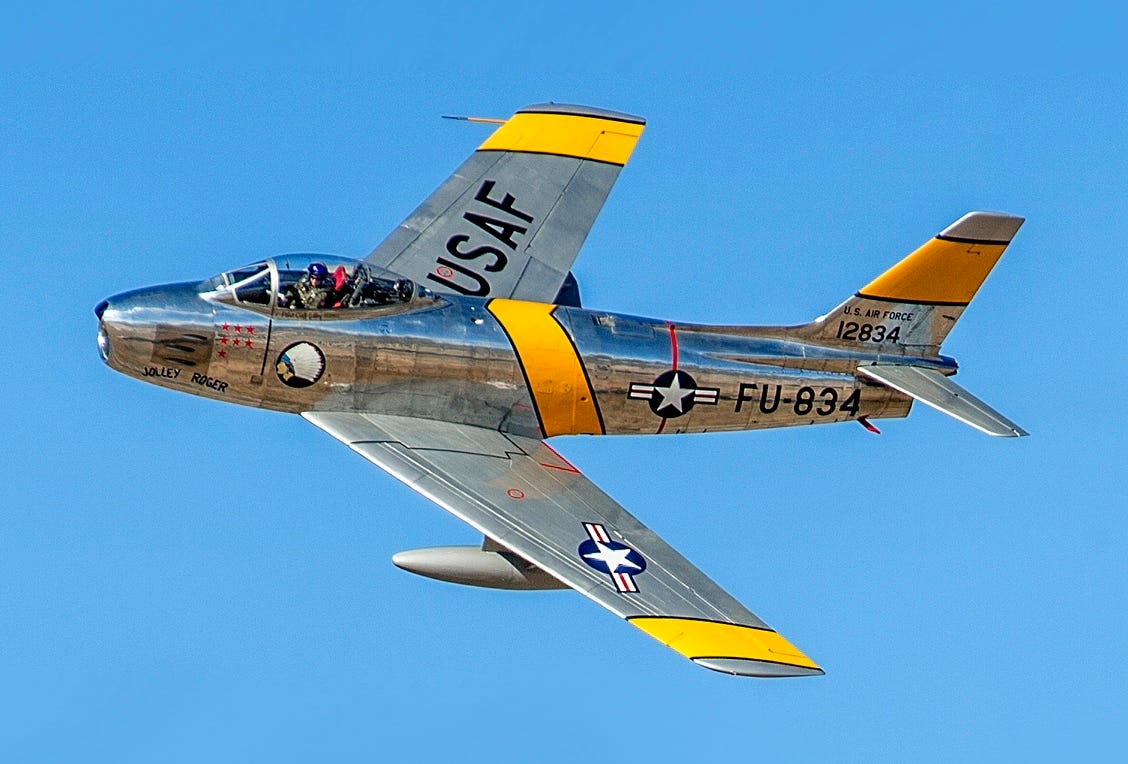
Let me take you back to the golden age of flight, where the sky was a wild frontier and every new jet was a leap into the unknown. Picture this: October 1947—a sleek, silver XP-86 streaks down the runway, powered by a gutsy Allison J35 engine.
That first flight was a taste of things to come. By April 1948, the XP-86 wasn’t just flying. It was breaking barriers, pushing past the speed of sound in a shallow dive, leaving nothing but a sonic boom and wide-eyed ground crews in its wake.
The Air Force saw the future, and they wanted in. On December 1947, they put in a hefty order for 221 P-86As, this time beefed up with a more powerful General Electric J47 engine. Names changed as fast as the technology; by June 1948, the P-86A became the iconic F-86A, the Sabre.
September 1948 brought bragging rights—a world speed record at 671 miles per hour. But the Sabre wasn’t just fast; it was a pilot’s dream, handling like a sports car at 40,000 feet. Armed to the teeth with six nose-mounted .50-caliber guns, and later, a radar-guided sight, the Sabre was ready for anything.
Then came Korea. December 1950 saw the 4th Fighter Interceptor Wing touch down in Seoul, ready to tangle with the MiG-15. In the first-ever clash between swept-wing jets, Lt. Col. Bruce Hinton bagged a MiG, starting a streak. By war’s end, Sabres racked up nearly 800 kills for fewer than eighty losses.
The Sabre kept evolving. New engines, better guns, even all-weather radar models. Built not just in the U.S., but in Canada, Japan, and Italy, over 8,400 Sabres took to the skies. Of those, 554 were the legendary F-86A, a true star of the jet age.
George Welch and the Sabre Legacy
George Welch’s story is stitched right into the fabric of American airpower, standing tall at not just one, but two turning points in aviation history. He was already a legend as one of the first U.S. pilots to scramble and fight back over Pearl Harbor, and that fighting spirit carried him into the jet age, where he blazed new trails.
As the folks at the Smithsonian put it, Welch was among the first to notch an air-to-air victory in World War II, and then he helped kickstart the era of jet and supersonic fighters that would become the backbone of the U.S. Air Force. He wasn’t just a gutsy pilot. He was the bridge that connected the old world of roaring piston engines to the sleek, high-velocity jets that followed.
Enter the F-86 Sabre. The bird that made the leap from propellers to swept wings real and lasting. The National Museum of the U.S. Air Force calls the Korean War the moment the modern Air Force truly took shape, with the Sabre as its unmistakable icon.
But the Sabre’s legend didn’t stop at American borders; the RAF Museum tells how it flew with the Royal Air Force when it mattered most, faced down MiG-15s in NATO service over Germany, and showed the world that Western airpower had met the challenge with a world-class swept-wing fighter. Every time Welch dove toward the sound barrier and every Sabre kill over Korea helped write the new rules for air superiority.
From Welch and the Sabre to the present, the Air Force’s mission hasn’t changed: stay ahead of the curve in speed, tactics, and tech; always one step ahead of the next challenger.
In Case You Missed It
Photo Outlet
Every issue of Hangar Flying with Tog gets you a free image that I’ve taken at airshows:
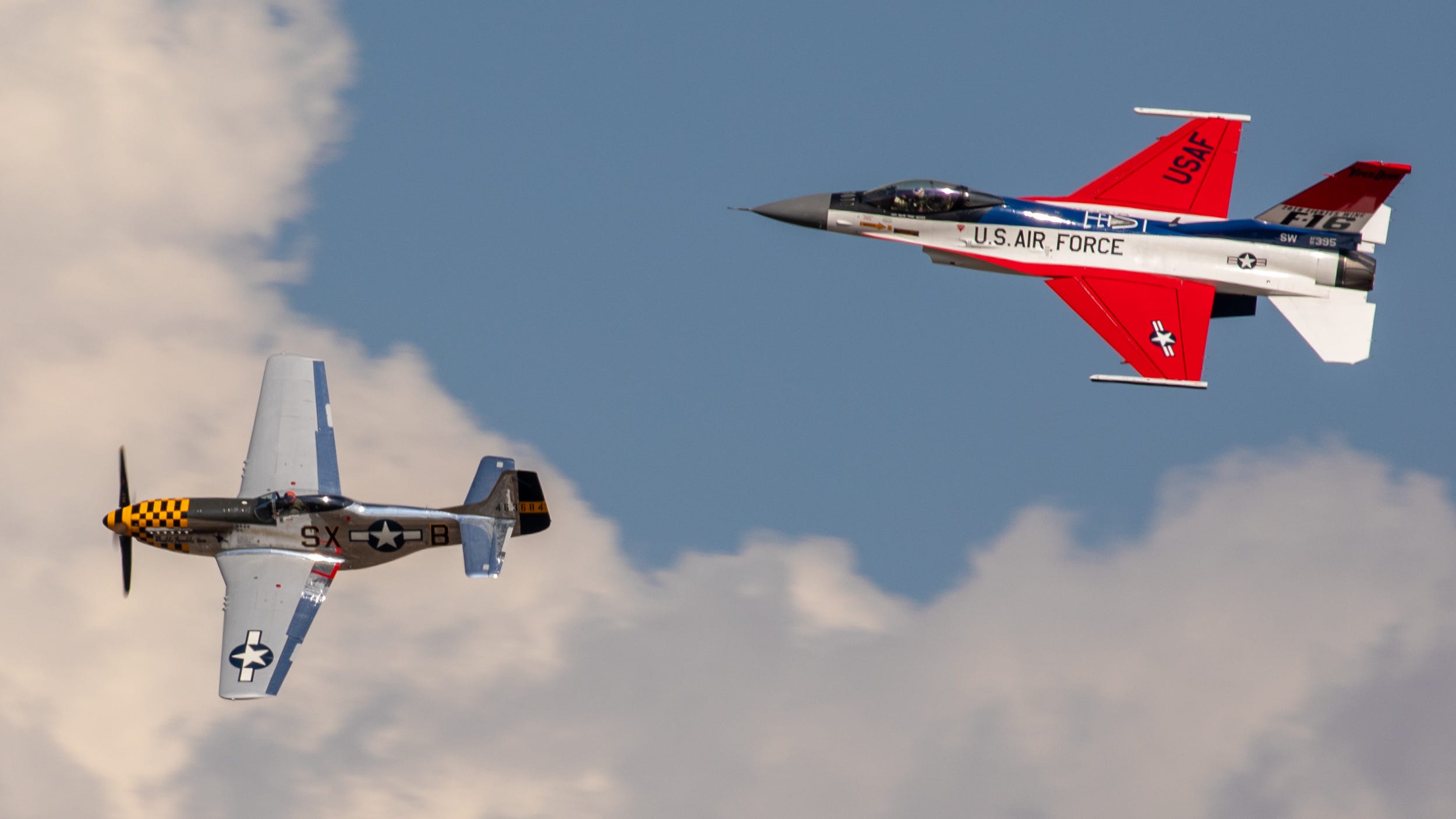
Feel free to use these photos however you like. If you choose to tag me, I am @pilotphotog on all social platforms. Thanks!
Post Flight Debrief
Like what you’re reading? Stay in the loop by signing up below—it’s quick, easy, and always free.
This newsletter will always be free for everyone, but if you want to go further, support the mission, and unlock bonus content like the Midweek Sortie, consider becoming a paid subscriber.
Your support keeps this flight crew flying—and I couldn’t do it without you.
– Tog