

X-62 VISTA Hunts by Heat, then Flies by AI, and Remember When X-15 Was First Rolled Out of Its Factory
From Joe Walker’s record-setting X-15 flight at the edge of space to the X-62’s AI-controlled intercepts, experimental aircraft continue redefining the boundaries of human flight and aerial warfare.
“Skunk Works®’ AI used Legion Pod® sensor data on the X-62A VISTA to autonomously intercept live targets.”
—Lockheed Martin
Mission Briefing
Drawing on data from a Legion Infrared Search and Track pod, AI copilots took the controls of the X-62 VISTA. Across eight action-packed flights, they pulled off 27 autonomous intercepts of airborne targets—like something straight out of a modern aviation epic.
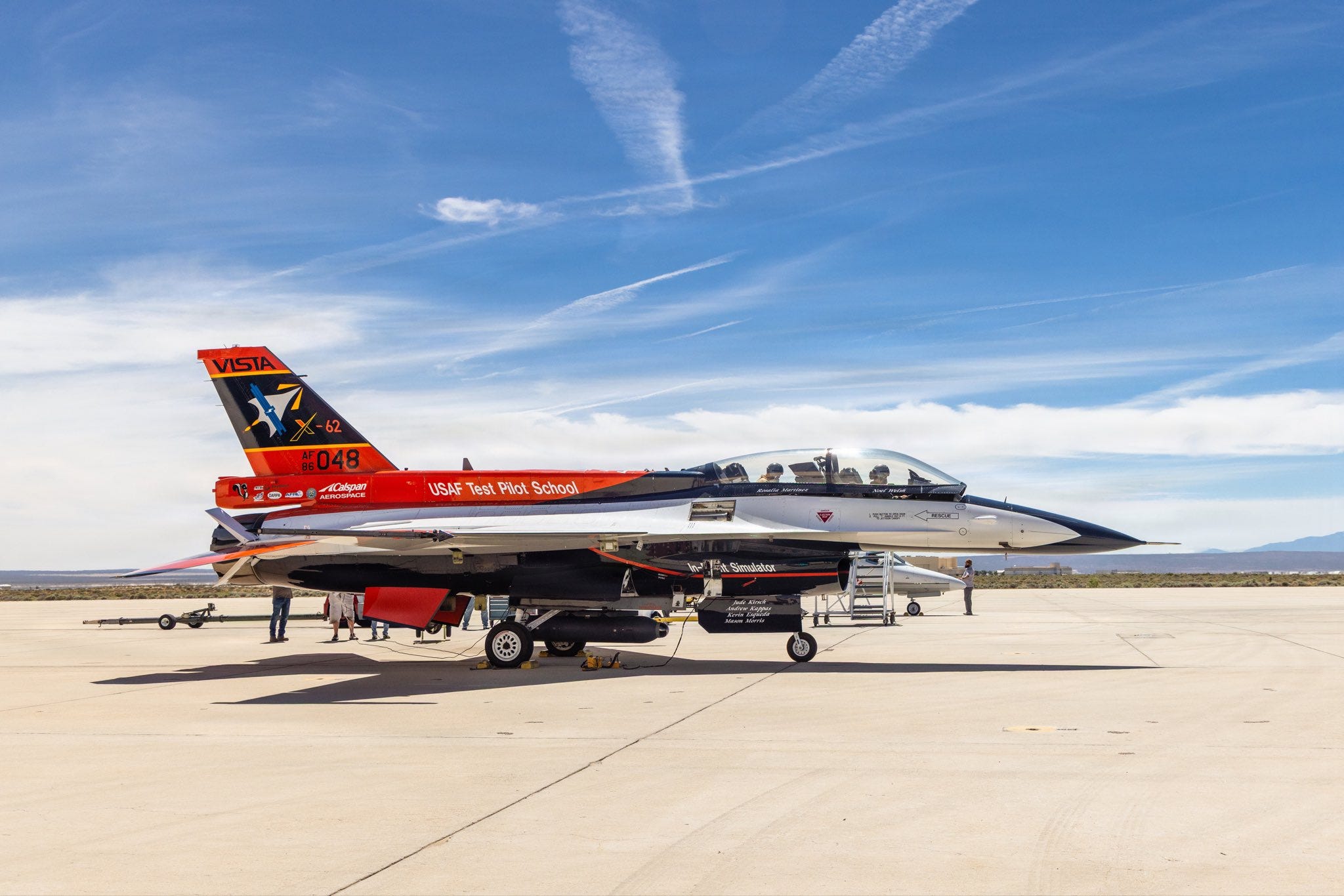
The X-62 Conducts AI-Controlled Intercepts with IRST Pod
The sun’s barely cresting the horizon over Edwards Air Force Base when the X-62 VISTA, that legendary test jet from Lockheed Martin’s Skunk Works, rolls onto the tarmac, shimmering with possibility.
The U.S. Air Force’s Test Pilot School and Skunk Works just pulled off something straight out of a sci-fi script; except this isn’t fiction. It’s the new chapter in air dominance, written in April 2026, revealed in August, and powered by artificial intelligence.
The stage was set by two programs—HAVE HEAT and HAVE HOLIDAYS—both turbocharged by the Mission Systems Upgrades, which turned the X-62 into an airborne playground for AI.
With the Legion Pod, Lockheed’s infrared search-and-track sensor riding shotgun, the mission: teach AI to hunt in the sky, in real time, against real targets. The X-62’s AI brain got raw IR sensor data and, like a bloodhound, sniffed out a live T-38 Talon. No human touch required; the AI took the stick, dialed in the intercept, and closed in with the kind of precision pilots tell stories about at barbecues.
Lt. Col. Joshua Strafaccia of the Test Pilot School called it a leap; AI not just thinking, but flying, making sense of multiple sensors, and commanding the jet with uncanny autonomy. In just three months, Skunk Works’ “Supermassive” AI agent was fully integrated and ground-tested, cranking the tempo up to a fever pitch.
Lockheed’s Ron Fehlen didn’t mince words: this was more than a test; it was a statement. Their AI closed the loop from sensor to action, eating up classified IR feeds and pulling off split-second, combat-worthy maneuvers.
Fehlen framed it as a decisive step toward AI-augmented air dominance; where pilots and their digital copilots write the future of the sky, one mission at a time. Cue the Top Gun soundtrack: the next era of flight just got real.
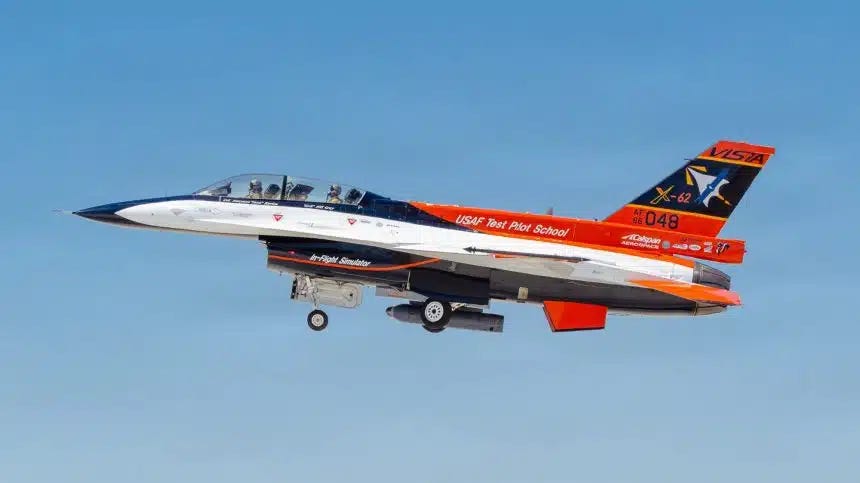
The X-62 MSU and the HAVE HOLIDAYS
While HAVE HEAT grabbed headlines, its twin program, HAVE HOLIDAYS, was quietly making waves in the shadows, turning the X-62 VISTA into an airborne Swiss Army knife for future flight.
The Air Force calls HAVE HOLIDAYS a parallel track, but really, it’s the other side of a coin spinning through the sky. Both programs ran full throttle, but HAVE HOLIDAYS was all about stuffing the X-62 with a modular buffet of cutting-edge tech, all plugged into its Enterprise Open Mission System Architecture—think of it as the X-62’s brain getting a serious software upgrade.
We’re talking integration of not just one, but a third-party AI pilot riding shotgun, plus smarter safety rules—so the AI doesn’t pull any Maverick moves outside the flight envelope—and next-gen sensor chips to squeeze every drop of data from the skies.
The Air Force said this “system-of-systems” test wasn’t just about gee-whiz factor; it was about reducing technical risk, laying the groundwork for a future where government, academia, and industry could all jump in, plug and play, and push the limits of autonomous flight together.
This flight of innovation builds on DARPA’s Air Combat Evolution program—the same one that staged the first human vs. AI dogfight in 2023. Now, the X-62 is prepping for even wilder rides: testing combat systems, airborne teamwork, and real-time decision-making in scenarios that would give even veteran pilots sweaty palms.
And here’s where it gets extra spicy: the radar. Back in August 2024, the Air Force started shopping for a radar that was as plug-and-play as your favorite gadget, modular enough to work solo or as part of a sensor dream team.
The real kicker? The AI wouldn’t just watch the radar; it would drive it, using machine learning to process raw data, flip between modes faster than a human, and even invent new combos on the fly.
Requirements were tight: under 200 pounds, air-cooled, AESA tech, fast start-up, and both air-to-air and air-to-ground muscle. By December 2025, RTX’s PhantomStrike got the nod, a 150-pound gallium nitride powerhouse, air-cooled and ready to light up the future of flight.
The AI Wingman Era: What the X-62 Means for America and Its Allies
The X-62A VISTA, a souped-up F-16 with a mind of its own, slicing through the sky over the desert. In a series of eight test flights, she locked onto a live T-38 target not in a flight sim. But for real, using only heat signatures picked up by that sleek Legion Pod hanging under her wing.
No radar pings, just pure infrared stealth. The AI onboard made the calls, twisting and turning to intercept, running the full “sensor-to-action” playbook in real time. That’s not just a technical flex; that’s cinematic dogfighting, 21st-century style.
For the U.S., this leap is about more than bragging rights. It’s the next step toward wingmen you don’t have to feed or brief, AI partners that can keep up, process faster, and brave the riskiest moves.
With IRST’s silent tracking, you’re ghosting through contested airspace while electronic warfare rages around you. And the kicker? Lockheed’s team plugged in those AI brains and got them flying in just three months, warp speed for military tech.
Allies, take note: imagine mixed squadrons where pilots and drones share targets and tactics on the fly. That means wider coverage, more punch, and fewer pilots in the danger zone; even for air forces with tight budgets or thin rosters.
Of course, the magic only works if everyone’s tech talks the same language and follows the same rules. But as VISTA blazes ahead, she’s charting the course from wild experiment to the new era of trusted, networked airpower.
This Week in Aviation History
On 15 October 1958, the X-15—a sleek, rocket-fueled marvel—emerged from its hangar, ready to chase the horizon like a daredevil with wings. Born from the dreams of NASA, the Air Force, and the Navy, this wild machine punched through Mach 6 and soared higher than 250,000 feet, rewriting the very rules of flight.
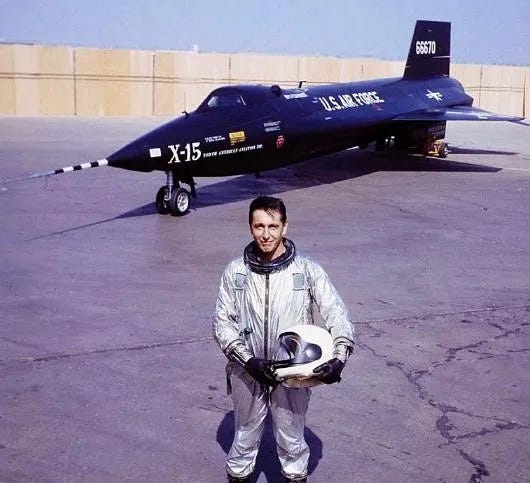
Riding the Edge: When The X-15 Chased the Sky
Picture the years between 1959 and 1968: twelve maverick pilots strapping into the X-15, braving 199 missions that would take them screaming toward the edge of space and back.
Each flight wasn’t just a test of nerve. It was a voyage into the unknown, pushing the boundaries of speed and altitude while gathering priceless data about how an aircraft behaves in the punishing furnace of hypersonic flight.
The X-15 became a flying laboratory, bristling with experiments to crack the secrets of the upper atmosphere and the hellish heat of Mach 6 and beyond. This was not a journey without peril; the program weathered its share of mishaps—including one tragic loss—but every lesson learned helped shape the future of space travel, leaving fingerprints all over the design of programs like the space shuttle.
The story of the X-15 begins further back, in 1952, when a group of visionaries at the National Advisory Committee for Aeronautics (NACA) decided it was time to push higher and faster than ever before.
They set their sights on flights between 12 and 50 miles high, at speeds from Mach 4 to Mach 10; a bold leap into uncharted territory. The Air Force and Navy jumped aboard, running feasibility studies and drumming up excitement at NACA’s field centers.
By December 1954, the Air Force issued a call to industry, inviting aerospace firms to dream up the next-generation rocket plane. North American Aviation, based in Los Angeles, won the contract in late 1955, bringing its muscle to the project, while Reaction Motors, a division of Thiokol, was tapped to build the XLR-99 rocket engine; a beast capable of 57,000 pounds of thrust.
But delays with the engine meant the first X-15s had to make do with older, less powerful engines, borrowing from the legendary X-1’s arsenal. For the first year and a half, the X-15 was underpowered, but that didn’t stop the team. By October 1958, NASA had taken the reins. Just in time to watch the first X-15 roll out, ready to write a new chapter in the story of flight.
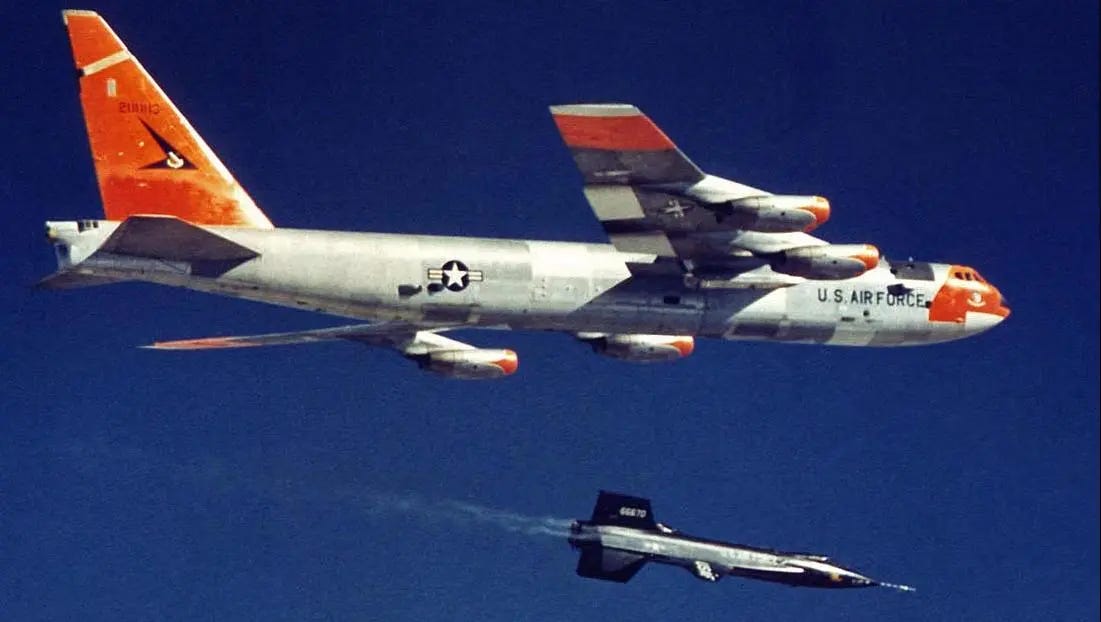
Beyond the Edge: The Test Pilots Who Tamed the X-15
When it came time for the X-15 to spread its wings, North American’s own A. Scott Crossfield was the man at the stick. He was a cool-headed aviator with a knack for wrangling wild machines.
Crossfield kicked things off in style on 10 March 1959, guiding X-15-1 through its first captive flight, still tethered to the massive B-52 mothership, like a rocket ship waiting to be unleashed.
Fast forward to June 8, and Crossfield was gliding the X-15 free and easy for five thrilling minutes, unpowered but full of promise. Then, on September 17, strapping into X-15-2, he fired up the rockets for the first powered flight. Blasting to Mach 2.11 and climbed to 52,000 feet, ironing out a few hiccups before bringing his futuristic steed safely home after nine white-knuckle minutes.
Over a series of 13 more flights, Crossfield kept stretching the X-15’s limits, nudging it to Mach 2.97 and nearly 90,000 feet, all the while collecting precious data on how this beast handled at the edge of the envelope.
Most of those flights relied on the old LR-11 engines (with limited punch), but for his final three rides, Crossfield finally got to let the mighty LR-99 engine roar. His 14th flight, on 6 December 1960, marked the end of North American’s testing chapter and handed the X-15 keys to NASA and the Air Force.
Enter Joe Walker, NASA’s chief X-15 pilot, who took the reins on 25 March 1960 and never looked back. Walker would notch 25 flights, including the first time an X-15 broke past Mach 3 on 12 May 1960.
Twice, Walker punched through the Kármán line—62 miles up—earning his astronaut wings, and on another flight, he soared past 50 miles, the Air Force’s own edge of space.
By that yardstick, eight X-15 pilots racked up 13 “astronaut” flights. On his final X-15 mission, August 1963, Walker rocketed X-15-3 to a jaw-dropping 354,200 feet, setting a record that stood for decades.
After the X-15, Walker helped pave the way to the Moon, flying the Lunar Landing Research Vehicle 35 times. Tragically, his story ended in 1966, lost in a mid-air collision—a true test pilot to the end, always chasing the horizon.
Beyond Mach 6: The X-15 Legacy That Still Shapes Flight
The X-15, a rocket plane straight out of a sci-fi serial, roaring off the dry lakebed at Edwards Air Force Base. Between 1959 and 1968, three of these needle-nosed daredevils blazed through the sky for 199 legendary flights, not just breaking speed and altitude records, but redefining what flight could mean.
Pilots in pressure suits pushed the X-15 to Mach 6.7 and above 350,000 feet—skimming the edge of space, where wings became suggestions and control surfaces went on strike.
This wasn’t just about adrenaline. The X-15 was a flying laboratory, its Inconel-X skin shrugging off searing heat as engineers learned how to steer with thrusters in the near-vacuum.
Every flight was a cinematic experiment, including testing hypersonic aerodynamics, adaptive controls, and even how humans handled the unknown. The data? Over 765 reports that fueled the dreams of Mercury, Gemini, Apollo, and the Space Shuttle. The way the X-15 glided home, engines silent, proved that space vehicles could land without a drop of fuel left.
But the real legacy? A blueprint for how to tackle the impossible: government, military, engineers, and intrepid test pilots working in sync, step by careful step. Neil Armstrong and his fellow aviators took these lessons into space.
Even the failures became chapters in the story, teaching us about risk, human limits, and the power of telemetry. Today’s hypersonic marvels owe their wings to the X-15, the original daredevil that turned the edge of space into a proving ground.
In Case You Missed It
Photo Outlet
Every issue of Hangar Flying with Tog gets you a free image that I’ve taken at airshows:
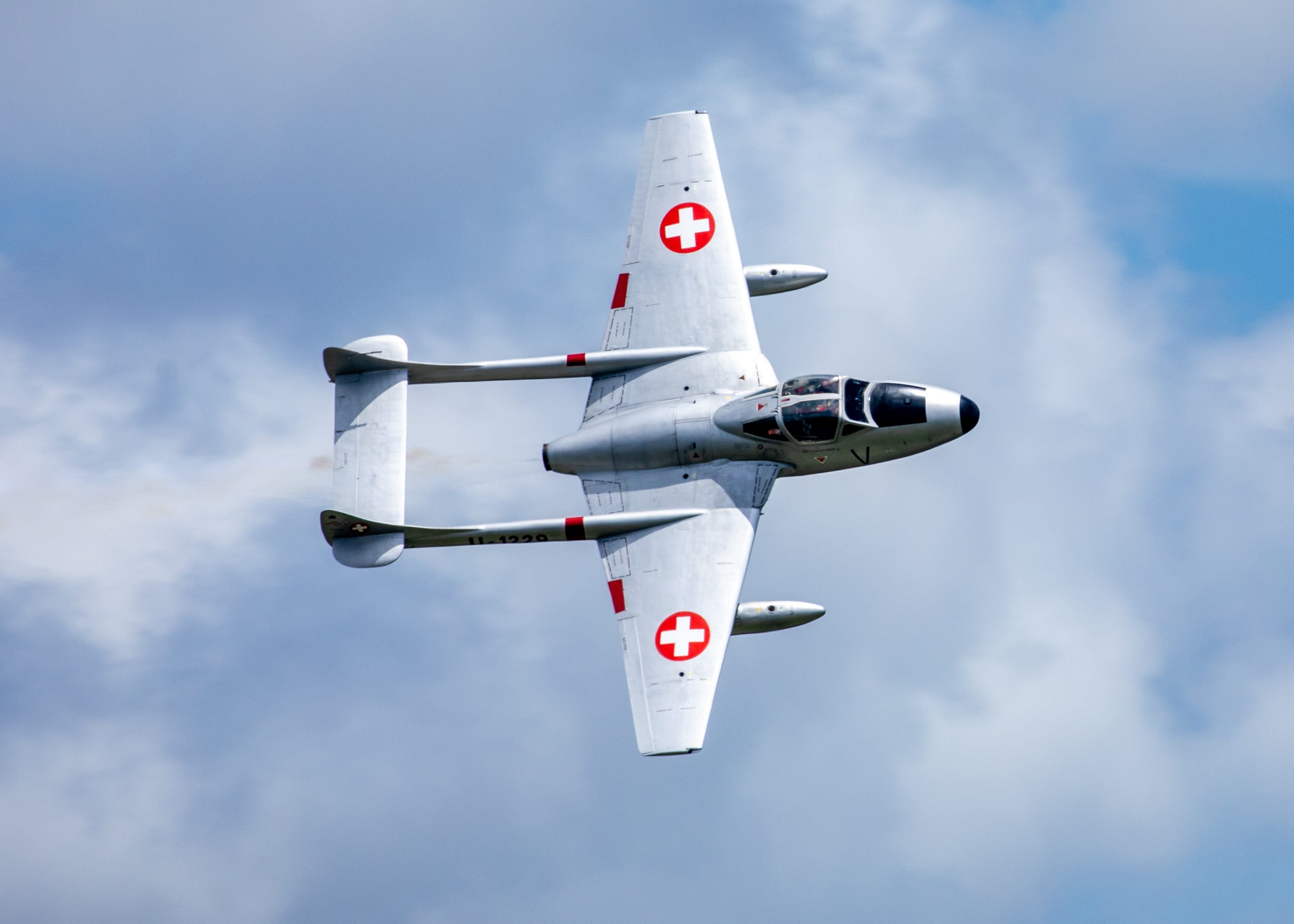
Feel free to use these photos however you like. If you choose to tag me, I am @pilotphotog on all social platforms. Thanks!
Post Flight Debrief
Like what you’re reading? Stay in the loop by signing up below—it’s quick, easy, and always free.
This newsletter will always be free for everyone, but if you want to go further, support the mission, and unlock bonus content like the Midweek Sortie, consider becoming a paid subscriber.
Your support keeps this flight crew flying—and I couldn’t do it without you.
– Tog