

X-59 Enters the Supersonic Sky and Look Back at the Berlin Airlift
From Berlin’s lifeline corridors to the quiet edge of Mach 1, aviation has always been at its most powerful when it turns barriers into bridges.
The X-59 has officially flown at supersonic speeds for the first time, marking a major step forward on the path to quieting the sonic boom. Even faster and quieter flights are coming soon.
—Lockheed Martin
Mission Briefing
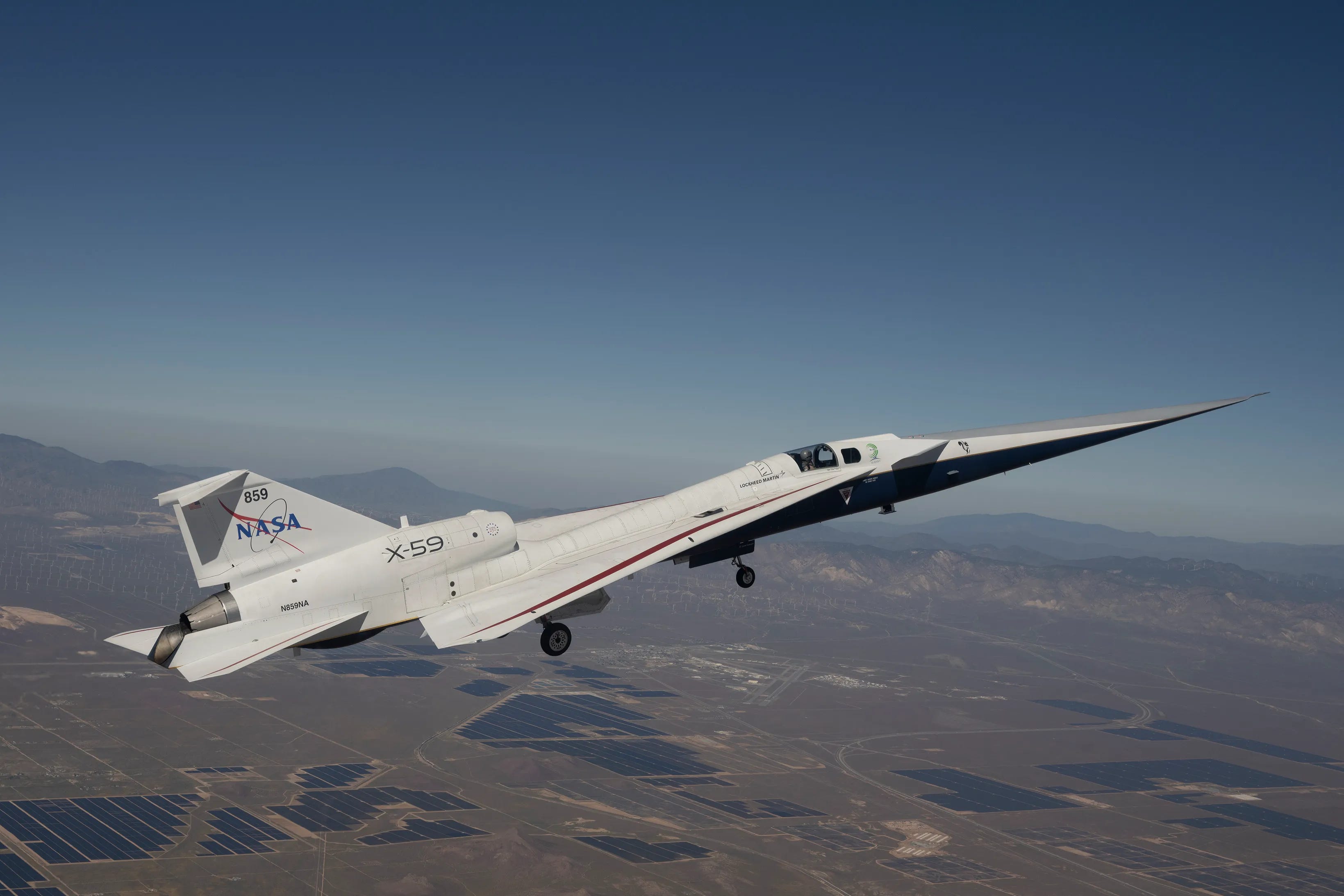
NASA’s X-59 QueSST just cracked the sound barrier for the very first time, diving headlong into the world of supersonic flight. Picture it: a sleek machine slicing through the sky, rewriting what we thought was possible.
The Quiet Boom Takes Flight
For this pivotal test flight, NASA’s X-59 QueSST (Quiet SuperSonic Technology) was in the hands of ace test pilot Jim “Clue” Less. He lifted off from the storied runway at Edwards Air Force Base under a late-morning California sky, the clock ticking 11:08 a.m. PDT. Eighty-one minutes later, Less brought the futuristic bird home, armed with a treasure trove of fresh data from both subsonic and supersonic realms.
Tagging along for the ride, a NASA F-15 played the role of the faithful chase plane, keeping a sharp eye on the X-59 as it pushed the boundaries.
But here’s the interesting twist: the F-15’s thunderous sonic booms drowned out whatever sound the X-59 made a deliberate design feature, since the X-59 is built to swap boom for a gentle, barely-there thump when it breaks the sound barrier. Supersonic, but subtle.
NASA’s press release teased even bigger milestones on the horizon, promising that the next crucial flight (labeled a “mission conditions” run) would see the X-59 hit Mach 1.4 (that’s 925 mph) and soar to 55,000 feet.
This is more than just a speed trial; it’s a rehearsal for real-world missions, where the X-59 will streak over actual communities. Why? To let residents experience that signature quiet thump, not a window-rattling boom, and help NASA collect the data regulators need to rethink the rules for supersonic travel over land.
Since its maiden voyage back in October 2025, the X-59 has been methodically stretching its wings, testing different speeds and altitudes in a careful expansion of its flight envelope. This first phase is all about mapping the aircraft’s limits.
Once that’s wrapped, the focus will shift to acoustic validation: making sure that whisper-quiet supersonic flight is more than just a theory, aiming for completion by the end of 2026.
Meanwhile, NASA’s engineers are keeping tabs on everything from how the aircraft handles and absorbs stress to how its innovative systems—like the eXternal Vision System, which replaces a traditional cockpit window with high-tech cameras—perform in the heat of action.
The stakes are sky-high, but so is the promise of a new era in aviation.
NASA’s X-59 QueSST: The Jet Built to Silence the Sonic Boom
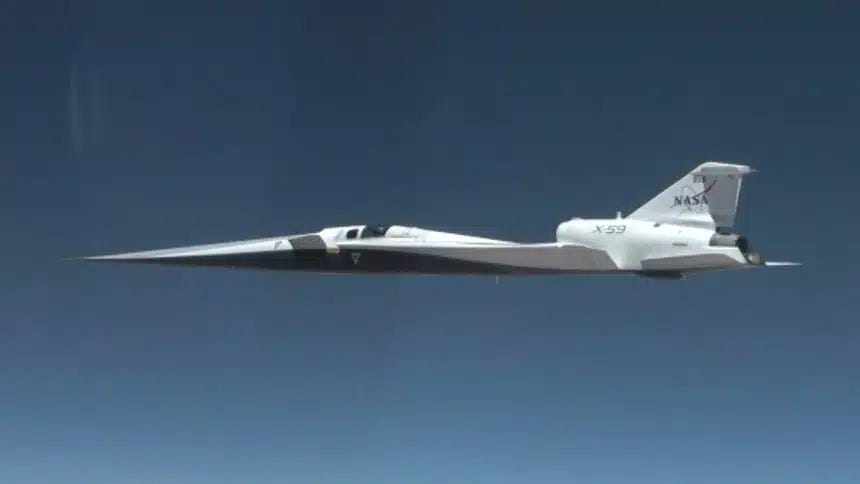
Meet the X-59 QueSST, a marvel of modern engineering and a head-turner straight out of NASA’s playbook, crafted at the legendary Skunk Works. This isn’t just another supersonic jet; it’s the flagship for NASA’s Low-Boom Flight Demonstrator project, a bold mission to bring back supersonic commercial travel without the ear-splitting booms that once grounded it.
The X-59 is all about quiet power, designed not just to break the sound barrier, but to do it gently enough to convince regulators it’s time to lift that 1973 ban on overland supersonic flight.
What sets this bird apart? It’s all in the hush. The X-59’s sonic boom promises to be a whisper compared to the thunder of the old Concorde. NASA says less than 75 perceived decibels on the ground, a third quieter than the Concorde’s infamous 100-110 dB rumbles.
The secret weapon? That impossibly long, slender nose; nearly a third of the plane’s total length. It’s meticulously shaped to shatter shockwaves before they can merge and create a boom, turning a sonic wallop into a polite thump.
But the nose isn’t just for show. It pushes the cockpit so far back there’s no room for a classic windshield up front. Instead, NASA’s engineers cooked up the eXternal Vision System, a cutting-edge array of high-res cameras streaming a crystal-clear 4K feed right to a monitor in the cockpit. It’s high-tech, it’s innovative, and it’s the future.
Under the hood, the X-59 packs a punch with its F414-GE-100 engine—22,000 pounds of thrust, borrowed and tuned from the F/A-18 Super Hornet. The engine sits up top, smoothing out the plane’s belly, which helps keep those pesky shockwaves in check and the sound down low.
Safety’s never an afterthought. The X-59 comes loaded with life support systems to keep the pilot sharp and safe (from oxygen delivery to G-suit power) plus an ejection seat and canopy adapted from the trusty T-38 trainer, complete with first aid, radio, and water.
Because in this next chapter of supersonic flight, it’s all about flying fast, flying quiet, and flying smart.
The Quiet Boom That Could Reopen the Supersonic Sky
For the U.S. and its friends in the sky, NASA’s X-59 QueSST breaking the sound barrier isn’t just another notch in aviation history. It’s a message, a ripple through policy, industry, and strategy alike.
The X-59 nudges past Mach 1.1, its first real taste of supersonic flight. NASA’s chase F-15 thundered alongside, its own boom stealing the sonic spotlight for now, but the world was watching.
Why does it matter? Because this bird is out to prove that speed can make a comeback. Sans the uproar that once grounded supersonic dreams over land. QueSST’s mission is all about listening to the ground: gathering real-world reactions to those gentler “thumps” instead of window-rattling booms, then handing over the findings to U.S. and global regulators.
The hope? Rewrite the rulebook on noise, and open the door for new, faster air routes connecting continents (think New York to London, Tokyo to LA) quicker and quieter than ever before.
There’s a lesson for defense, too. The X-59 isn’t a fighter jet, but its sleek shape, sensors, and whisper-smooth design send a clear signal: in aerospace, survival, stealth, and speed still reign.
Right now, supersonic flight over land is off-limits for civil aircraft, unless the FAA says otherwise. That’s why this data could become the key, linking today’s experiments to tomorrow’s regulations.
If the X-59 can turn the dreaded sonic boom into little more than a polite knock, then the next great aviation race won’t just be about velocity. It’ll be about who can win hearts, win over the rule-makers, and bring this breakthrough to allies worldwide.
So keep your eyes on those noise tests, policy shifts, and whether the industry can turn NASA’s hard-won data into jets that let you cross an ocean before your coffee gets cold.
This Week in Aviation History
On 24 June 1948, the Soviets slammed the gates shut, cutting off every rail, road, and waterway into Allied-held Berlin. Refusing to let the city starve, American and British pilots took to the skies, turning their planes into lifelines as they flew in food and fuel from the west. After months of high-stakes flights and tense standoffs, the blockade finally cracked on 24 May 1949, and the roads to Berlin reopened.
When the Sky Became Berlin’s Lifeline
When the dust settled after World War II, Germany was a shattered country, and nowhere felt it more than Berlin.
With about 2.5 million people scraping by among the ruins, the city’s daily life was a struggle. Food was scarce, shelter even scarcer, and the only real economy was whatever you could find in the black market. To chart a path out of the rubble, the Allies carved Germany into zones, dividing Berlin right down the middle: the Soviets taking the east, the Americans, British, and French splitting the west.
For a while, uneasy cooperation kept things moving, but by 1948, the cracks in the alliance had split wide open. The Soviets were meeting with their former partners to hammer out how to run the place, but when they caught wind that the U.S., Britain, and France were planning to fuse their zones into a new West German state, the gloves came off.
Tensions flared even hotter when the Allies rolled out the Deutschmark. It is a brand-new currency for their zones, including West Berlin. It was a bold move meant to reboot the economy, crush the black market, and channel Marshall Plan aid into the city. But the Soviets weren’t invited to the party and saw their grip on Berlin slipping away.
Here’s the kicker: Berlin itself sat deep inside Soviet-controlled East Germany, a Western outpost surrounded by rival forces. Sensing an opportunity, the Soviets made their move.
On 24 June 1948, they slammed shut every road, rail line, and waterway leading into Allied-controlled Berlin, hoping to starve the city into submission. With Allied troop numbers a fraction of the Soviet garrison, there was no chance of breaking the blockade by force.
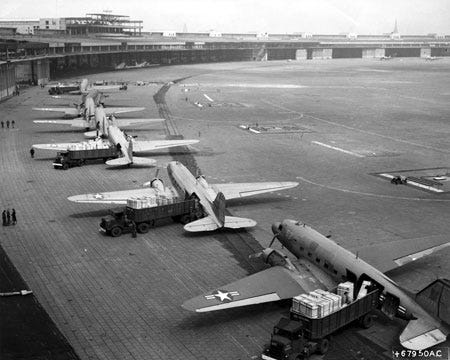
The Soviets may have controlled the ground, but they couldn’t seal off the sky. So, the Americans and British fired up their engines and launched Operation Vittles, known to history as the Berlin Airlift.
Starting June 26, wave after wave of cargo planes threaded the air corridors, dropping in food, coal, and hope. It was the largest aerial supply mission the world had ever seen. Meanwhile, the Allies hit back with their own economic squeeze, cutting off trade with the East. The Cold War’s first major standoff had begun, and it was playing out above the clouds of Berlin.
Operation Vittles: The Sky’s Greatest Supply Mission
At first, the Berlin Airlift looked like a mission straight out of an aviator’s nightmare—over two million Berliners counting on you for every meal, every drop of fuel, every life-saving dose of medicine. But as weeks turned into months, the operation found its rhythm.
The skies above Tempelhof became a well-oiled ballet of engines and wings, with planes touching down every 45 seconds at the height of the effort. On Easter Sunday, April 1949, the airlift’s pilots pulled off a feat for the history books: 13,000 tons of cargo (enough to fill 600 railcars with coal) delivered in just one day.
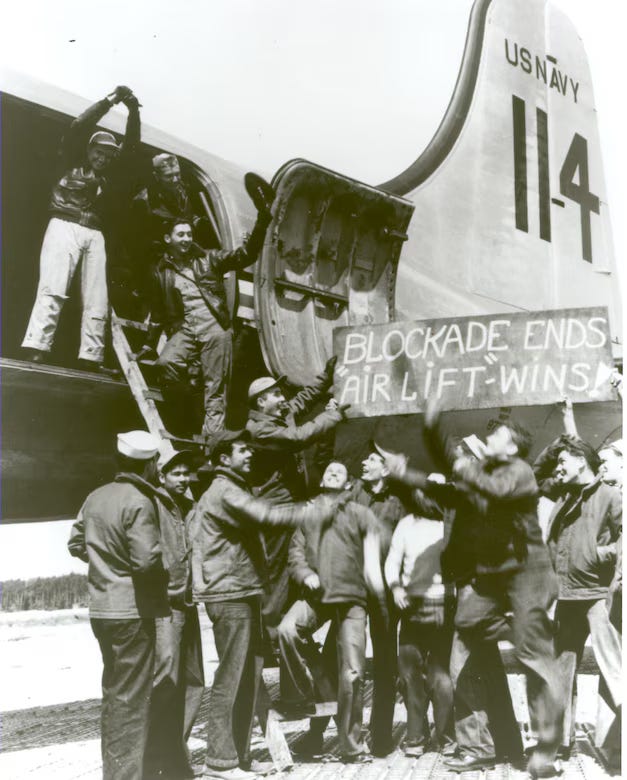
For the Soviets, the story was unraveling. Ten months in, the Allies had shown they could keep the lifeline going as long as it took, and the blockade was backfiring, painting the Russians as the heavy-handed villains.
Worse still, the Allied counter-blockade was squeezing supplies in the Soviet sectors, stirring unrest on the other side of the wall. Finally, the Soviets blinked, lifting the blockade on 11 May 1949. Still, the Allies kept the airlift running until September 30, just in case Moscow thought about slamming the door shut again.
By the end, American and British crews had flown over 278,000 missions, delivering a staggering 2.3 million tons of supplies over nearly 92 million miles.
The Berlin Airlift became a living testament to American ingenuity, grit, and the power of allied teamwork; proof that some burdens are too great to shoulder alone. Though the blockade ended without a shot, the Iron Curtain was only beginning to fall.
NATO formed in its wake, and Berlin split in two, each half a symbol: democracy and freedom in the West, communism in the East.
The Berlin Airlift: The Legacy That Kept Freedom Flying
The story of the Berlin Airlift isn’t just measured in cargo manifests or tally sheets of coal and flour. Its true legacy soars somewhere higher, in the moment when airpower stopped being just about force and became a lifeline, a promise stitched across the clouds.
When the Soviets slammed the gates on West Berlin in 1948, the world held its breath. The answer wasn’t gunfire or retreat, but a steady, determined parade of aircraft. C-47s, C-54s, and allied transports threading the needle through narrow corridors, turning the sky into a living bridge. Every landing wasn’t just a delivery; it was hope with wings.
This cinematic chapter rewrote the script for what military aviation could mean. Suddenly, logistics weren’t background details. They were acts of defiance. Aircrews defended a city not with bombs, but with bread, milk, and medicine.
The airlift became a symbol: that unity could fly, and that freedom could be kept alive from above. Berliners looked up and saw more than machines. They saw proof they weren’t alone.
The doctrine born over Berlin was simple and bold: when roads close and diplomacy stalls, air mobility can still break through. The echo of those engines still resonates wherever planes carry relief into places cut off by conflict or disaster.
From the crowded corridors of 1948 to today’s global air missions, the lesson lands the same way, when liberty is on the ropes, sometimes the sky itself becomes the story’s hero.
In Case You Missed It
Photo Outlet
Every issue of Hangar Flying with Tog gets you a free image that I’ve taken at airshows:
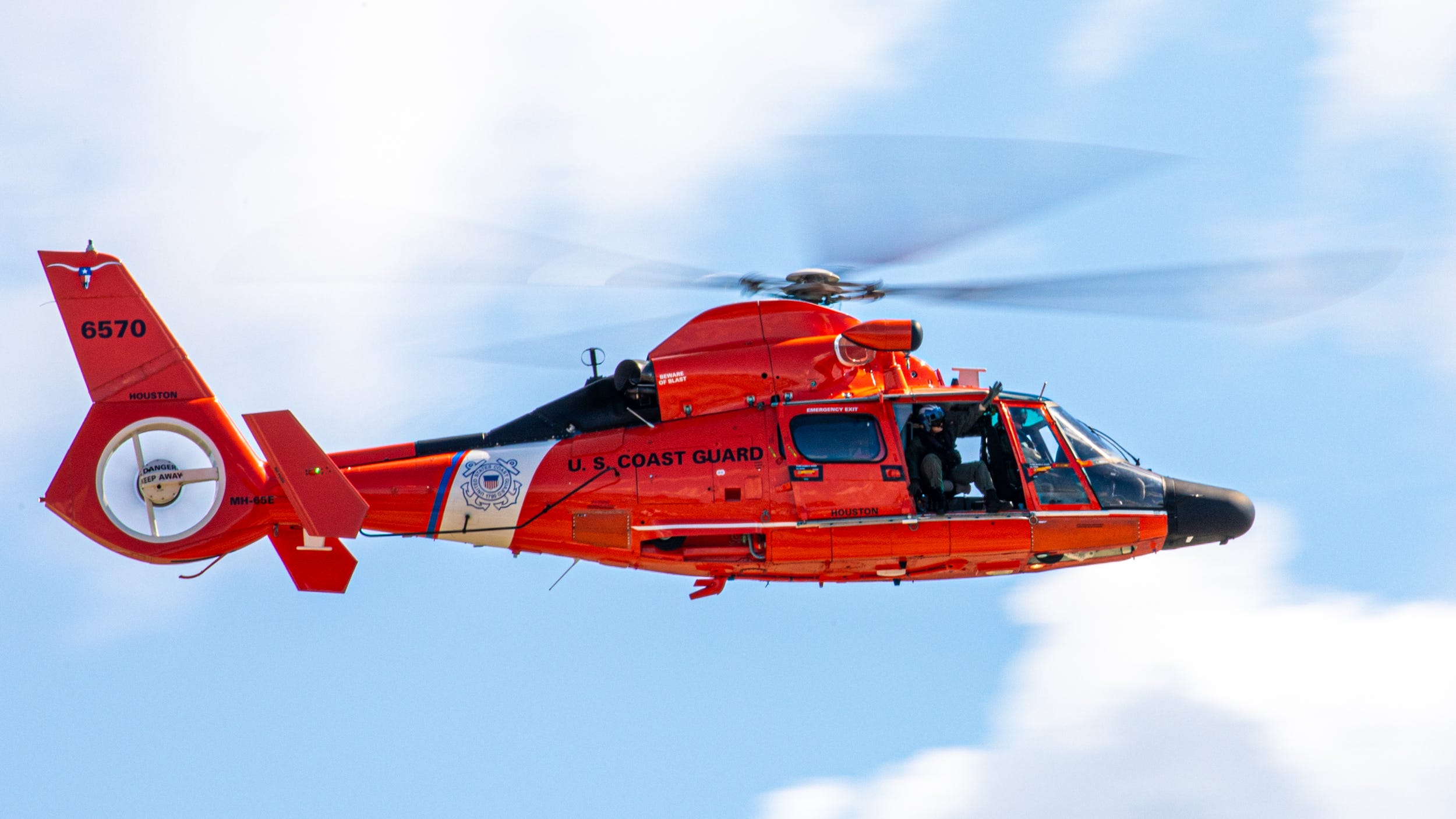
Feel free to use these photos however you like. If you choose to tag me, I am @pilotphotog on all social platforms. Thanks!
Post Flight Debrief
Like what you’re reading? Stay in the loop by signing up below—it’s quick, easy, and always free.
This newsletter will always be free for everyone, but if you want to go further, support the mission, and unlock bonus content like the Midweek Sortie, consider becoming a paid subscriber.
Your support keeps this flight crew flying—and I couldn’t do it without you.
– Tog