

VC-25B ‘Bridge’ Aircraft Completed Its Flight Testing and the Launch of Skylab
Before trust comes testing, from Skylab’s hard-earned launch lessons to the VC-25B Bridge aircraft, high-consequence machines must prove they can survive the mission.
“By intentionally integrating the 747-8i platform now, we are doing more than bridging a gap; we are executing a strategic stand-up of a high-consequence fleet.”
—@SecAFOfficial Troy Meink
Mission Briefing
It’s 1 May 2026, and the U.S. Air Force takes to the skies with a big announcement. Their newest bird, the VC-25B Bridge (a Boeing 747 graciously gifted by Qatar) has just aced its transformation and flight tests, earning its wings as a stand-in Air Force One.
That’s the call sign reserved for the Commander-in-Chief’s ride. Now, the aircraft is getting suited up in a bold new paint job—classic red, white, and blue—ready to make its cinematic debut later this summer. Buckle up, the next chapter in presidential aviation is about to take flight.
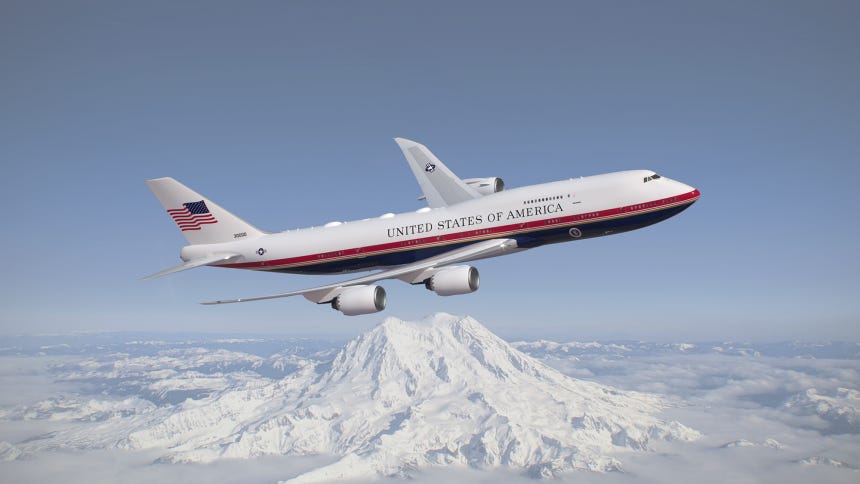
‘Bridge’ Aircraft for New Air Force One Completes Testing
The sky over Texas shimmered with anticipation as a sleek, all-white aircraft took flight, its fresh livery masking a story of urgency and innovation. Fresh from L3Harris’ hangars in Waco, this wasn’t just any airplane. It was the Air Force’s answer to a ticking clock and a fleet growing long in the tooth.
Enter the VC-25 Bridge program, a mission forged from necessity and executed with the kind of focus you see in the movies when the stakes are sky-high. Think of it as the “get it done” squad: one person holding the reins, every player in the game laser-focused on a single goal; putting a new bird in the air, fast, to take the burden off the aging VC-25A jets.
General Dale White summed it up with cinematic clarity: when you give one leader clear authority and everyone rallies behind them, things move at a breakneck pace. “Deliver a bridge capability as soon as possible,” he said. No time for red tape, just results.
The backstory? The VC-25 Bridge, built on a 747-8i frame, is a stopgap hero, stepping in as the long-awaited VC-25B replacement program faces delay after delay. With Boeing’s timeline drifting past 2024 and maintenance for the old VC-25A fleet dragging out, the Air Force needed a fix, now.
February 2025 saw the launch of a dedicated task force. A full-court press, the kind that doesn’t wait for halftime. They pushed the Bridge program forward while also lighting a fire under Boeing, nudging the VC-25B schedule closer by a year, now aiming for 2028. By May, they’d welcomed a former Qatari jet into the fold, ready for its transformation.
Of course, turning requirements into reality is never easy. Shifting specs had slowed things down before, but this time the team zeroed in on the essentials: keep the President safe, secure, and connected, no matter what.
General Ken Wilsbach put it plainly: the mission is about resilience and reliability, whatever the world throws at them. And while the public speculates, the Air Force is keeping the details of the jet’s transformation under wraps. Letting the results do the talking as the story unfolds above our heads.
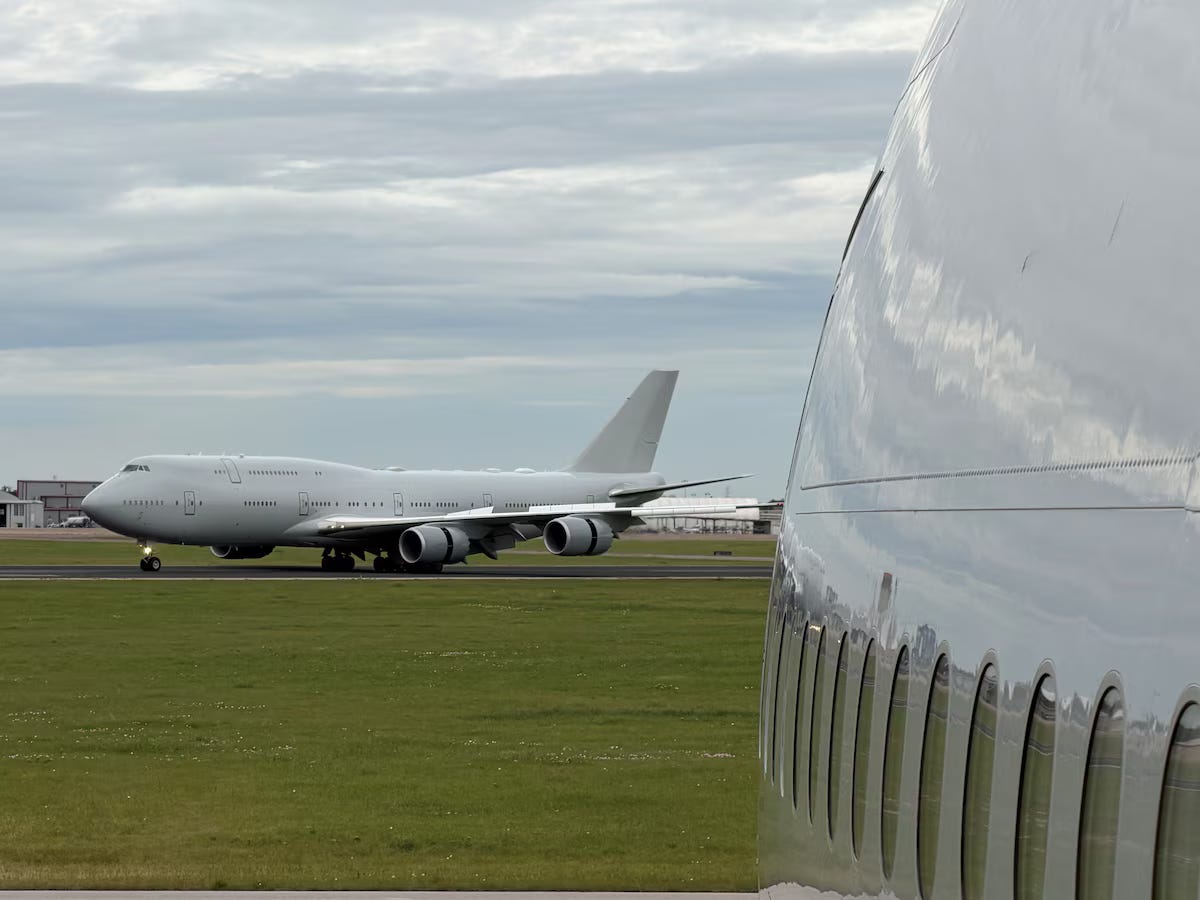
Features of the “Bridge”
The presidential air fleet is made up of two iconic Boeing 747-200Bs, bearing the tail numbers 28000 and 29000, officially known as VC-25s by the Air Force. Whenever the president steps aboard—on these or any Air Force plane—the world tunes in to the legendary radio call sign: “Air Force One.”
But these aren’t your standard jumbo jets. The VC-25s are packed with specialized electronics, advanced communications gear, their own baggage loader, built-in air-stairs at both ends, and even the ability to refuel midair. They are the true marvels of airborne engineering.
Inside, it’s a flying White House. The president has a private executive suite, complete with a stateroom, office, dressing room, and shower. A conference and dining room is ready for high-stakes meetings or family meals at 30,000 feet. There are secure spaces for staff, Secret Service agents, guests, and the press.
Two full galleys can serve up 100 meals at once, while six lavatories (including accessible ones) keep everyone comfortable. There’s even a medical suite on board, just in case.
General Characteristics
Primary Function: Presidential air transport
Contractor: Boeing Airplane Co.
Power Plant: Four General Electric CF6-80C2B1 jet engines
Thrust: 56,700 pounds, each engine
Length: 231 feet, 10 inches (70.7 meters)
Height: 63 feet, 5 inches (19.3 meters)
Wingspan: 195 feet, 8 inches (59.6 meters)
Speed: 630 miles per hour (Mach 0.92)
Ceiling: 45,100 feet (13,746 meters)
Maximum Takeoff Weight: 833,000 pounds (374,850 kilograms)
Range: 7,800 statute miles (6,800 nautical miles) (12,550 kilometers)
Crew: 30
Passengers: 71
Introduction Date: Dec. 8, 1990 (No. 28000); Dec. 23, 1990 (No. 29000)
Date Deployed: Sept. 6, 1990 (No. 28000); Mar. 26, 1991 (No. 29000)
Inventory: Active force, 2; ANG, 0; Reserve, 0
The Interim Jet Keeping Air Force One Mission-Ready
With the VC-25B “Bridge” aircraft wrapping up its modifications and flight testing, the United States is putting on a cinematic display of strategic foresight. Picture it: a gleaming, freshly painted 747-8, ready to take its place in the skies by summer 2026. Not just as a showpiece, but as a vital link in the chain of presidential mobility.
For the Presidential Airlift Group, this isn’t just a new ride; it’s a lifeline, a way to keep the gears of government turning at altitude while the long-awaited, permanent VC-25B replacements inch their way through delays and budget hurdles.
This moment is about more than swapping out an old jet for a new one. It’s about ensuring the president (and, by extension, the nation) has a secure, resilient flying command post, regardless of what the headlines say about defense procurement woes.
To America’s friends and rivals alike, the message is as clear as the contrail across a blue sky: the U.S. is committed to maintaining credible, flexible airlift for its highest office, even when the perfect solution is still years away.
There’s a bit of drama, too. The interim jet started life as a Qatari 747, a detail that adds an extra layer of political and security intrigue. But the takeaway here is simple: readiness can’t always wait for perfection. The Air Force has chosen action over delay, fielding an “in-between” aircraft to bridge the gap, because the business of leading a nation doesn’t pause for supply chain issues or shifting budgets.
As Air & Space Forces Magazine points out, this Bridge aircraft will serve only until the new VC-25Bs finally arrive. Still, it sets the stage for a new era in presidential aviation, one where adaptability and speed may matter just as much as the latest technology.
When even Air Force One needs a stopgap, it’s a sign that tomorrow’s aerial battlegrounds will be shaped as much by how fast you can adapt as by what you fly. In this high-stakes game, being ready—right now—might be the most powerful statement of all.
This Week in Aviation History
On 14 May 1973, America launched Skylab. It is their very first space station, riding atop the last mighty Saturn V. The Soviets had Salyut a couple of years earlier, but Skylab was bigger, bolder, and packed with gadgets for all kinds of cosmic science. Astronauts became both lab rats and explorers, studying how their bodies handled floating for weeks, gazing back at Earth, and peering into the sun’s secrets.
Even students got a ticket to the stars—well, their experiments did—making class projects a lot cooler than baking soda volcanoes. Three astronaut crews took turns calling Skylab home, some for nearly two months, carrying out a whopping 270 experiments against the backdrop of endless night and day.
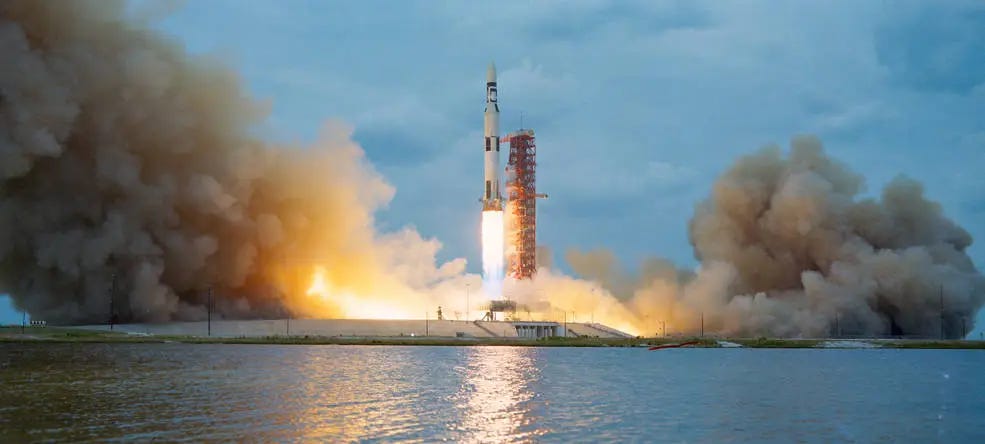
The Launching of America’s First Space Station
Just a minute into flight, Houston’s flight controllers saw trouble brewing: Skylab’s micrometeoroid shield, meant to ward off space debris and protect against the Sun’s relentless heat, had deployed far too early.
As the rocket sliced through a cloud bank and thundered past the sound barrier, aerodynamic forces ripped the shield away, tearing and jamming one of the solar panels.
With the shield gone, the station’s belly was exposed to the Sun, and the lab’s main solar arrays were damaged. One stuck, the other torn right off from the force of retrorockets during the final stage separation.
Inside Mission Control, Flight Director Donald Puddy and his engineers faced a nail-biting dilemma: point Skylab toward the Sun for power but risk roasting the lab or turn away and freeze out their power supply.
After a tense day of calculations and coffee, the team found a delicate balance, buying precious time. But onboard temperatures soared, threatening to wreck sensitive equipment and make the station uninhabitable for the astronauts who were supposed to launch just a day later.
NASA delayed the crew’s flight, sending Pete Conrad, Paul Weitz, and Joe Kerwin back to Houston for an intense crash course in space repair. Engineers in Houston and Huntsville worked around the clock, improvising solutions to deploy the stuck solar panel and shade the exposed workshop.
Meanwhile, NASA chief James Fletcher launched an investigation into what went wrong. The board found the shield simply wasn’t built to survive the supersonic winds of launch, and that engineers had focused mostly on what would happen in the weightless calm of orbit, not the violent ride up.
Nobody had assigned a dedicated engineer to champion the shield’s design, and vital conversations between shield designers and aerodynamic experts never happened. Skylab’s near-disaster was a lesson in teamwork, adaptability, and the real-life drama that unfolds when humans dare to build castles in the sky.
Against the odds, a crew would soon fly uphill to save America’s battered space station, proving that the story of exploration is written not just by triumphs, but by how we respond to setbacks.
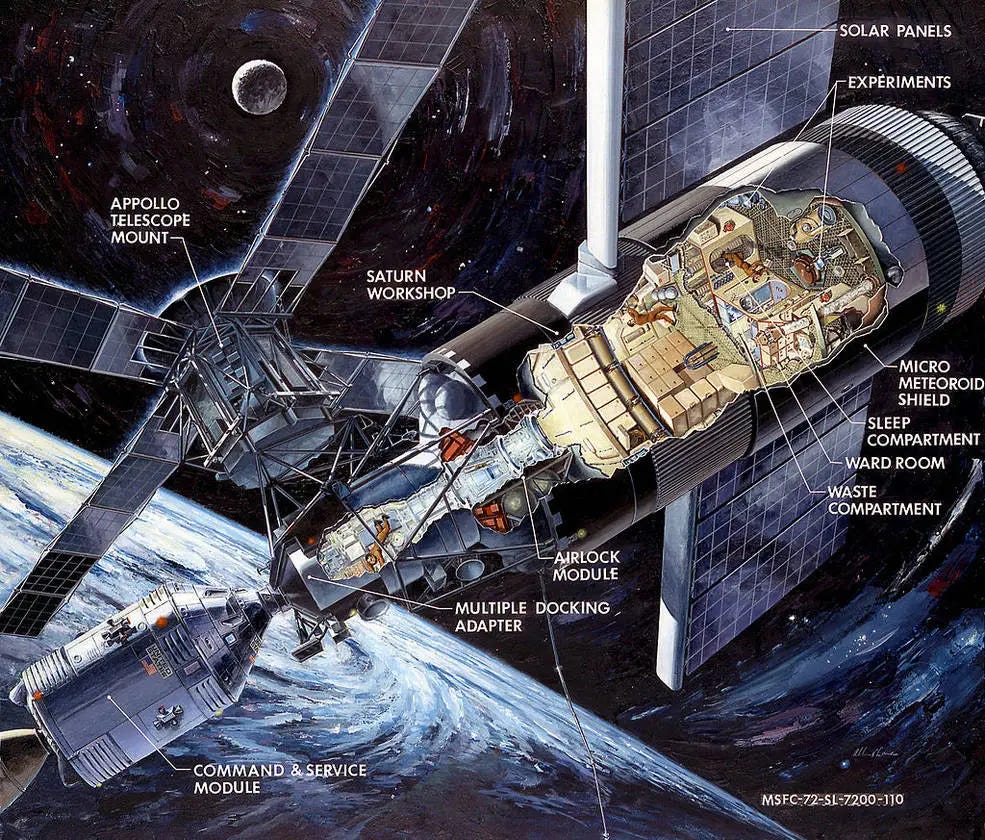
A Closer Look at the First Space Station
America’s first experimental space station, Skylab, was designed for long durations. Its objectives were twofold: To prove that humans could live and work in space for extended periods, and to expand our knowledge of solar astronomy well beyond Earth-based observations. The program was successful in all respects despite early mechanical difficulties.
Skylab made extensive use of Saturn and Apollo equipment. Through the use of a “dry” third stage of the Saturn V rocket, the station was completely outfitted as a workshop area before launch. Crews visited Skylab and returned to Earth in Apollo spacecraft.
Three, three-man crews occupied the Skylab workshop for a total of 171 days and 13 hours. It was the site of nearly 300 scientific and technical experiments, including medical experiments on humans’ adaptability to zero gravity, solar observations and detailed Earth resources experiments.
The Skylab complex consisted of four major components: the Orbital Workshop (OWS), the Airlock Module (AM), the Multiple Docking Adapter (MDA), and the Apollo Telescope Mount (ATM). The Apollo Command and Service Module transported crews to and from Skylab and remained attached to the station throughout a crew’s occupancy to serve as an emergency escape vehicle.
The OWS served as the main working, living, and sleeping compartment for the crews, and contained exercise equipment, a galley, and many of the scientific experiments for the life sciences studies.
Two large solar arrays on the OWS provided 12.4 kW of power to the station. The AM enabled astronauts to conduct spacewalks, while the MDA included a prime and backup docking port for the Apollo spacecraft and also housed the Earth Resources Experiment Package.
The ATM contained telescopes for solar observations and four solar arrays for additional power. Once in orbit, the complex weighed 170,000 pounds, by far the heaviest spacecraft at that time.
Skylab’s Lasting Legacy
Skylab’s story kicks off with disaster: a wounded station, battered and bruised, refusing to quit. Launched atop the mighty Saturn V, America’s first space station barely made it to orbit before calamity struck: a ripped-away meteoroid shield and a missing solar array. But here’s where legend takes flight.
Rather than throwing in the towel, NASA turned this near-miss into a masterclass in space survival, showing the world that astronauts could do more than ride rockets. They could roll up their sleeves, improvise, and fix what broke, 270 miles above the ground.
Skylab quickly became America’s first classroom in the sky. Over three missions, crews spent 171 days aboard, running almost 300 experiments: testing what happens to the human body in zero gravity, capturing the Sun’s secrets, and looking back at Earth with new eyes. NASA would later call Skylab the bedrock for the science that powers today’s International Space Station and tomorrow’s Moon and Mars adventures.
But Skylab’s most enduring legacy isn’t just the data it sent home. It’s what it proved about us. Humans could adapt, repair, work, sweat, and thrive in space for months at a stretch.
The lessons learned didn’t burn up when Skylab finally reentered Earth’s atmosphere in 1979. Instead, they live on, woven into the fabric of every space station and mission that followed. Skylab’s past keeps orbiting, high above, shaping the future of exploration.
In Case You Missed It
Photo Outlet
Every issue of Hangar Flying with Tog gets you a free image that I’ve taken at airshows:
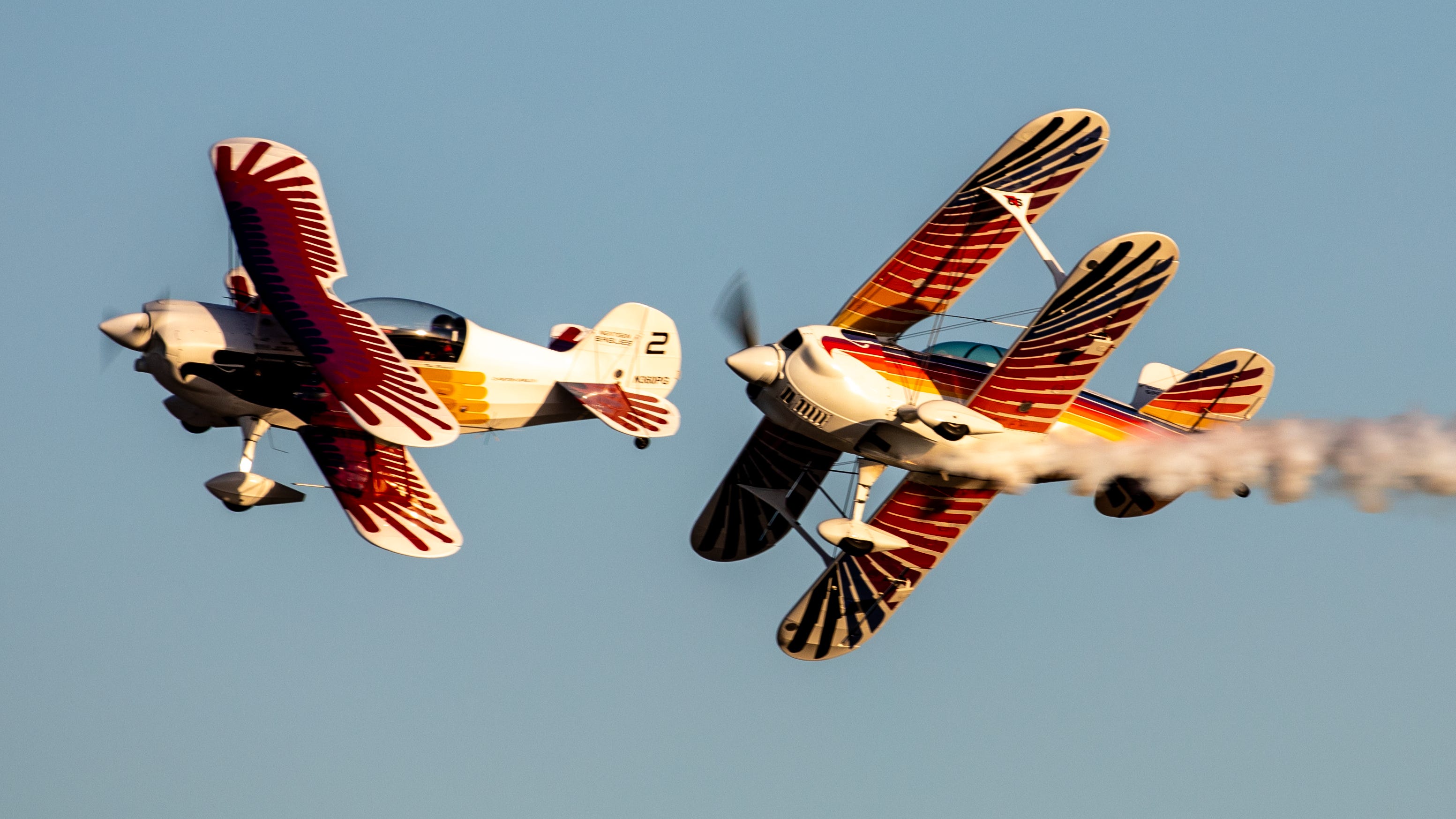
Feel free to use these photos however you like. If you choose to tag me, I am @pilotphotog on all social platforms. Thanks!
Post Flight Debrief
Like what you’re reading? Stay in the loop by signing up below—it’s quick, easy, and always free.
This newsletter will always be free for everyone, but if you want to go further, support the mission, and unlock bonus content like the Midweek Sortie, consider becoming a paid subscriber.
Your support keeps this flight crew flying—and I couldn’t do it without you.
– Tog