

Valkyrie Wingman—Marines’ Next Edge and Remembering the E-2C Hawkeye Prototype’s First Flight
From Hawkeye to Valkyrie, airborne battle networks evolve: an E-2C’s radar-and-command “quarterback” to today’s loyal wingmen drones, distributing sensing, relays, and effects across the formation.
“The integration of the Kratos Valkyrie aircraft system configured with the world’s best multifunction mission systems from Northrop Grumman results in a high-capability CCA at a price point that enables the uncrewed systems to be deployed in mass with crewed aircraft.”
—Steve Fendley, president Kratos Unmanned Systems Division.
Mission Briefing
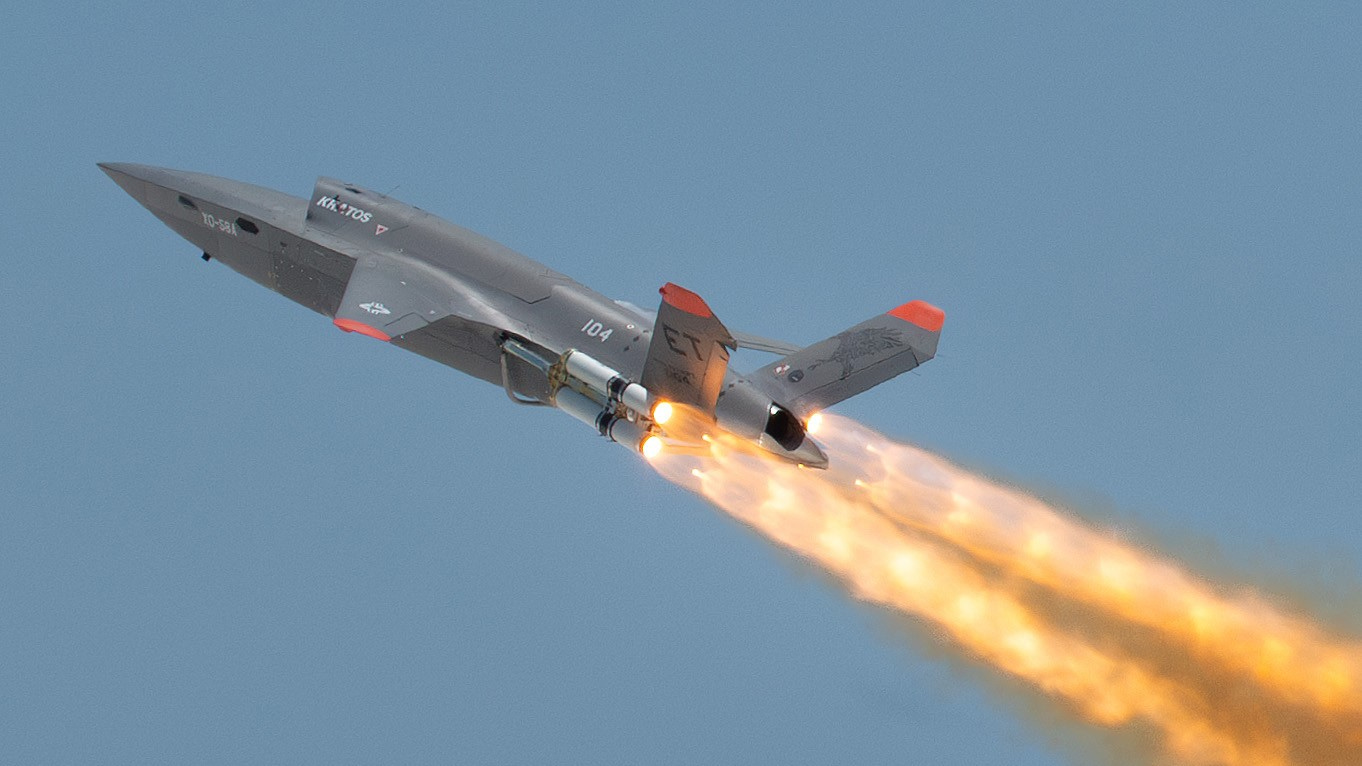
Northrop Grumman and Kratos are joining forces, blending cutting-edge autonomy with the daring Valkyrie UAS to stand shoulder-to-shoulder with Marine aviators in the world’s most dangerous skies. The next chapter of air dominance is being written, not just by pilots, but by teams where man and machine fly as one.
Sky Bound Partnerships: Charting the Future with Northrop and Kratos
The folks at Northrop Grumman and Kratos have been busy, and not just with blueprints or boardroom talk. They’ve already pulled off more than twenty successful flight demos, each one in environments that aren’t just test ranges but true proxies for the real-world skies our aviators fly through. That’s not just proving the hardware works. That’s putting skin in the game.
Now, the contract for this new Marine Air-Ground Task Force Uncrewed Expeditionary Tactical Aircraft—MUX TACAIR CCA, in the lingo, is no small thing. Northrop Grumman’s Krys Moen, the face of their Advanced Mission Capabilities, says it’s an “Other Transaction Agreement,” which is Pentagon-speak for a flexible, fast-moving contract—the first slice: $231.5 million, with an initial run of 24 months. No fixed finish line yet, but the wheels are turning fast.
Here’s where it gets interesting for us in the cockpit or the control van: Northrop’s building these platforms to deliver quickly. The kit is modular; a mix of advanced sensors, open-architecture autonomy software, and Kratos’ Valkyrie UAS.
Moen puts it straight: Northrop’s at the front of the pack on sensing and reliability, and they’re shrinking their mission kit to fit the leaner, meaner profile of an uncrewed system. It’s all about packing more punch into a smaller, lighter, and thrifty package, because drones don’t have the luxury of spare pounds or surplus power.
And this isn’t just about dropping ordnance. The tech is flexible, handling both kinetic and non-kinetic effects. The fully integrated sensor suite spans multiple frequency bands, combining Northrop’s own technology with hand-picked best-in-breed industry sensors, all at a price that keeps commanders satisfied.
Their autonomy backbone, Prism, has already proven itself on other platforms and is built to integrate seamlessly with partner modules. The bottom line is that when Northrop Grumman, Kratos, and their partners roll out this CCA, crews will have a platform that’s not just smart and connected, but also built for the fight. Survivable, lethal, and ready to support wherever the mission leads.
The Sleek Features of the XQ-58A Valkyrie
The XQ-58 Valkyrie is a sleek, stealthy unmanned combat aerial vehicle, runway-independent and built for speed and distance, rolling out not from some decades-long defense program, but from a bold partnership between Kratos and the Air Force Research Lab. The mission? Deliver high-value punch at a fraction of the cost, as part of the Low Cost Attritable Aircraft Technology (LCAAT) initiative.
The Valkyrie is attritable by design—tough enough for reuse, cheap enough to risk, and quick to build. From contract to first flight took just two and a half years, a pace that would make old-school procurement chiefs shake their heads in disbelief.
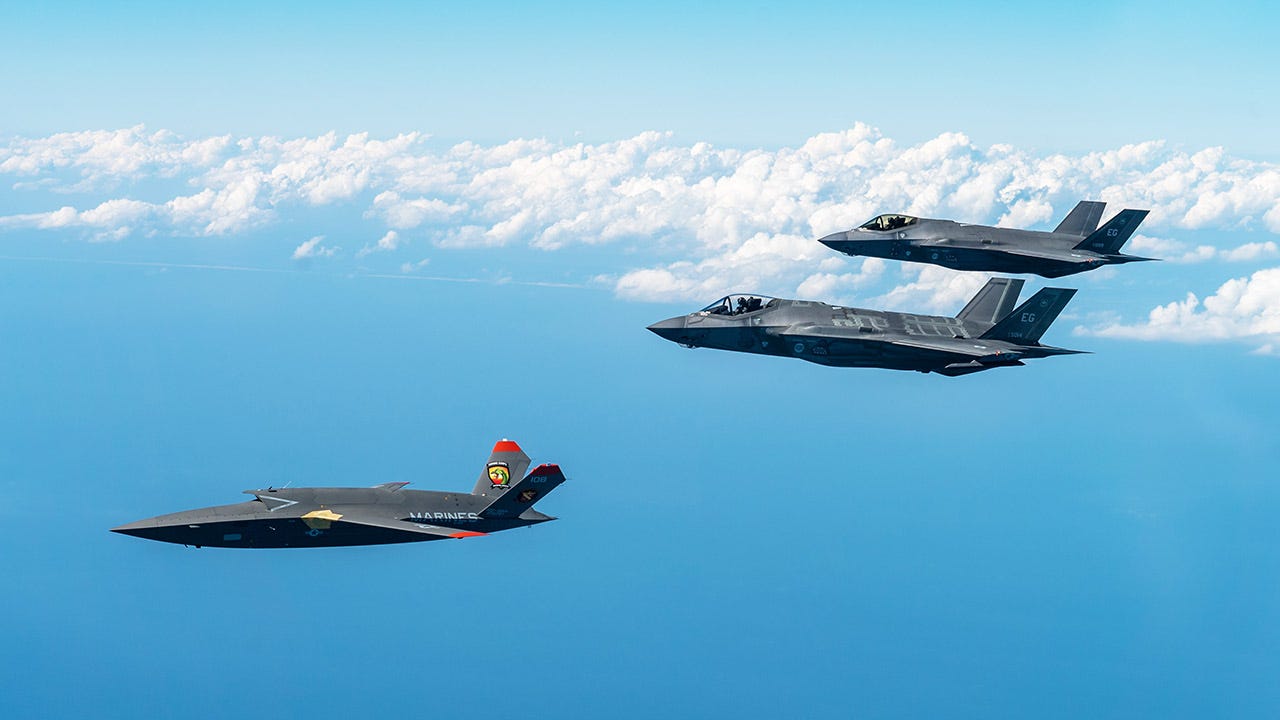
Its V-tail, stealthy lines, and internal payload bay hint at its intent. This bird can launch from a simple rail and recover under parachute, never needing a runway, giving ground crews and planners unmatched flexibility wherever the fight takes them.
Versatility is the name of the game. The XQ-58A can strike, gather intelligence, jam enemy radars, act as a decoy, or relay communications. It’s already proven its worth in manned-unmanned teaming with fifth-gen jets, and in 2021, wowed the test crowd by launching an ALTIUS-600 mini-drone from its own belly—a glimpse at the future of airborne swarming tactics.
The Block 2 Valkyrie upped the ante with stronger bones and sharper teeth, joining experimentation at Eglin AFB under programs like Skyborg.
Since 2023, the Corps has been flying the XQ-58 Valkyrie drone in formation with crewed aircraft, such as the F-35, pushing hard to see how man and machine can work together above the battlespace.
These flights aren’t just for show; they’ve tested electronic warfare, autonomous maneuvers, and even helped hunt enemy air defenses as part of the PAACK-P program. It is one of the boldest modernization pushes under Project Eagle, looking out toward the 2040s fight.
The story got another twist in 2024, when the Valkyrie flexed its new Link-16 muscles—passing tactical data back and forth and setting the stage for its role in the Emerald Flag exercise. For the first time, Marines demonstrated their ability to close the kill chain by having both pilots and drones act in concert, thereby rewriting the playbook for future combat.
Ensuring That We and Our Partners Stay Sharp
The days of sending just a handful of highly specialized, crewed fighters into contested airspace are giving way to a new playbook: pairing those pilots with a cadre of networked, uncrewed wingmen. These drones aren’t just tagalongs. They’re force multipliers, bringing extra eyes, reach, and sheer numbers to the fight.
That’s the heart of the Marine Corps’ latest move, teaming Northrop Grumman’s advanced autonomy and mission systems with Kratos’ XQ-58 Valkyrie under the MUX TACAIR Collaborative Combat Aircraft banner.
It’s the first step toward an “airborne battle network. “It is a formation where every node, manned or unmanned, shares data and tasks in real time, making the whole greater than the sum of its parts. This isn’t theory; Marines have already flown the Valkyrie alongside the F-35, showing how seamlessly these platforms can cooperate to dominate high-threat skies.
The way the program is structured tells its own story. Instead of waiting years for perfection, the Marines are fielding usable, relevant capabilities in fast, iterative cycles—spiraling forward with each new increment. The contract itself is a signal of intent, focused on deploying Northrop’s sensor-packed Advanced Mission Kit, open-architecture autonomy (Prism), and the flexible Valkyrie airframe.
Allies are watching closely. Many already fly the F-35 and are moving toward this same mix of crewed and uncrewed teaming.
With rocket-assisted launches and expeditionary basing in the mix, this approach makes it harder for any adversary to target or neutralize the force—a new era in coalition deterrence, where adaptability and numbers rule the sky.
This Week in Aviation History
January 1971 — E-2C Hawkeye takes flight
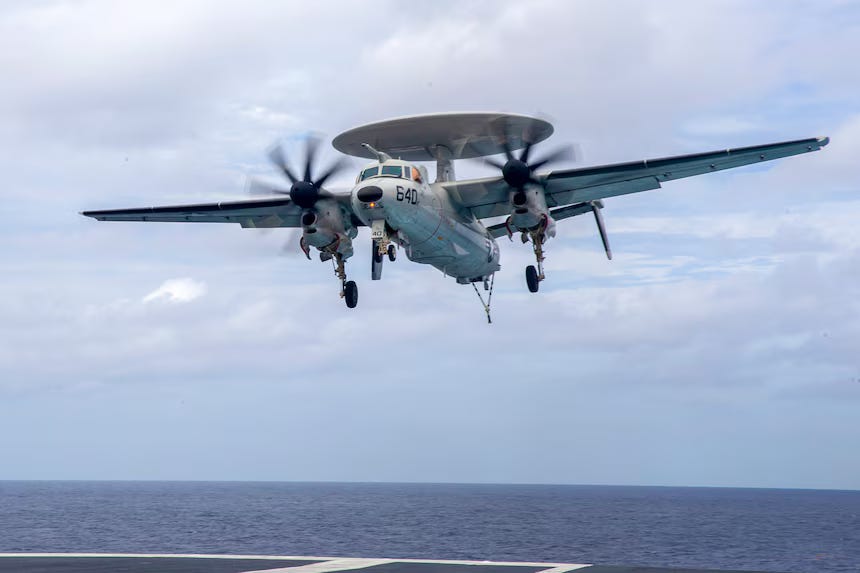
Out on the restless carrier deck, the E-2C Hawkeye launches skyward, its iconic rotodome spinning like a watchful halo. Ready to serve as the fleet’s ever-vigilant quarterback, a role it’s played for over half a century.
Since its first flights in the early 1970s, the Hawkeye has evolved into a powerhouse of battle management, fusing data, upgrading workstations, and weaving together scattered sensors to give the fleet a single, unified view of the battlespace. Even as the E-2C prepares for its sunset in 2026, its legacy lives on in the E-2D, passing down decades of command-and-control wisdom to shape the future of the fight beyond the horizon.
Eyes Above the Fleet: The E-2C Hawkeye Story
By 1956, the Navy’s radar technology had advanced to the point where folks started thinking: why not put early warning and command right up there in the sky? The first to answer that call was the Grumman E-1 Tracer, a quirky but effective offshoot of the S-2 Tracker sub-hunter. She flew her watch from 1954 to 1964. It is ten solid years of peering past the horizon for trouble. But the E-1 was just the opening act.
Then came the E-2 Hawkeye, a machine purpose-built to be the fleet’s all-weather sentinel. Unlike the Tracer, the Hawkeye was designed from the ground up for carrier operations and command and control, able to launch and recover from a heaving deck in the worst conditions. When she replaced the E-1 in 1964, the Hawkeye became the “eyes of the fleet.”
The E-2 got its baptism by fire during the Vietnam conflict, where she proved her worth as the fleet’s airborne quarterback. From then on, wherever the Navy sailed—be it the chilly North Atlantic or the steamy Pacific—the Hawkeye was overhead, knitting together the picture so fighters, bombers, and ships could work as one. She’s been at it for generations now, always evolving to match the times.
Take the E-2C: first flight in 1971, operational by 1973, and by 2004 she’d logged over a million flight hours. Every decade brought upgrades, which include better sensors, new engines, and smarter propellers. The Hawkeye 2000 variant, with its advanced mission computer, crisp radar displays, and Cooperative Engagement Capability (CEC), could team up with the Aegis shipboard weapon system and anchor sea-based Theater Air Missile Defense. That’s not just hardware. That’s the spine of modern naval air defense.
The E-2C’s reach goes far beyond American decks. You’ll spot her rotodome spinning in the skies over Egypt, Japan, Taiwan, and France. It is a testament to the Hawkeye’s reputation around the globe. She’s been on the scene for just about every major dust-up in the last half-century. During Desert Storm, she orchestrated the air campaign; in the ‘90s, she kept watch over Iraq and the Balkans, managing airspace and missions with the calm of a seasoned traffic controller.
When 9/11 rattled the homeland, E-2Cs were scrambled to guard America’s own skies. Patrolling the East Coast, relaying communications, and tracking anything that moved. For an aircraft born in the Cold War, she sure proved her mettle in the modern fight.
Every aviator who’s flown the Hawkeye has a story. Machi remembers flying E-2C Group II Plus birds over the Mediterranean, supporting operations in Syria. Those old radars, designed to spot Soviet aircraft, were still sharp enough to track threats in today’s complex skies.
And then there’s King, who recalls a day in Northern Virginia meant for routine training. In the middle of touch-and-go landings, a mayday crackled over the radio—a plane was down off the coast. Unplanned but never unprepared, the Hawkeye crew shifted gears, cancelled the drills, and became the on-scene commanders, coordinating search and rescue until help arrived. That’s the Hawkeye spirit. Always ready, always watching, no matter the mission.
The E-2C Hawkeye Up Close
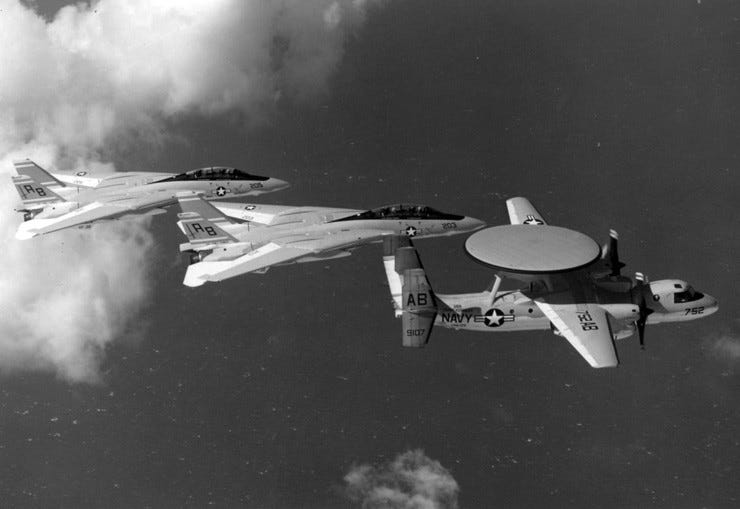
Let me give you a rundown of this airborne sentinel:
Crew: 5: pilot, copilot, radar officer (RO), combat information center officer (CICO), aircraft control officer (ACO)
Length: 57 ft 9 in (17.596 m)
Wingspan: 80 ft 7 in (24.56 m)
Height: 18 ft 4 in (5.582 m)
Wing area: 700 sq ft (65 m2)
Empty weight: 40,200 lb (18,234 kg)
Gross weight: 43,068 lb (19,535 kg)
Max takeoff weight: 57,500 lb (26,082 kg)
Powerplant: 2 x Allison/Rolls-Royce T56-A-427 (E-2C), T56-A-427A (E-2D) turboprop, 5,100 shp (3,800 kW) each
Maximum speed: 350 kn (400 mph, 650 km/h)
Cruise speed: 256 kn (295 mph, 474 km/h)
Ferry range: 1,462 nmi (1,682 mi, 2,708 km)
Endurance: 6 hours (8 hours land-based)
Service ceiling: 34,700 ft (10,600 m)
Avionics:
AN/APS-145 Radar
OL-483/AP IFF interrogator system
APX-100 IFF Transponder
OL-698/ASQ Tactical Computer Group
AN/ARC-182 UHF/VHF radio
AN/ARC-158 UHF radio
AN/ARQ-34 HF radio
AN/USC-42 Mini-DAMA SATCOM system
Legacy in the Rotodome: The Enduring Story of the E-2C Hawkeye
The E-2C Hawkeye would thunder off the carrier deck, its radar spinning like a vigilant halo, and turn chaos into clarity, weaving scattered contacts into a single, living picture of the battlespace. But its legend wasn’t built just on watching from afar; the Hawkeye was always where the action demanded. Coordinating strikes over sea and land, guiding search and rescue, chasing down smugglers, delivering aid after disasters, and even stepping in as air-traffic control when the tower went dark.
The Hawkeye earned its stripes by evolving with the times. Each upgrade made her sharper and more versatile, culminating in the Hawkeye 2000. It is a leap forward in mission computing and displays, fused with Cooperative Engagement Capability and the Aegis system to make her the backbone of sea-based missile defense.
You can trace the E-2C’s impact through the pages of recent history: orchestrating aerial command in Desert Storm, standing guard over Iraq during Northern and Southern Watch, coordinating NATO airspace in Deny Flight, and patrolling American skies in the tense days after 9/11. The Hawkeye didn’t just serve the U.S., either—she became a bridge-builder, flying in the colors of Egypt, France, Israel, Japan, Mexico, Singapore, and Taiwan, tightening bonds of partnership and shared defense.
Even as the E-2C prepares to take its final bow in 2026, its legacy endures. Habits of teamwork, multi-mission readiness, and data fusion now passed on to the E-2D squadrons charting the future. The Hawkeye’s story is the story of vigilant command, woven into every mission, every crew, and every horizon it’s watched over.
In Case You Missed It
A four-hour masterclass on US jet strategic bombers:
Photo Outlet
Every issue of Hangar Flying with Tog gets you a free image that I’ve taken at airshows:
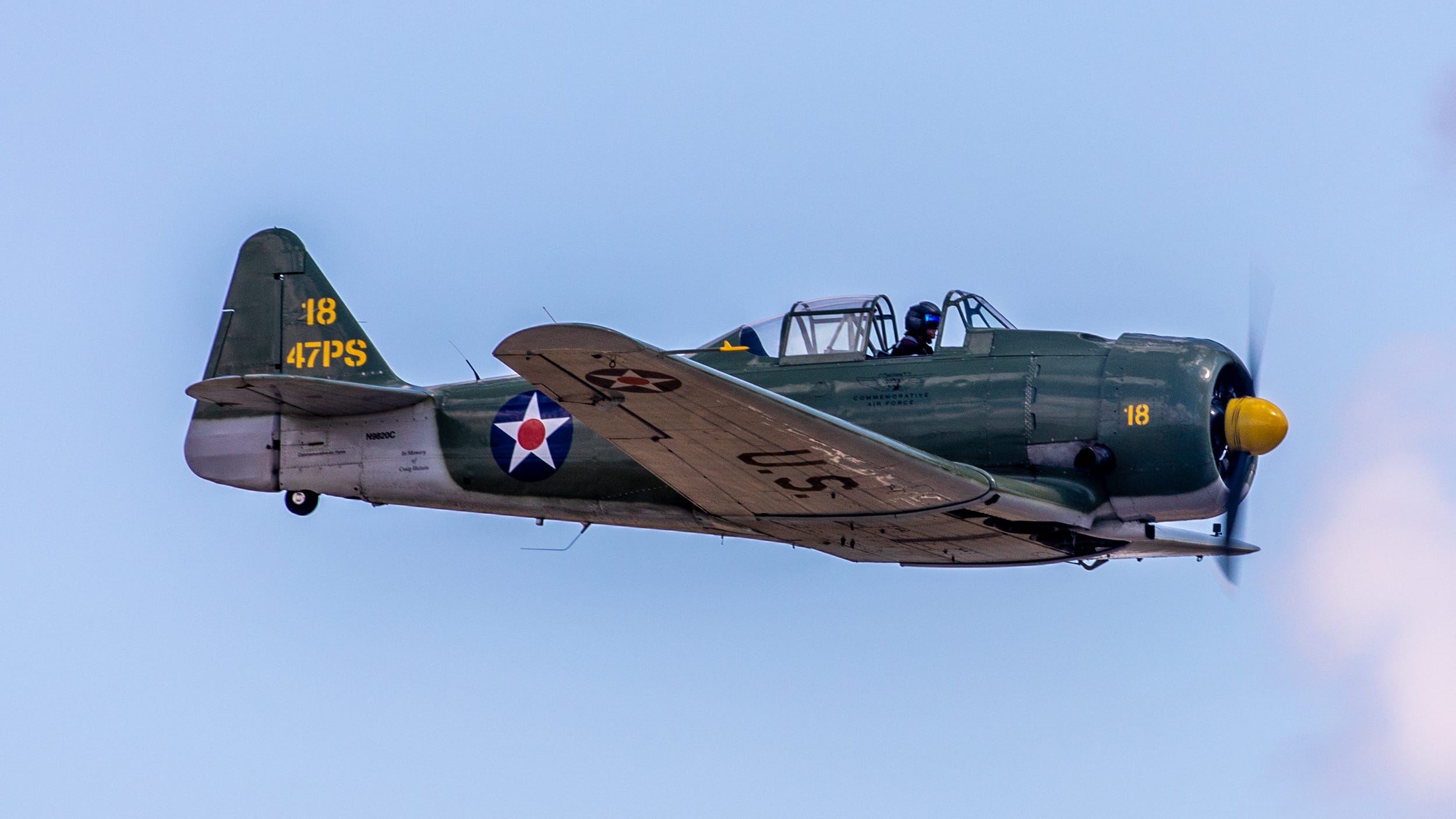
Feel free to use these photos however you like. If you choose to tag me, I am @pilotphotog on all social platforms. Thanks!
Post Flight Debrief
Like what you’re reading? Stay in the loop by signing up below—it’s quick, easy, and always free.
This newsletter will always be free for everyone, but if you want to go further, support the mission, and unlock bonus content like the Midweek Sortie, consider becoming a paid subscriber.
Your support keeps this flight crew flying—and I couldn’t do it without you.
– Tog