

“This twin-carrier surge is a calibrated message that the U.S. can surge overwhelming force across the Indo-Pacific at short notice, and do so from sovereign U.S. territory.”
—Dr. Marc Delaney, a senior fellow at the Pacific Maritime Institute
Mission Briefing
For the first time in years, two U.S. carrier strike groups are sailing together across the Western Pacific—USS Abraham Lincoln standing alongside her sister flattop near Guam. It’s a powerful formation, sending a clear message: American air power is on station, ready to keep the peace and back our allies as the temperature rises in these contested waters.
The Twin Carrier Arrival: Why It Matters Now?
The mighty silhouette of the USS Abraham Lincoln carrier group gliding into the Western Pacific is joining the USS George Washington, already anchored off Guam since December 1st.
For those of us who’ve spent a lifetime watching the ebb and flow of carrier decks and international headlines, this isn’t just a show of force. It’s a carefully orchestrated move with real muscle behind it.
The dual-carrier presence marks the first time since 2022 that two U.S. Navy carrier groups have operated from Guam, turning the island into a bustling hub of American power projection in the Indo-Pacific. Guam, with its runways, deep harbors, and unshakeable stars-and-stripes sovereignty, is more than just a speck on the map. It’s now the anchor point for long-haul operations, the kind that keep allies reassured and would-be challengers wary.
The stakes have only grown sharper since President Trump’s second term kicked off, with the White House and Pentagon both zeroing in on one priority: countering China’s rapid military rise. Secretary of War Pete Hegseth put it plainly—America must keep a firm grip on naval superiority in the Pacific if stability is to be preserved.
“China’s ambitions to dominate the Pacific cannot go unchallenged,” Hegseth declared, and you can almost hear the engines spooling as carrier groups answer that call. From the Taiwan Strait to the Philippine Sea, these flattops aren’t just steel and steam. They’re the first line of defense, living proof that American resolve sails on.
With the Lincoln’s arrival, Guam now plays host to a full complement of U.S. naval might: not just the two nuclear-powered carriers, but their escorting destroyers—USS Spruance, USS Michael Murphy, USS Frank E. Petersen Jr.—all bristling with the latest guided missiles and ready for advanced drills, regional patrols, and joint exercises with partner navies.
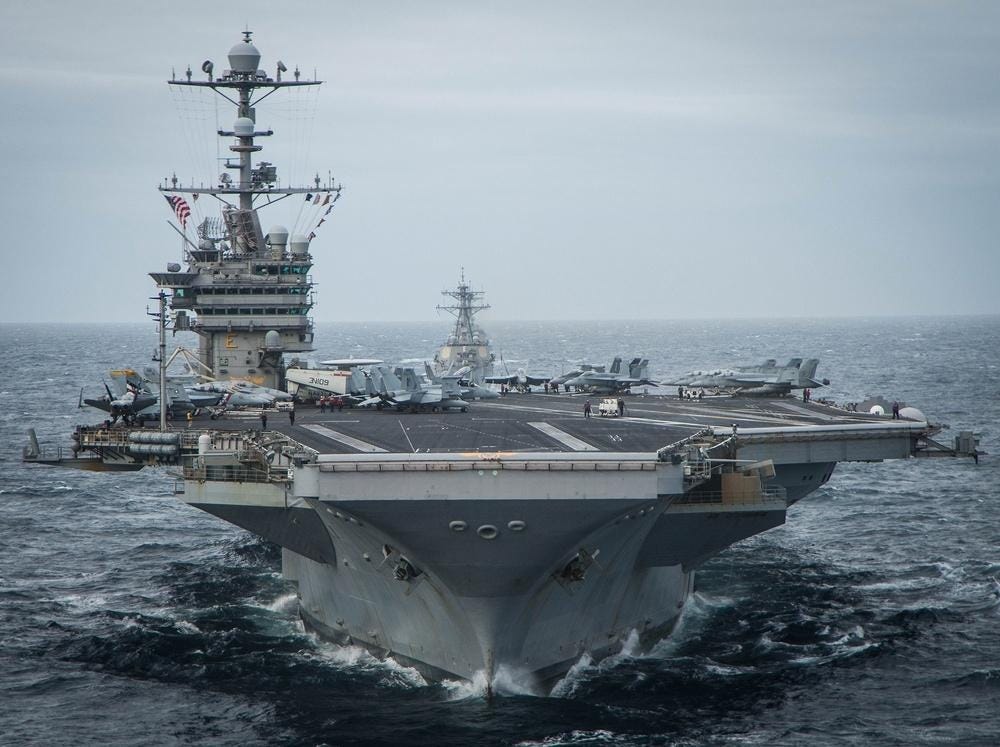
USS George Washington (CVN 73) is the sixth Nimitz-class nuclear-powered aircraft carrier and is named in honor of the first president of the United States. (US Navy)
Key Features of the USS Abraham Lincoln and USS George Washington
The USS Abraham Lincoln (CVN-72) is a true titan of the seas and a proud member of the Nimitz-class carrier fleet. Stretching more than a thousand feet from bow to stern and tipping the scales at over 100,000 tons, she’s a floating city built to house nearly 6,000 souls—sailors, aviators, and all the specialists needed for the mission. Her nuclear heart means she can roam the world’s oceans for years without pausing to refuel, always ready and always on watch.
Step onto her flight deck, and you’ll witness the choreography of modern airpower: Lincoln’s advanced electromagnetic launch system (EMALS) sends strike fighters roaring skyward, while her arresting gear catches returning jets with precision. The carrier’s radar arrays and secure comms keep her connected to the fleet, turning her into the nerve center of any operation.
She’s not just about launching planes. Lincoln can fight back, too. Twin Sea Sparrow missile launchers and triple-barreled Gatling guns stand ready to swat down incoming threats, while a full suite of electronic warfare and early warning aircraft keep her one step ahead of danger.
With F/A-18 Hornets, E-2C Hawkeyes, and EA-18G Growlers aboard, this carrier can dominate the skies, strike targets far afield, and gather the intelligence that shapes tomorrow’s missions. In every sense, the Abraham Lincoln is not just a ship—she’s a symbol of American power, purpose, and relentless innovation.
Meanwhile, the USS George Washington (CVN 73), another Nimitz-class marvel, glides across the Pacific with the presence of a floating fortress. Stretching 1,092 feet from bow to stern and boasting a flight deck wider than two football fields,
George Washington is one of the world’s most formidable warships, displacing nearly 97,000 tons when fully loaded. She’s a self-contained city at sea, hosting more than 5,000 sailors, aviators, and support crew, all working in a rhythm that keeps air operations humming around the clock. Her flight deck, sprawling across 4.5 acres, is a stage for relentless action; four steam catapults launch jets into the sky, while four arresting gear engines reel them back aboard with practiced precision.
Beneath her armored skin, George Washington is packed with cutting-edge technology. Twin Westinghouse A4W nuclear reactors grant her unlimited range, allowing the carrier to sprint or loiter as the mission demands, untethered from the nearest fueling port. Advanced radar and communications suites—like the AN/SPS-48E air search radar and AN/SPQ-9B target acquisition radar—give her commanders an eagle’s view of the battlespace, while the Integrated Shipboard Information System (ISIS) brings a symphony of data together for quick, informed decision-making.
George Washington’s true punch comes from her air wing: F/A-18 Hornets and Super Hornets for air combat and strikes, E-2C Hawkeyes for command and control, EA-18G Growlers to jam and blind enemy defenses, and Seahawk helicopters ready for everything from rescue missions to anti-submarine warfare.
For her own defense, she bristles with Sea Sparrow and Evolved Sea Sparrow missiles, plus Phalanx CIWS; those radar-guided Gatling guns that chew through incoming threats at close range. Electronic warfare suites like the AN/SLQ-32(V)4 round out her arsenal, detecting, analyzing, and jamming enemy signals. In every detail, the George Washington stands as a beacon of American power, precision, and adaptability on the high seas.
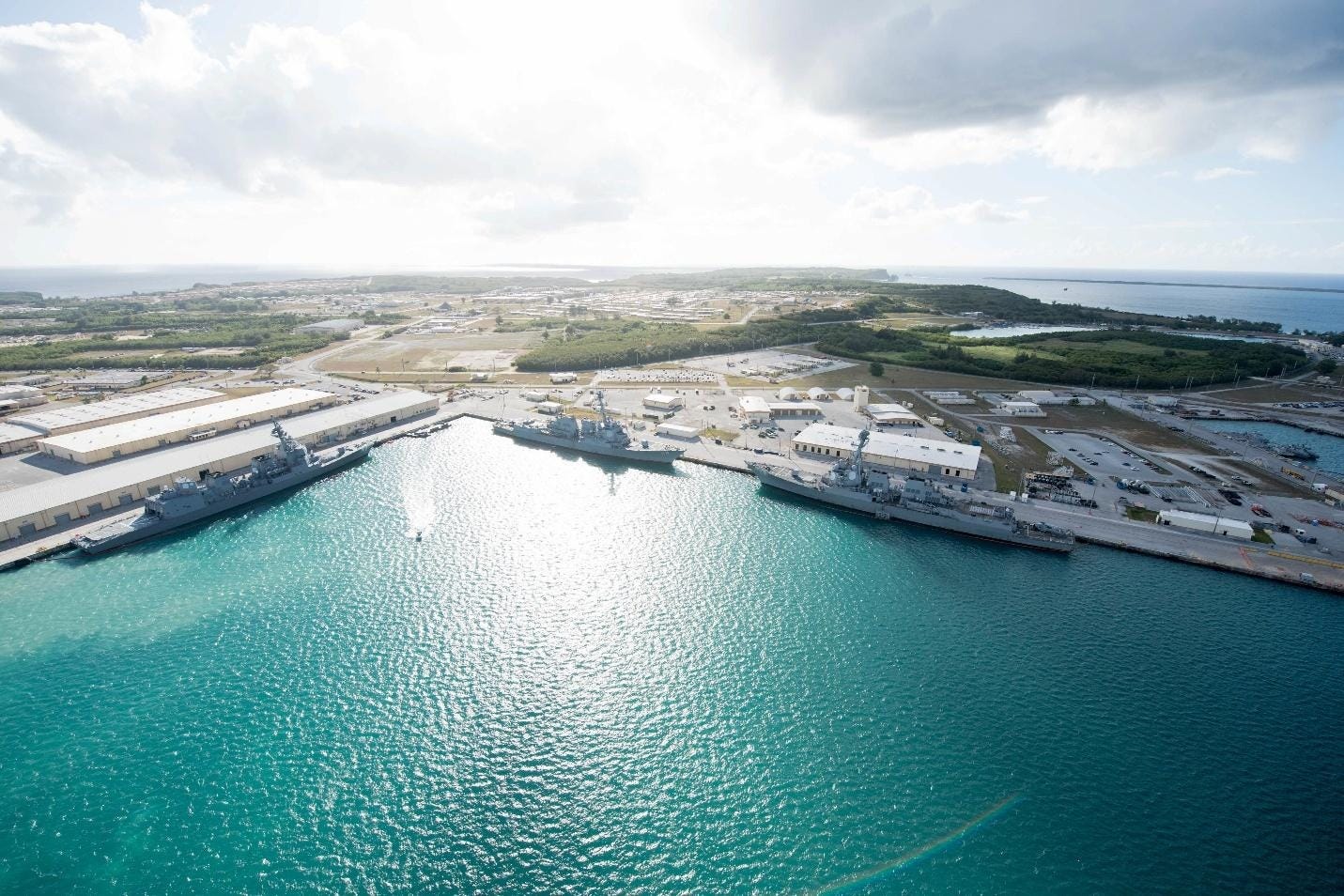
The island of Guam is located approximately 3,300 miles West of Hawaii, and 1,500 miles east of the Philippines and south of Japan. Guam is a territory of the United States and its residents are US citizens. (US Naval Base)
Keeping Us and Allies Primed for the Fight
The arrival of two carriers isn’t a routine shuffle of ships. It’s a direct response to China’s own moves, especially the unveiling of its fourth aircraft carrier—a nuclear-powered giant boasting electromagnetic catapults, signaling Beijing’s intent to operate far from home waters and tip the regional balance in its favor.
For those of us who know what it means to keep a steady hand on the controls, these deployments are more than headlines. They’re the unmistakable hum of readiness, a reminder that in the world’s most contested seas, the next chapter is being written in steel, strategy, and the unbroken line of American carriers on watch.
More than that, the presence of two mighty American carrier strike groups is more than a show of flag—it’s a masterstroke in the chess game of Pacific power. Here, USS Abraham Lincoln and her Carrier Air Wing 9 bring a potent mix of muscle and finesse: Super Hornets ready to sweep the skies, Growlers prowling for signals to jam, Advanced Hawkeyes keeping watch far beyond the horizon, and Seahawks patrolling both above and below the waves.
This forward posture isn’t just to steady the nerves of America’s allies; it’s a calculated move to keep potential adversaries, especially China, guessing and rethinking their every step. By anchoring these forces in Guam—with its hardened bases and robust logistics—the U.S. ensures it can respond swiftly, sustainably, and on its own terms. As Dr. Marc Delaney puts it, this twin-carrier surge is a clear signal: America is prepared to project overwhelming strength across the Indo-Pacific, and do it from home turf.
As the future unfolds, Guam’s horizon will likely remain crowded with steel and ambition, shaping the next chapter of air and sea power.
This Week in Aviation History
In January 1945, U.S. Navy carrier planes swept over the China coast and Formosa, their rockets and bombs tearing through Japanese airfields and ships as the Pacific War neared its boiling point. From the decks of fast carriers, aviators surged into the dawn, striking deep at enemy harbors and severing Japan’s vital supply lines with ruthless precision. The thunder of engines and the glare of explosions danced across the waves; a bold reminder of how naval air power could tilt the destiny of nations.
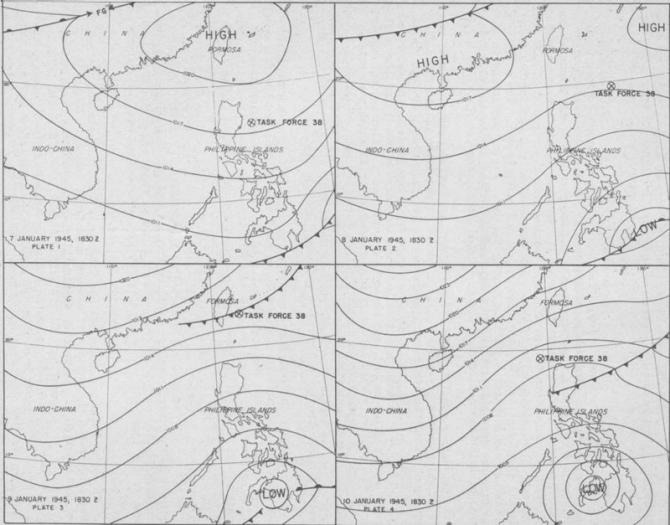
Weather Maps: Task Force 38, 7-10 January 1945. (US Navy)
Carrier Strikes on the China Coast
Let me take you back to the opening days of 1945, high above the swirling mists and jagged peaks of Formosa. Task Force 38, a relentless armada of American carriers, arrived on station just after New Year’s, their decks bristling with aircraft ready for the next great push in the Pacific.
The mission was clear but daunting: strike at the heart of Formosa’s western airfields, nestled on the central plains and shielded by a spine of mountains running north to south; mountains that soared over 13,000 feet into the winter sky.
For the aviators, this was no simple hop. To reach their targets, pilots had to muscle their way over those lofty ridges, often blind in thick weather. As one carrier captain put it, a cold front was dragging squalls and a heavy overcast across the island by the morning of January 3rd, making the launching point a cauldron of turbulence and low visibility.
Pilots climbed through a solid cloud deck on instruments, not breaking through to clear air until they reached 10,000 feet—a climb that cost the task force a torpedo plane, which vanished without a trace. West of the mountains, the clouds thinned and the ceiling over the targets sat at a modest 4,500 feet, but the flying was treacherous all the same. By afternoon, worsening weather forced commanders to recall a planned strike, the skies dictating the rhythm of battle.
Task Force 38 didn’t let up. By January 6th, they’d repositioned off northeastern Luzon, launching fresh waves at southern Luzon’s airfields. The weather played its part, hiding the carriers’ maneuvers beneath its cloak. Good flying prevailed over the targets on the 6th. Still, by the next day, another disturbance rolled in, making conditions at sea ugly and unpredictable, as stated by the Commander Officer of the USS San Jacinto.
Still, American aviators pressed on, reaching their targets despite the odds, though plans to strike Formosa again were scrapped as the storms refused to lift. Instead, Clark Field on Luzon became the new bullseye, with blue skies over the target offering a rare window for attack.
January 9th saw another attempt to hammer Formosa. But, as the Commander Officer of the USS Wasp claimed, a sharp cold front once again muddied the skies, and the day’s strikes ended in frustration. Undeterred, the task force slipped through the Bashi Channel into the South China Sea by nightfall, shifting its sights to new territory.
On the 12th, they unleashed their fury on Indo-China, searching and striking across a widening front. Formosa itself felt the weight of their return on January 15th, followed by Hong Kong, Canton, and Hainan, as the carriers attacked “in force,” leaving devastation in their wake along China’s coast.
The relentless pace came at a cost; monsoon seas made refueling a nightmare, with waves and wind stalling operations for days. But by January 20th, the weather eased, and that evening, Task Force 38 threaded the Balintang Channel back into the Pacific, fending off Japanese air attacks during their exit.
Thus ended a cruise that marked the first American carrier strikes against the China and Indo-China coasts, a campaign designed to sever Japan’s last southern lifelines—a feat of courage, endurance, and adaptation written in the logbooks and in the sky.
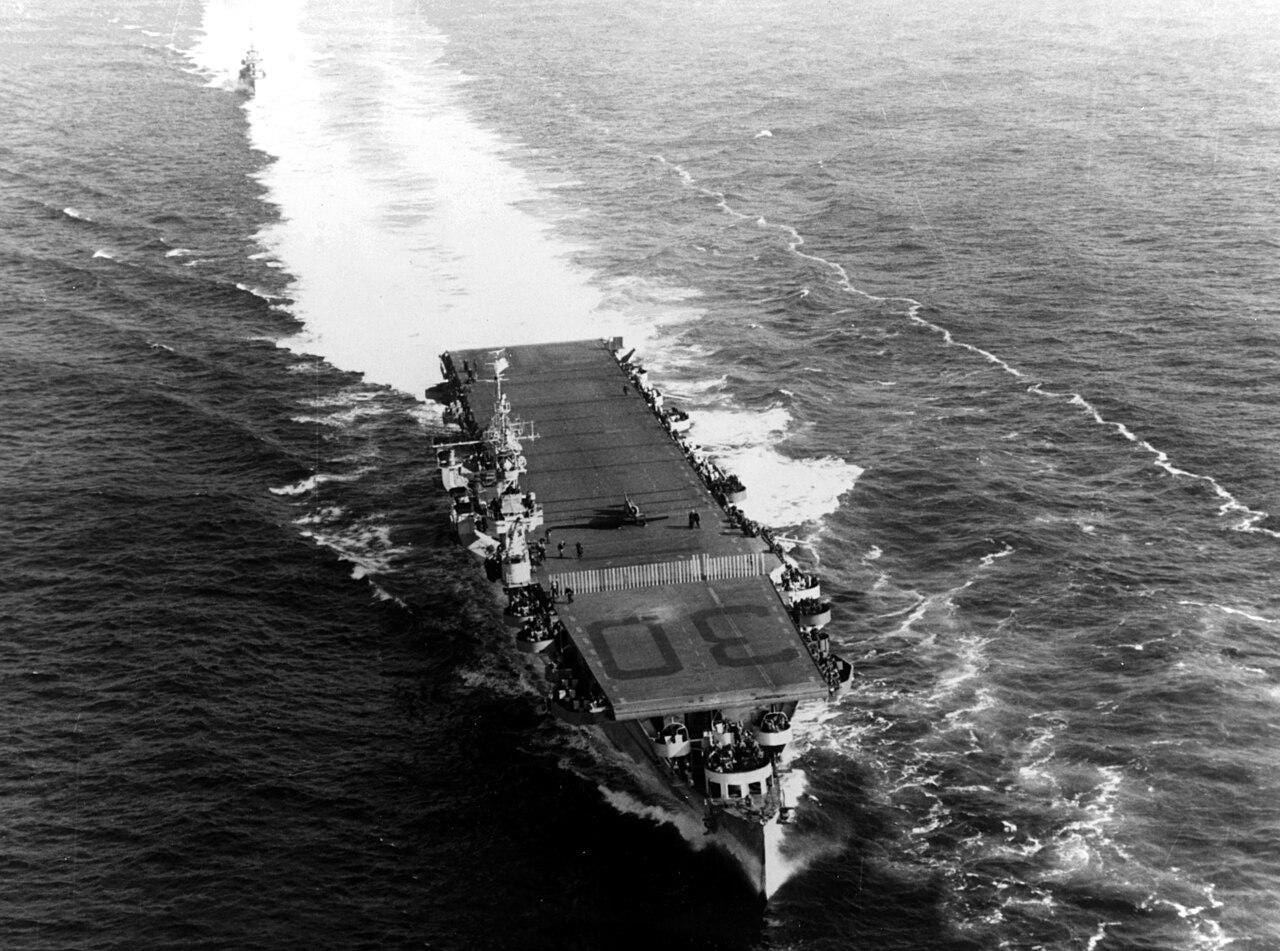
The U.S. Navy light aircraft carrier USS San Jacinto (CVL-30) underway off the U.S. East Coast (U.S. Navy)
Wasp and San Jacinto: Features of the Steel Deck Twins
Let me take you back to a time when the roar of engines filled the skies above a turbulent Pacific Ocean—a time when the USS San Jacinto (CVL-30) began her storied journey as an Independence-class light aircraft carrier during World War II.
Named in honor of the decisive Battle of San Jacinto, this formidable vessel became an unsung hero of the U.S. Navy’s fleet, playing a crucial role in providing aerial support for critical amphibious landings and participating in key operations.
Picture her flight deck, a marvel of engineering tailored for swift action amidst the challenges of warfare. Stretching an impressive 622.5 feet in length and 109 feet at her widest point, the deck was designed to house up to 45 aircraft; a symphony of fighters and bombers ready for deployment.
Two strategically placed elevators efficiently whisked planes between the hangar and the flight deck, ensuring that the rhythm of operation never faltered. A single catapult system launched heavily-laden aircraft into the fray, deftly handling the demands of combat conditions.
The hangar deck, with its enclosed structure and meticulous layout, was a hive of activity where aircraft were readied for their next missions, all while anti-skid material underfoot ensured safety during frenetic launches and recoveries, enhanced even further by innovative lighting systems guiding pilots at night.
As for her defenses, the San Jacinto was armed to the teeth—initially boasting 28 Bofors 40 mm anti-aircraft guns and 40 Oerlikon 20 mm cannons, crafting a formidable shield against enemy threats.
Throughout the war, her armament was updated and refined, adapting to the evolving landscape of aerial warfare, culminating in a potent anti-aircraft defense network that made her one of the most resilient vessels of her time. The San Jacinto wasn’t just a ship; she was a symbol of strength and resilience in the skies.
Meanwhile, the USS Wasp carrier emerged from the constraints of the Washington Naval Treaty, which seemed to prioritize diplomacy over might. Following the construction of the iconic Yorktown and Enterprise, the U.S. was allowed to build one more carrier within the weight limits of 15,000 long tons, and thus, the Wasp took flight.
She was a trailblazer, becoming the first carrier to boast a deck-edge elevator, revolutionizing the way aircraft were handled. Her flight deck, a strategic reinterpretation of the Yorktown design, stretched about 741 feet long and 109 feet wide at its most expansive point.
A masterpiece of efficiency, it featured three elevators—one at the front, one in the middle, and one at the rear, allowing for a seamless flow of planes from hangar to launch. With four hydraulic catapults, including two on the flight deck, the Wasp was ready for action, though her hangar catapults saw little combat use. However, her compact design meant that she could realistically accommodate only 80 to 100 aircraft, depending on the circumstances.
Now, the heart of the Wasp, the propulsion system. It wasn’t as powerful as some of her contemporaries, relying on six water-tube boilers that fed steam to two Parsons geared turbines, generating 70,000 shaft horsepower. This gave her a respectable top speed of 29.5 knots, perfect for extended missions across the vast ocean—think 12,000 nautical miles at a cruising speed of 15 knots!
As for defense? The Wasp was equipped with a potent arsenal, including eight dual-purpose 5-inch guns for targeting both surface and aerial threats, alongside 16 quad-mounted 1.1-inch anti-aircraft guns providing tight protection. To top it off, she carried .50 caliber machine guns to fend off any close-range attackers. The USS Wasp was not just a ship; she was a testament to innovation and resilience in the face of challenge.
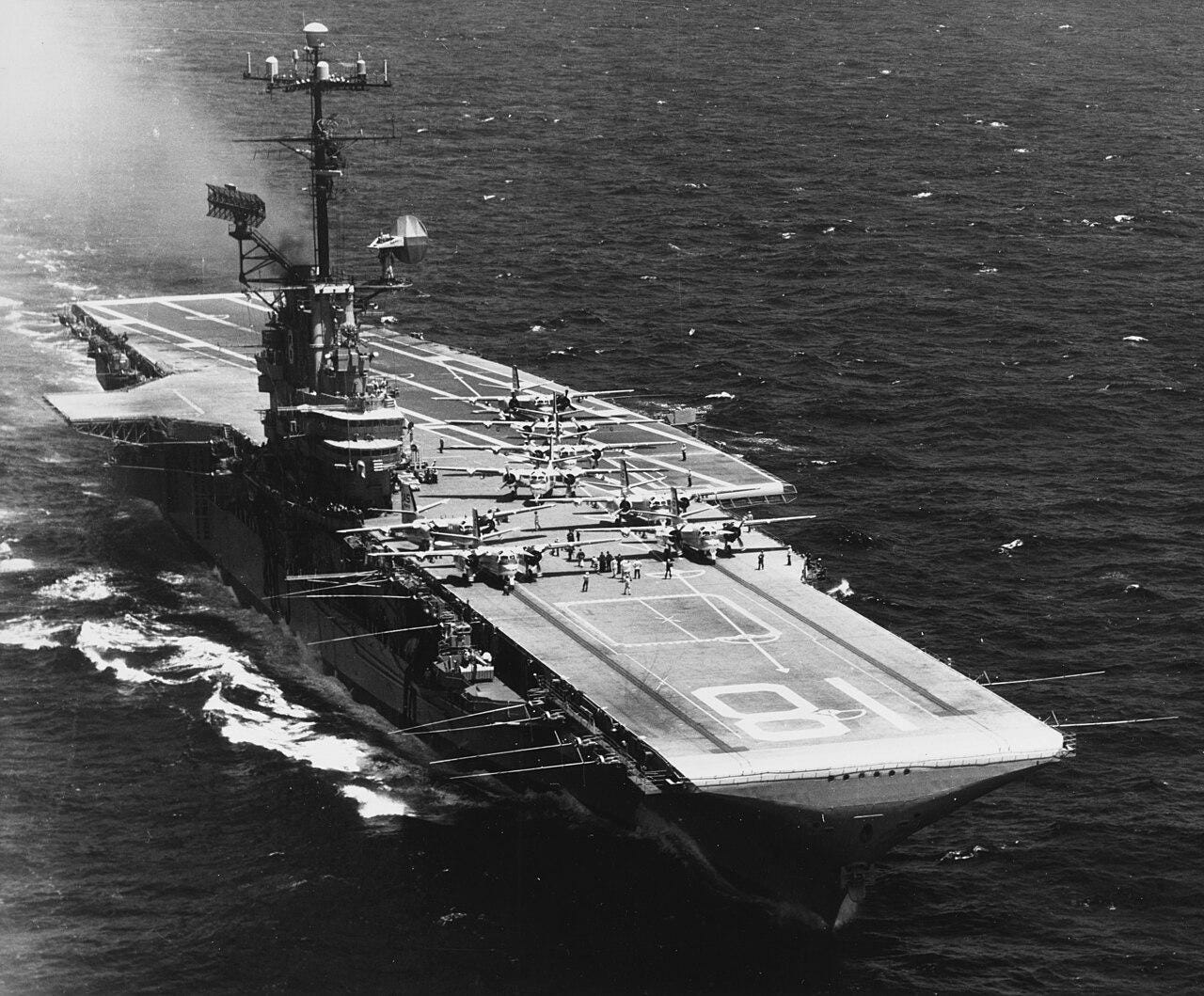
The U.S. Navy aircraft carrier USS Wasp (CVS-18) underway, circa in early 1967. On deck are Grumman S-2E Tracker aircraft of Carrier Anti-Submarine Air Group 52 (CVSG-52). (US Navy)
The Wasp and San Jacinto’s Enduring Legacy
The USS Wasp (CV-18) and USS San Jacinto (CVL-30) revealed the true nature of carrier warfare. It wasn’t just about the overwhelming firepower but also the ability to adapt under the immense pressures of weather, terrain, and timing.
Picture the aircrews preparing for their missions, faced with the daunting task of crossing a mountain spine soaring over 13,000 feet. They had to climb through thick clouds and squalls, relying solely on instruments to break through near 10,000 feet. The conditions proved relentless; though planes were launched, the treacherous weather hampered their impact.
The Wasp’s report laid bare this harsh reality—attacks were sent forth, yet success was elusive due to the elements. Ironically, this same weather protected the fleet, cloaking their movements from enemy eyes as Japanese forces struggled to respond.
Then came the moment of strategic brilliance with the San Jacinto, highlighting their flexibility. When Formosa became unflyable, they shifted their sights to Clark Field.
The lesson remains clear: victory in the skies isn’t just about striking hard; it’s about remaining adaptable when the atmosphere turns adversarial, a principle that still defines sea-based airpower today.
In Case You Missed It
Photo Outlet
Every issue of Hangar Flying with Tog gets you a free image that I’ve taken at airshows:
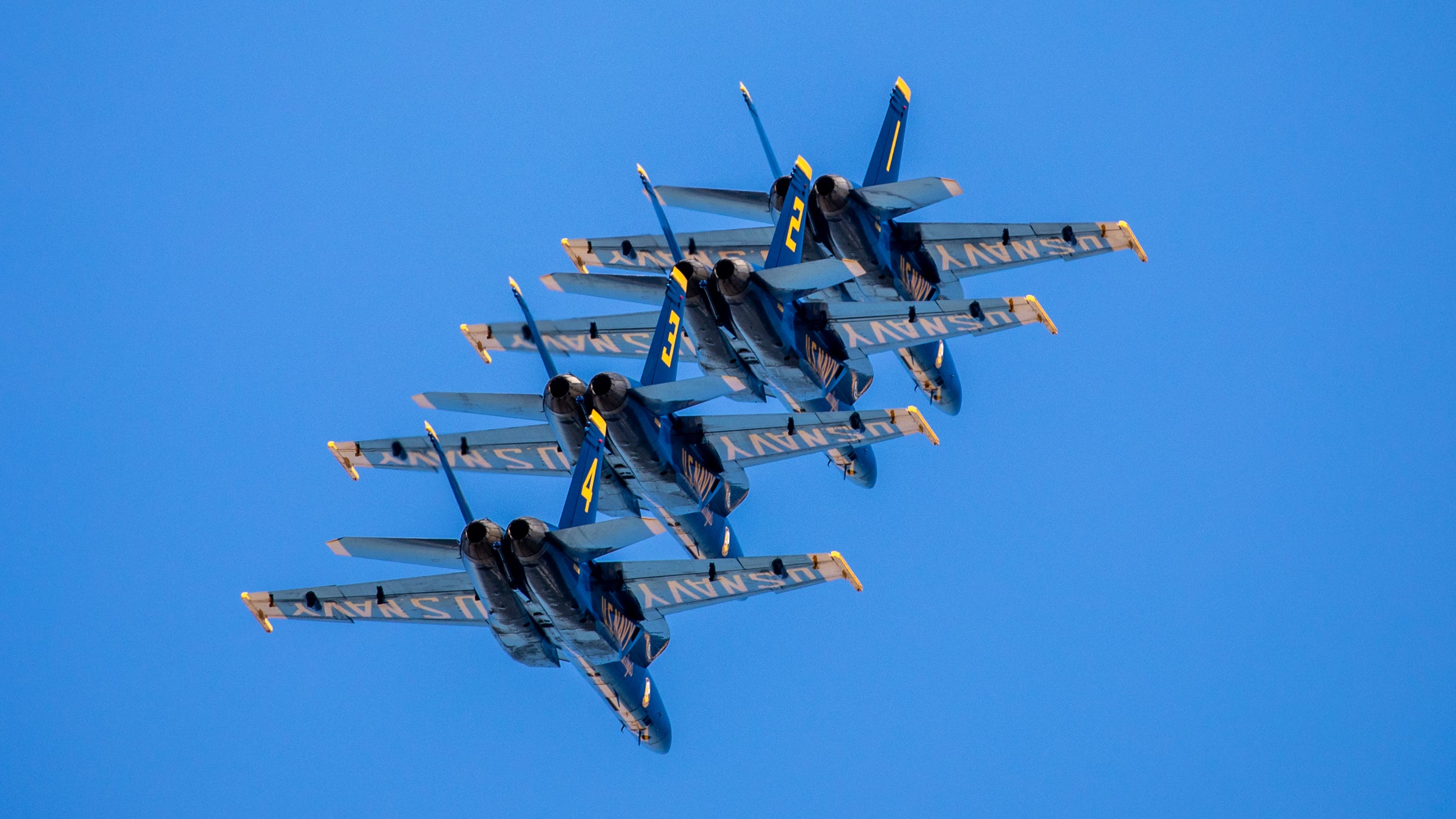
Feel free to use these photos however you like, if you choose to tag me, I am @pilotphotog on all social platforms. Thanks!
Post Flight Debrief
Like what you’re reading? Stay in the loop by signing up below—it’s quick, easy, and always free.
This newsletter will always be free for everyone, but if you want to go further, support the mission, and unlock bonus content like the Midweek Sortie, consider becoming a paid subscriber.
Your support keeps this flight crew flying—and I couldn’t do it without you.
– Tog