

U.S. Air Force Launched Analysis for the Next B-52 Bomber and the Inauguration of the First Full-Scale Wind Tunnel in Langley
From Langley’s wind tunnel to the B-52 successor study, airpower advances by reducing risk on the ground before committing steel, strategy, and crews to the sky.
“New heavy bomber analysis of alternatives will begin initial planning activities to develop key performance parameters, key system attributes, and additional performance attributes for a follow-on heavy bomber in the USAF. The FY27 work scope will include key planning activities for programmatic, requirements, capabilities, and vendor options that could field in the future.”
—Quote from Air Force Research, Development, Test & Evaluation Volume IV
Mission Briefing
Next year, the U.S. Air Force is kicking off a bold new chapter: they’re rolling out a Heavy Bomber Analysis of Alternatives. Think of it as a high-stakes mission briefing, where they’ll chart the course for the future—deciding whether to supercharge the legendary B-52 with fresh upgrades or set their sights on designing a brand-new heavy bomber altogether. The sky’s the limit, and the story is just beginning.
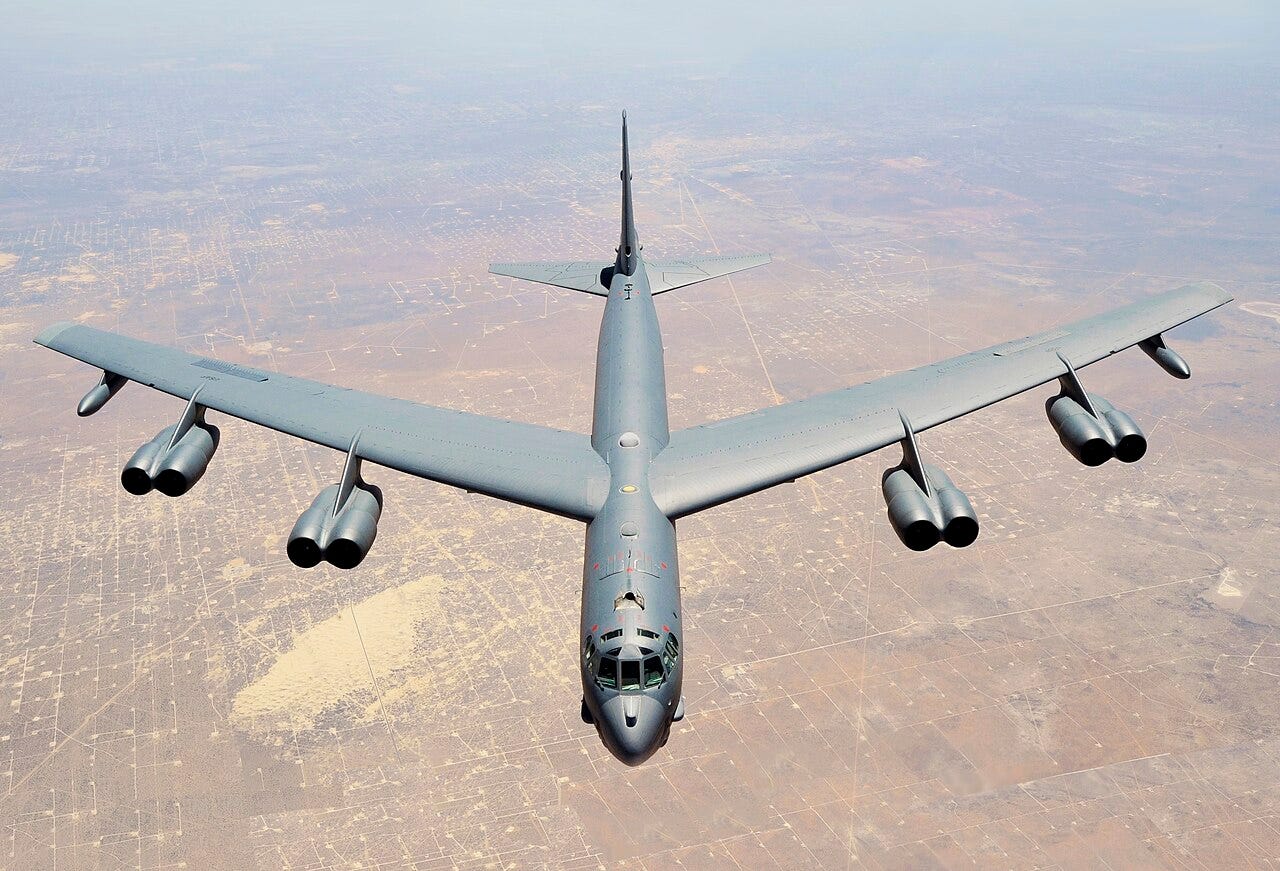
The Next B-52 Bomber: Analyzing the Alternatives
The B-52 System Improvements project, as it’s called, is more than just a tune-up for an old warbird. The Air Force has set out on a sweeping mission: to keep the legendary Stratofortress not just flying, but dominating, ready for whatever tomorrow’s skies might bring.
This isn’t just about swapping out a part here or bolting on a new gadget there. We’re talking a top-to-bottom overhaul. Think Advanced Wing Weapon Pylons (AWWP), integrating cutting-edge missiles like the LRASM and JASSM, and pushing the envelope with advanced weapon systems.
But the real headline? The Heavy Bomber Analysis of Alternatives. For the first time, there’s talk of what might come after the B-52, a study launching in FY27 to size up the long-range strike game. Will the Air Force stick with the old champ, or is it time for a new contender to take the stage?
Meanwhile, behind the hangar doors, there’s been a hush-hush Advanced Concept Demonstration—a classified proof-of-concept that wrapped up in FY25. No peeks, no details, just hints and possibilities.
The money trail tells its own story: $1 million is set aside in FY27 for the bomber study, while last year’s demonstration drew nearly $4 million. Now, all eyes are on the future, and the only certainty is that the next chapter for America’s heavy bombers is still being written, high above the clouds.
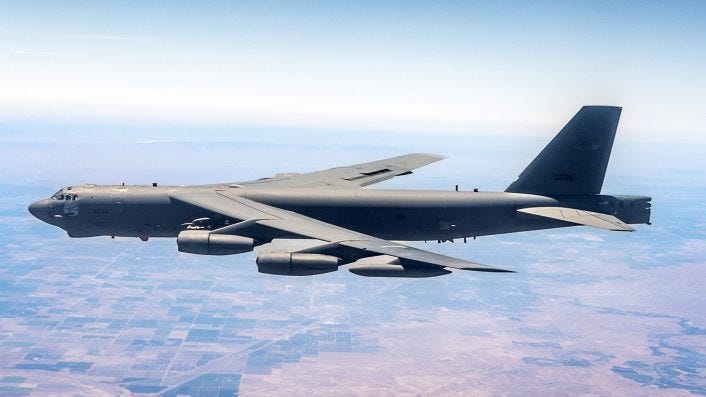
The Future of the Bomber
The B-52 Stratofortress—America’s legendary airborne heavyweight—has been carving contrails across the skies since the dawn of the jet age. And believe it or not, she’s nowhere near ready for retirement.
In fact, the Air Force expects these titans to keep flying until at least 2050. Imagine that: by the time the youngest B-52 finally parks for good, it’ll have outlived not only its own generation, but even the sleeker B-1B Lancer and the futuristic B-2A Spirit bombers that once threatened to steal the spotlight.
Here’s the game plan: the Air Force is betting big on a mixed fleet: 76 modernized B-52Js teaming up with over 100 of the stealthy, next-gen B-21 Raiders. Once the B-21 enters the fray, the Stratofortress’s mission shifts; she’ll hang back and unleash standoff strikes, letting the new kid on the block handle the sneaky stuff up close.
But to stay relevant in this new era, the B-52 needs more than a fresh coat of paint. She’s getting a major overhaul, transforming from the B-52H to the B-52J. The path hasn’t exactly been smooth; delays and development hiccups have made headlines. But the commitment is clear: the Air Force isn’t letting go of its old warhorse just yet.
Two upgrades stand out above the rest. First, the Radar Modernization Program: Raytheon’s AN/APQ-188, a state-of-the-art AESA radar, is replacing the relic AN/APQ-166 that’s been humming since the Cold War.
Borrowing technology from Navy Super Hornets and Air Force Eagles, this radar brings sharper eyes, better target tracking, and the kind of digital muscle that keeps the B-52 in the fight, whether that’s tracking moving targets on the ground or scanning for threats in the air.
Next up, the Commercial Engine Replacement Program. Out go the ancient Pratt & Whitney TF33s: stalwarts since the ‘60s, but well past their prime. In come Rolls Royce F130s, descendants of engines found in luxury Gulfstreams, promising more range, less maintenance, and a cleaner burn. The new engines look familiar but pack a modern punch, sitting closer to the wing for better aerodynamics.
The upgrade rollout starts in 2026 or 2027, with the first B-52Js ready for action by 2033. Full re-engineering wraps up by 2036. The radar’s big debut is still under wraps. But one thing’s certain: the B-52’s saga is far from over. It’s just taxiing out for its next mission.
After the Stratofortress: America’s Next Heavy Bomber Question
The mighty B-52 Stratofortress, that iron-winged legend of American airpower, is getting a new lease on life: fresh engines, modern guts, still roaring into the sunset. But somewhere in a Pentagon conference room, a new story is quietly preparing for takeoff. The United States and its allies are already plotting what comes after the B-52J, even as the old bird gets its upgrades. In 2027, the Air Force will huddle for a Heavy Bomber Analysis of Alternatives, deciding if the future belongs to souped-up B-52s or a yet-unseen heavy bomber built for tomorrow’s skies.
This isn’t just about swapping out old airframes. It’s about keeping a long shadow over the world’s tough neighborhoods, where China, Russia, and others are raising the stakes with their own missiles and fortress-like defenses.
The B-21 Raider, a stealthy ghost, is set to become the backbone of America’s bomber fleet, but the B-52 brings what Hollywood would call “presence”—endurance, payload, and that unmistakable silhouette on the horizon.
For America’s friends in NATO and across the Indo-Pacific, this means the bomber umbrella stays open. U.S. bombers mean reassurance, headaches for rivals, and a fast-moving response force that doesn’t need to park on every runway overseas.
The B-52J will keep flying, but the first whispers of its successor are already in the air—a cinematic prelude to the day a new aviator’s story takes flight.
This Week in Aviation History
27, May 1931: At Langley Field in Virginia, the world’s first full-scale wind tunnel threw open its massive doors, sixty feet wide, thirty feet high, ready to shape the future of flight. Inside, everything from WWII fighters to space capsules and submarines braved the artificial gale, their secrets revealed in the roaring wind.
Wind tunnels have always been the aviator’s crystal ball, letting designers peer into the unknown before their birds ever left the ground. Even the Wright brothers, chasing their dream of powered flight, crafted their own six-foot wind tunnel to test wings before making history in 1903.
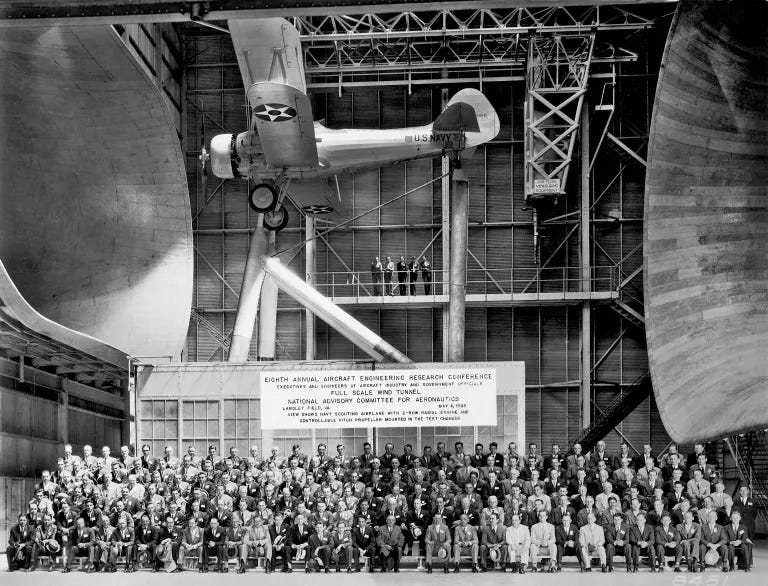
Wind Tunnel Lets Airplanes ‘Fly’ on Ground
It is the Roaring Twenties, aviation’s golden dawn, out in Hampton, Virginia, the National Advisory Committee for Aeronautics—NACA, the grandparent of NASA—was dreaming bigger than ever at its Langley Memorial Aeronautical Laboratory.
Their first wind tunnels gave them a taste for aerodynamic adventure, but those early tunnels just whetted their appetite. After seeing what the Propeller Research Tunnel could do with its big test section, the engineers decided to aim for the sky, literally. They set out to create a wind tunnel massive enough to swallow a whole airplane and lay bare its aerodynamic soul.
Enter Smith J. De France, a man with vision and nerves of steel. In 1929, as the world teetered on the edge of the Great Depression, NACA seized the moment, stretching their budget on cheap materials and snapping up a brigade of talented, suddenly unemployed aeronautical engineers.
Construction moved at a clip, and by May 1931, the Full Scale 30- by 60-Foot Tunnel (FST) was ready for action. Its dedication at the Sixth Annual Aircraft Engineering Conference was a spectacle: the world’s largest wind tunnel stood with its steel skeleton visible to all, a colossus measuring 434 feet long, 222 feet wide, and 97 feet tall—a new landmark at Langley and a beacon for every aviator’s ambition.
As the decades rolled on, the FST became a stage for the next acts of flight. In the postwar 1950s, engineers put cutting-edge ideas through their paces: swept wings, delta shapes, and boundary-layer tricks for low-speed performance.
But this wasn’t just about airplanes. Dirigibles, submarines, radar antennae, gliding parachutes, inflatable planes (even entire wind tunnels) took their turn in the FST’s artificial hurricane.
Jet engines eventually outran the tunnel’s top speeds, but the FST never lost its place in the spotlight. When NASA took the reins in 1958, shifting priorities sparked something new—remote-controlled, free-flying models dancing through the vast test section, bigger and bolder than ever before. Suddenly, radical designs got their moment in the sun, tested with a realism that matched the dreams of their creators.
In the grand sweep of aviation history, the FST wasn’t just a wind tunnel. It was a proving ground for every wild idea and a launchpad for the future of flight.
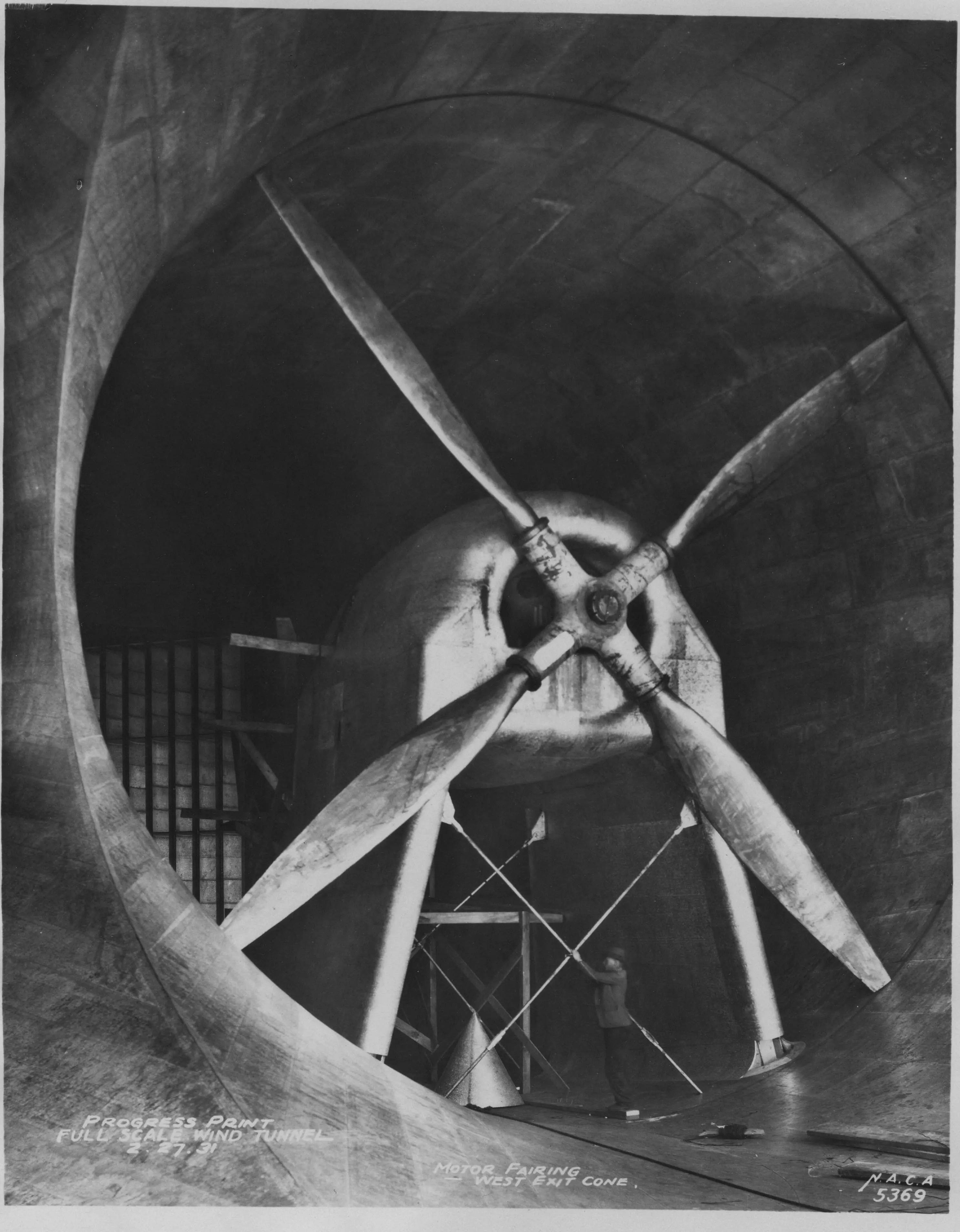
Where Wings Meet the Wind: Features of the Wind Tunnel
Step into the Full-Scale Tunnel and you’re entering the set of a true aviation epic. Its semi-elliptical test section soars 30 feet high and 60 feet wide, with nothing but open air around the wings.
That meant even aircraft with wingspans up to 40 feet could face the wind head-on, as two massive 35-foot propellers—each spun by a thunderous 4,000-horsepower motor—sent air swirling through the tunnel at anywhere from a breezy 25 to a stormy 118 mph.
The air followed a clever double-return path, splitting into left and right streams that looped around the building, perfectly tuned by rows of airfoil-shaped vanes so that the test section saw only the smoothest, steadiest currents—less turbulence than the older tunnels ever managed.
Planes were mounted atop a six-component strut system, each movement and force meticulously measured by dial-type scales that could read every ounce of air pressure. Early calibrations used real aircraft that also took to the skies, letting engineers compare tunnel data with actual flight results. It worked so well that the tunnel quickly became a national testing treasure, shaping generations of aviation and space research for nearly eighty years.
At first, the focus was on how every part of a plane. Its geometry, construction methods, and those seemingly harmless little bumps changed drag and cooling. The winds soon revealed that even the smallest protrusions could steal performance in ways few expected. In 1938, the Navy’s Brewster F2A-2 Buffalo arrived at Langley, stuck at a sluggish 250 mph.
After engineers hunted down every drag-inducing detail (landing gear, exhaust stacks, gun mounts), they recommended fixes that turned the Buffalo into a contender, giving it a 31-mph boost. That’s the magic of the Full-Scale Tunnel: where every airplane faces the wind and comes out stronger.
The Wind Tunnel’s Lasting Legacy
Picture the dawn of aviation, when flying was more dream than science. It is a wild leap into the unknown. Then, in 1931, Langley’s 30-by-60-foot Full-Scale Wind Tunnel roared to life, a colossal cathedral of wind where real airplanes, not just models, met the invisible currents head-on. Suddenly, flight wasn’t just a hunch; it was a calculation.
When war clouds gathered, this tunnel became the proving ground for every U.S. warbird with a future in the sky. Round-the-clock, mechanics and pilots hustled beneath the cavernous fans as engineers chased the secrets of speed and survival.
Drag was the enemy; the wind tunnel became the crucible. Tests here scrubbed off precious seconds and saved countless lives by helping aircraft slip faster, farther, higher.
But Langley’s reach soared beyond dogfights and bomb runs. Its culture of full-scale testing shaped everything from rotorcraft to reentry vehicles. Anything daring the air to resist.
Though the tunnel’s doors eventually closed, its spirit endures. The Smithsonian’s preserved fan blades whisper of the days when steel giants first learned to fly before ever leaving the ground.
Today’s stealth jets and tomorrow’s dream machines all owe a debt to that wind-borne legacy. Langley proved an eternal truth: every aircraft’s fate is first written in the wind.
In Case You Missed It
Photo Outlet
Every issue of Hangar Flying with Tog gets you a free image that I’ve taken at airshows:
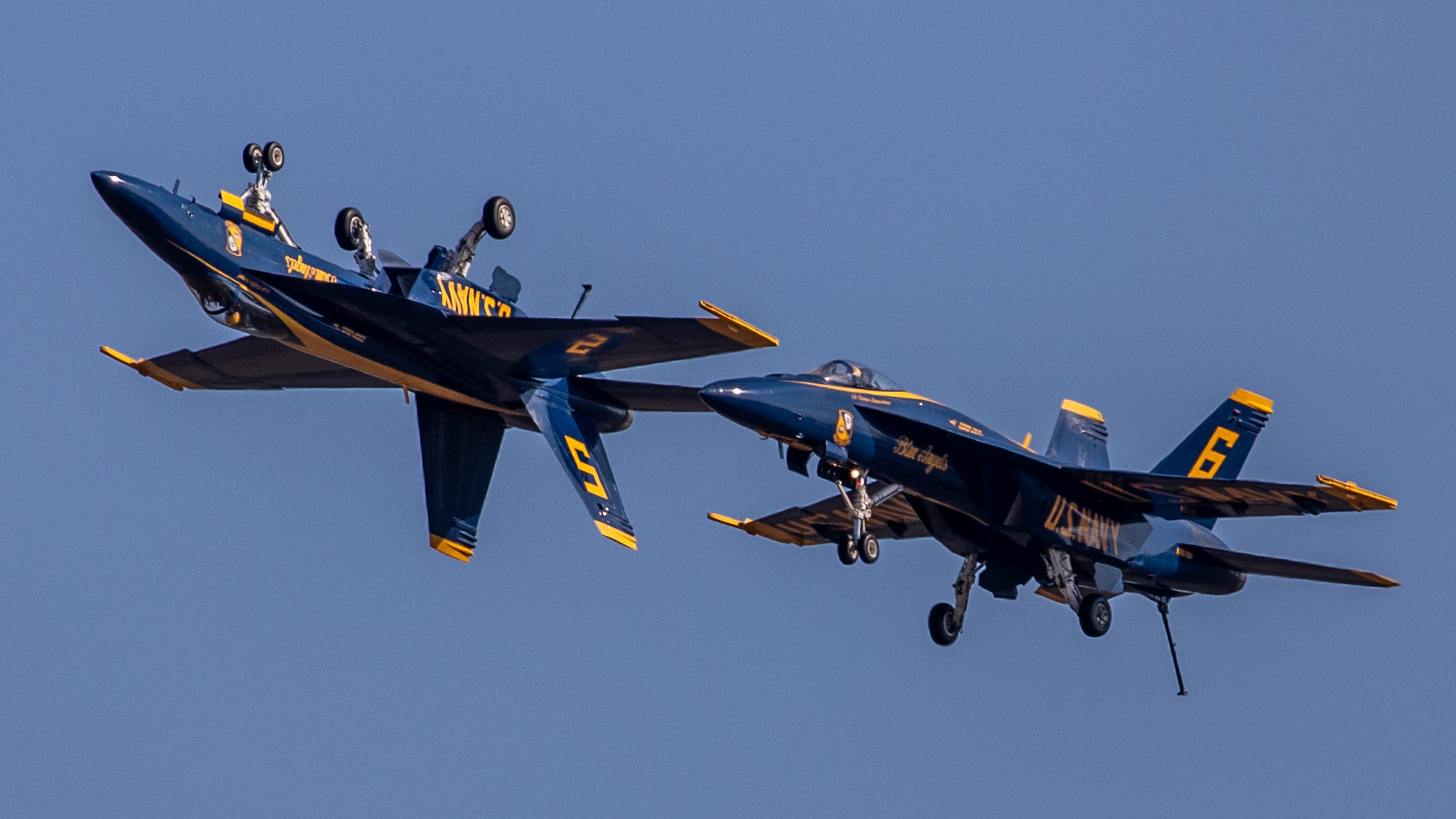
Feel free to use these photos however you like. If you choose to tag me, I am @pilotphotog on all social platforms. Thanks!
Post Flight Debrief
Like what you’re reading? Stay in the loop by signing up below—it’s quick, easy, and always free.
This newsletter will always be free for everyone, but if you want to go further, support the mission, and unlock bonus content like the Midweek Sortie, consider becoming a paid subscriber.
Your support keeps this flight crew flying—and I couldn’t do it without you.
– Tog