

US Air Force Just Showed Off Their New V-25B Bridge Aircraft and Remembering RAF R-34’s First Transatlantic Flight
From the R34 to the VC-25B, aviation has always carried national confidence, continuity, and the dream of crossing dangerous gaps—whether those gaps are oceans, eras, or aging fleets.
“This will be a flyover on July 4th I think I can say the likes of which we’ve never seen before.”
—U.S President Donald Trump
Mission Briefing
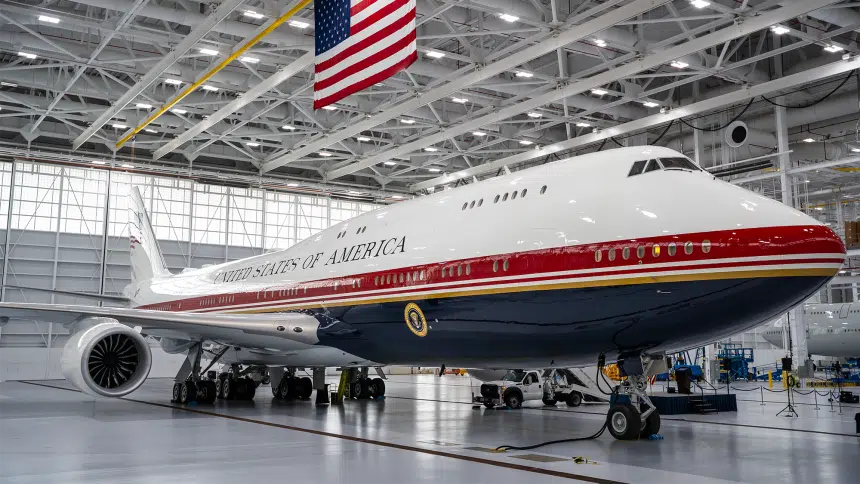
Fresh off a hush-hush midnight landing at Joint Base Andrews earlier this June, the VC-25B Bridge—an ex-Qatari 747-8 transformed at breakneck speed—finally steps into the spotlight. The U.S. Air Force has pulled back the curtain, revealing the jet in its crisp service colors for the world to see. It’s a moment straight out of a movie: a storied aircraft getting its star turn after a covert arrival.
The Bridge Aircraft Unveiled
After a whirlwind conversion process that left many skeptics shaking their heads, the U.S. Air Force has officially unveiled the VC-25B Bridge. It is a jet that’s as fascinating in its story as it is striking on the tarmac.
Unlike the painstaking, years-long modifications underway for the two standard VC-25Bs at Boeing, the Bridge’s transformation was a fast-tracked operation.
The secret? Its plush Qatari VIP origins. The aircraft’s interior required only minimal tweaks since it was already dripping with luxury, arguably outshining even the current VC-25A, which is more about serious business than lavish comfort.
Speculation is swirling in aviation circles: will the VC-25B Bridge’s first presidential flight be the much-anticipated journey to Mount Rushmore for the nation’s 250th birthday bash?
While nothing is set in stone, President Trump made waves at the unveiling, announcing that the jet will star in the July 4th flyover above Washington D.C., soaring in formation with cutting-edge F-22 Raptors, F-35 Lightning IIs, and a cast of military heavyweights. It’s a blockbuster entrance for an aircraft that’s already earned legendary status before even carrying its first Commander in Chief.
General Ken Wilsbach, Air Force Chief of Staff, delivered a victory speech worthy of a movie script: “Many thought it could not be done, but the United States Air Force was able to execute and provide a secure, reliable airborne command post on an accelerated timeline.”
The Bridge isn’t just a pretty face. Behind those luxury seats, the Air Force has woven in advanced communications and self-defense systems, though whether it’s ready for globe-trotting presidential missions is still under wraps.
Secretary of the Air Force Troy Meink underscored the meticulous balancing act: “We meticulously evaluated every requirement to accelerate delivery while maintaining the high standards expected of the presidential mission. This effort proves that the U.S. Air Force can move fast without sacrificing quality, security, or reliability.”
The dramatic reveal of the newly painted VC-25B Bridge comes hot on the heels of what appears to be the final major Presidential journey for 92-9000, one of the two stalwart VC-25As.
The White House team celebrated the aircraft’s legacy after it ferried President Trump home from the G7 Summit in France, painting a poignant picture on social media.
Though the VC-25A will soldier on in service for now, all signs point to 82-8000 resuming its role as primary after an overhaul, with 92-9000 shifting gracefully into a supporting role, a torch quietly, but unmistakably, being passed.
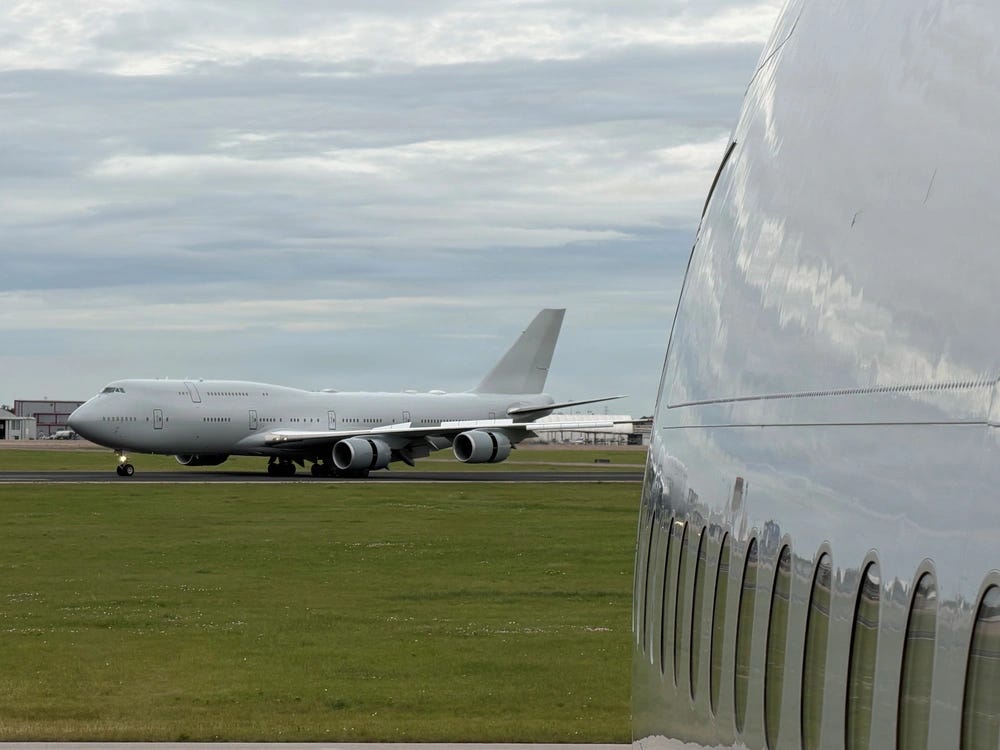
A Closer Look at the New V-25B Bridge Aircraft
Step inside the legendary “flying Oval Office,” where 4,000 square feet of airborne ingenuity unfolds like a scene from the golden age of flight.
Up here, above the clouds, the president’s world is a seamless blend of top-secret command center and private sanctuary. Whisper-quiet corridors lead to a suite with all the trimmings: a bedroom for a few hours’ shut-eye at 30,000 feet, a bathroom, an office, and a meeting space fit for history in the making.
Mission control? You bet. Senior staff can orchestrate global operations midair, with advanced comms lighting up the cabin so not a single message gets lost in the jet stream. The VC-25B, built on the mighty 747-8 frame, is more than a plane. It’s a fortress with wings, boasting extra room and upgraded tech to keep up with the world’s most demanding schedule.
Medical suite? Absolutely. There’s a mini-hospital tucked away, ready for anything, staffed and stocked with high-grade gear to handle emergencies without missing a beat.
Touching down at any airport, this bird doesn’t need ground support. Its systems are so self-sufficient, it could run a government summit from a tarmac in the middle of nowhere. And navigation? Think sci-fi: pinpoint accuracy, reliable in the stormiest skies or the darkest night.
Boeing’s masterpiece comes loaded with cutting-edge electronics, delivering real-time, ironclad communications so the president is always plugged in. No blackout, no downtime, no matter how high, how far, or how turbulent the world gets.
Air Force One’s Bridge Across Uncertainty
When the VC-25B Bridge rolled onto the tarmac, it wasn’t just about fresh paint or another notch in Air Force One’s storied legacy. This was a signal. A promise that, even as the old fleet ages and the shiny new VC-25Bs linger in development limbo, America’s leader won’t be grounded.
The interim 747-8 steps in as a winged safety net, letting Washington’s top brass travel, command, and connect whether it’s a handshake across the world or a scramble during crisis.
For America’s allies, the message is clear: Air Force One is far more than a ride. It’s a high-flying emblem of U.S. commitment. Each touchdown in Europe, the Indo-Pacific, or the Middle East is a reminder. America’s leadership is mobile, present, and ready to answer the call, modernization hiccups or not.
The Bridge aircraft itself is a lesson in flexibility. Born in Qatar, refitted in record time, it’s sparked debate at home about politics and security. But above all, the Air Force frames it as a stopgap that puts mission first, proof that sometimes you need to improvise while waiting for the future to catch up.
This isn’t the final chapter. It’s a crucial pause, a moment where power adapts midflight. And looming on the horizon is the bigger question: when the president’s jet, national pride, and industry delays all converge, who gets cleared for takeoff?
This Week in Aviation History
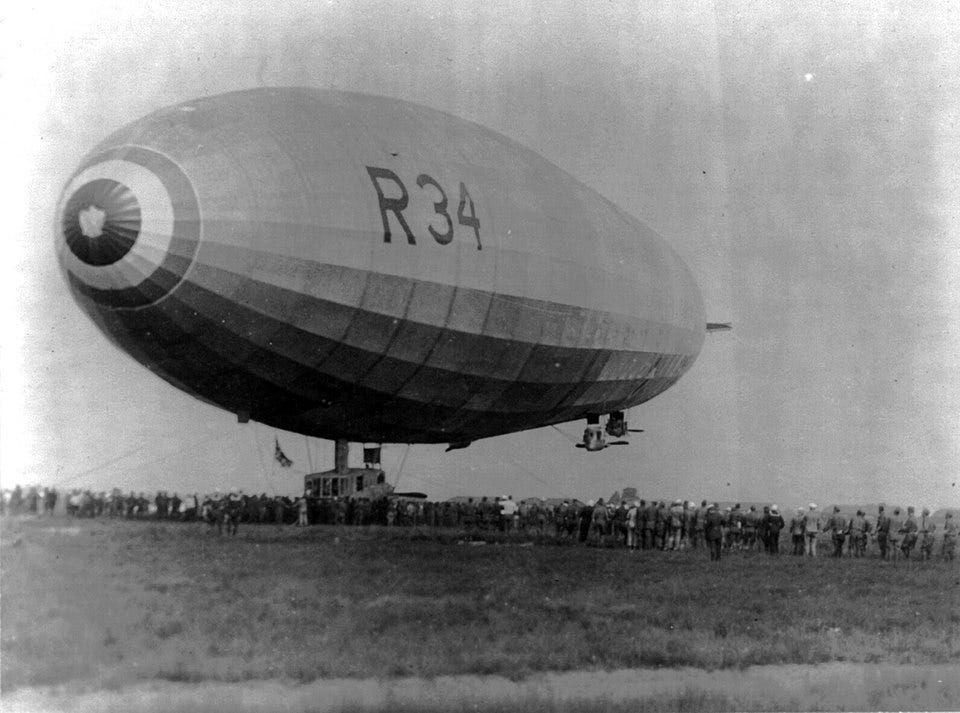
On 2 July 1919, the mighty Airship R34 soared out of East Fortune Airfield and, on July 6th, the aircraft touched down on Long Island, New York. This epic crossing marked the first time anyone had flown from Britain to the United States—history written in the clouds.
RAF R34’s First transatlantic flight
On a chilly, fog-laced morning—2 July 1919, 1:42am—the airship R34 rose from East Fortune, its silver hull slicing through the mist. At the helm were eight officers and 22 men, fueled by daring, joined by an unexpected trio: a stowaway, two pigeons, and a mischievous kitten named Wopsie.
Their mission? To etch history as the first to complete a round-trip flight across the Atlantic, bridging Britain and the United States by air.
The world was still reeling from Alcock and Brown’s legendary west-to-east crossing just weeks prior. Now, the R34 was about to attempt what no one had done before: an east-to-west journey across the ocean’s wildest skies.
The airship itself was a marvel. 643 feet long, affectionately dubbed “Tiny” despite its enormous size. Built at Inchinnan near Glasgow, R34 had missed the Great War but had proven herself over the Baltic, flexing Britain’s aerial muscle before peace settled over Europe.
East Fortune, once a Royal Naval Air Station and now the National Museum of Flight, served as R34’s launchpad. No camera caught her departure, but British artist David Weston’s painting immortalizes the moment; capturing the ship’s immense scale as it drifted into adventure.
Their destination: Mineola, Long Island. Its wide meadows and steady winds made it the aviator’s promised land after four and a half days (108 hours and 12 minutes) of battling fierce squalls, rationing dwindling fuel, and patching a leak with nothing but the crew’s chewing gum reserves.
The R34 touched down at 9:54am on 6 July 1919. But not before another first: Major Pritchard parachuted down to greet the awestruck ground crew, marking the inaugural arrival in America by air.
And then, there were the stowaways. William Ballantyne, a Newcastle man and former crew member, snuck aboard, sharing cramped quarters with Wopsie the cat. The first human and feline to sneak across the Atlantic by air.
When her American adventure was done, R34 charted a course back to Britain, landing at Pulham in Norfolk. The journey had been fraught with danger and wonder, but above all, it was a triumph of human spirit and ingenuity, a true cinematic saga of the skies.
Airship’s Design and Construction
The story of the R34’s construction is, in some ways, as mysterious as it is fascinating. Much of the intricate record-keeping vanished forever in the chaos of WWII.
Beardmore Factory and its archives were lost to a ferocious German bombing raid in 1941. What remains are fragments and memories, but even these scattered details reveal a marvel of early aviation engineering.
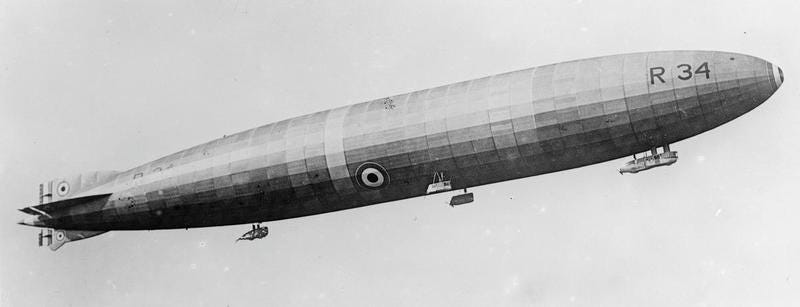
Like her sister ships of the era, R34’s skeleton was a masterpiece of practicality and ingenuity. The entire framework was varnished, a glossy armor against the ever-present threat of atmospheric corrosion, and the structure was laced with a complex web of bracing wires.
Between each pair of frames, linen fabric was stretched taut and fixed in place with laces, then overlain with glued strips to keep everything sleek and secure. The airship’s hull was painted with a special “dope” mixed with aluminum powder.
Not just for show, but to bounce back the sun’s rays and keep the interior from overheating during long flights under the open sky.
Inside her vast frame, nineteen huge gasbags filled every available chamber formed by the airship’s girders and frames. These gasbags were crafted from a single layer of rubber-proofed cotton, varnished and lined with goldbeaters’ skin; a material so fine and delicate, it was once used in the making of early balloons.
Cord mesh surrounded each gasbag, a protective cradle to keep them from rubbing against the girders during turbulent stretches above the ocean.
Hanging beneath the main body, the R34 sported four small gondolas, each suspended with long wooden struts and braced with rigging wires, a design borrowed from the earlier R33.
The forward gondola looked like one continuous pod, about fifty feet long, but it was actually split into two, separated by a narrow gap. The reason? To keep the vibration of the big engine from interfering with the wireless telegraph equipment; a clever solution for the age.
In the nose, you’d find the control room and a compact wireless cabin, with a long aerial trailing below during flight.
The control cabin was built for both visibility and safety, featuring Triplex glass panels and sturdy handling rails. Here, the pilots managed an array of wheels, toggles, and instruments—steering, elevator controls, gas valves, engine telegraphs, and even emergency ballast toggles.
A ladder, sheltered by a streamlined canvas, connected the cabin to the ship’s central keel, while another covered conduit protected the maze of control wires leading into the hull above.
Powering this floating giant were five Sunbeam ‘Maori’ engines—a design by French engineer Louis Coatalen, built in Wolverhampton especially for airships. They weren’t quite as refined as the Rolls-Royce engines used in earlier airships, but wartime priorities meant all Rolls-Royces were reserved for planes.
Each engine came with a hand starter and a clever Hele-Shaw dog-clutch system, allowing crew to safely start, warm up, or repair engines mid-flight. If an engine stopped, its propeller could freewheel in the wind to cut down drag, or a special brake could hold it still for delicate maneuvers like landing.
Every line, every rivet, every ingenious workaround tells the tale of the R34. It is a marvel of courage, creativity, and technical ambition, built to conquer the skies.
The Airship That Turned the Atlantic Into a Sky Road
The R34 wasn’t just a hulking piece of sky machinery, it was the world’s first real passport across the Atlantic. R34 is a British airship built for war but destined for adventure, slicing through clouds from east to west.
No one thought an ocean could become a sky road, but there she was, a silver giant drifting into legend, not just surviving the trip, but daring to return the way she came.
Inside this behemoth, it was no smooth ride. The crew, a motley band of officers, mechanics, and a surprise stowaway (plus a cat named Wopsie!), faced storms, fuel running low, and endless uncertainty.
Every mile was a gamble, every engine cough a heartbeat skipped. They patched and prayed, charted and cheered, proving that flying over oceans was never meant to be comfortable. Just possible, if you had enough guts and stubbornness.
The R34’s journey wasn’t only about distance; it was about making skyways out of barriers. For a brief, shining moment, Britain stood atop the world, showing flight could connect continents and carry more than just people; ideas, hope, pride.
Sure, airships faded into history, but every jet streaking across the Atlantic today owes a debt to that first wild crossing. The R34 didn’t just cross the ocean. It changed what the sky could mean.
In Case You Missed It
Photo Outlet
Every issue of Hangar Flying with Tog gets you a free image that I’ve taken at airshows:
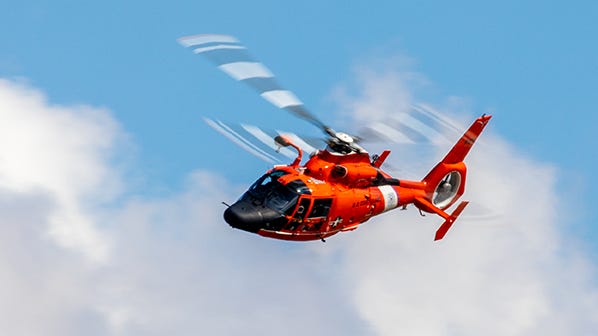
Feel free to use these photos however you like. If you choose to tag me, I am @pilotphotog on all social platforms. Thanks!
Post Flight Debrief
Like what you’re reading? Stay in the loop by signing up below—it’s quick, easy, and always free.
This newsletter will always be free for everyone, but if you want to go further, support the mission, and unlock bonus content like the Midweek Sortie, consider becoming a paid subscriber.
Your support keeps this flight crew flying—and I couldn’t do it without you.
– Tog