

The Ghost Bat’s First Flight in the US and When Pioneer 10 crossed Neptune’s Orbit
From Pioneer 10’s deep-space pathfinding to MQ-28’s allied autonomous flights, machines go first—testing distance, risk, and new frontiers before humans follow.
MQ-28 just went international! Three flights from Point Mugu proved rapid allied deployment, autonomous ops and payload integration — paving the way toward exportable uncrewed capability.
—Boeing Defense
Mission Briefing
Boeing just tipped their hat—turns out the MQ-28 Ghost Bat has soared through three daring test flights over California’s Point Mugu Sea Range, far from its home turf in Australia. The sky’s the limit now, as this ghostly bird stretches its wings across new horizons.
Ghost Bat Breaks Stateside: New Skies for a Maverick Machine
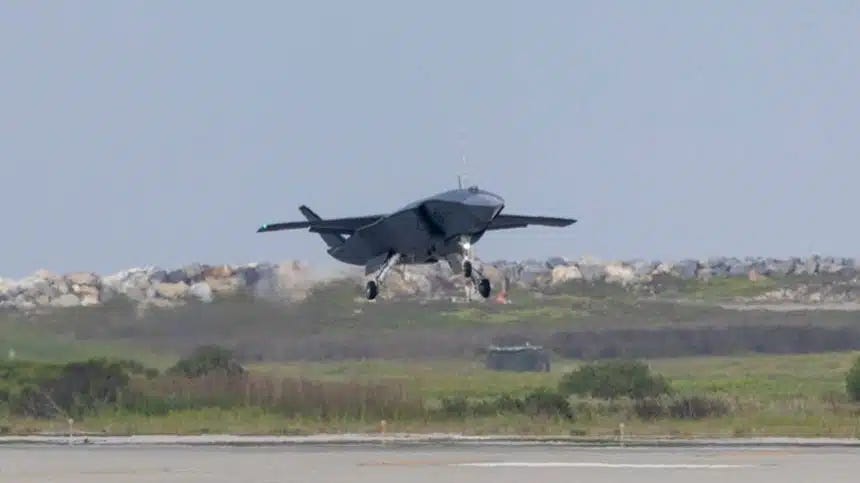
On 27 May 2026, Boeing made headlines by announcing the MQ-28 Ghost Bat has officially taken to American skies, marking its first flights outside its native Australia. In this very land, it was dreamed up and built by Boeing’s Australian team.
The Ghost Bat, a sleek, uncrewed aviator, slicing through the Pacific airspace above California’s Point Mugu Sea Range, not once but three times, as part of its operational test campaign at the legendary U.S. Naval Base Ventura County.
These flights weren’t just for show. The mission? Prove the Ghost Bat could think for itself and operate autonomously, all while demonstrating that it can be rapidly deployed and sustained from any allied outpost.
Boeing’s message was crystal clear: the world is watching, and interest in autonomous combat aircraft is taking off. These U.S. flights aren’t just a technical milestone. They’re a signal to global partners that the Ghost Bat is ready to spread its wings beyond the Outback, opening the door for future exports and international collaborations.
Glen Ferguson, the program’s global director, summed it up: Point Mugu’s test flights are a proving ground, not just for the Ghost Bat’s flight systems, but for the entire idea of deploying next-gen tech from remote, allied locations.
While Boeing kept the flight dates under wraps, aviation sleuths already spotted at least one Ghost Bat at NAS Ventura County in a video from December 2025, following a visit from U.S. Secretary of War Pete Hegseth.
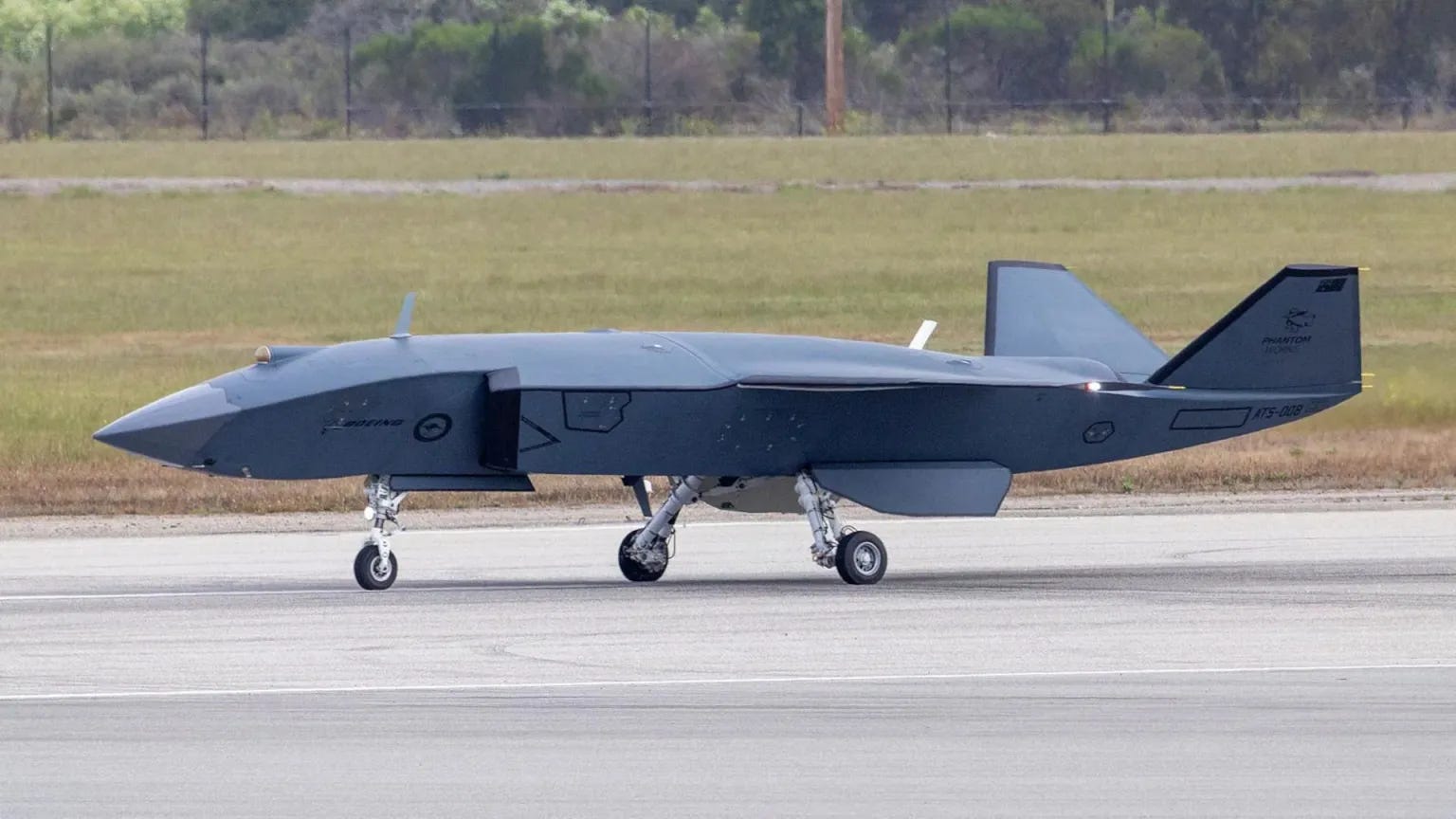
That clip showed an early model dressed in high-visibility orange stripes, while the latest footage reveals a more recent, all-gray ATS-008 variant, sporting a nose-mounted IRST sensor and the Phantom Works insignia on its tail—details sure to quicken any aviation buff’s pulse.
Let’s not forget: before these U.S. sorties, American Navy test pilots flew out to Australia to get hands-on with the Ghost Bat, working alongside their Aussie counterparts. Whether those same pilots took the stick (or, more accurately, the console) during the Point Mugu flights remains a mystery shrouded in California mist.
One thing’s for sure, the Ghost Bat’s journey has just begun, and the sky’s looking wide open ahead.
The Anatomy of the Ghost Bat
The MQ-28 Ghost Bat, originally dubbed the Boeing Airpower Teaming System (ATS), was crafted by Boeing Defence Australia for the Royal Australian Air Force to operate as a multirole, unmanned wingman alongside piloted jets.
Dreamed up back in 2013, the Ghost Bat made its grand debut at the 2019 Australian Airshow, turning heads before its first flight at the vast Woomera Range Complex in southern Australia on February 27, 2021.
This isn’t your average drone. It’s a next-gen Loyal Wingman, built with brains and brawn. Its 1.5-cubic-meter nose was designed for versatility, ready to swap out payloads to handle ISR (Intelligence, Surveillance, Reconnaissance), aerial radar sweeps, electronic warfare, or even to carry attack munitions.
Over 55 Aussie companies lent their expertise to bring this vision to life, and by February 2024, the program had already pulled in a hefty $600 million in funding.
The Ghost Bat is all about teaming up, powered by artificial intelligence that lets it coordinate seamlessly with crewed military aircraft. Think of it as the size of a lightweight fighter, sporting side air intakes, striking cranked-kite wings, and canted V-tails.
Built to go the distance, with a range approaching 3,200 kilometers, and the smarts to fly solo if needed. Artistic renderings show this stealthy bird flying in loose formation with E-7A Wedgetail AEW&C aircraft and even F-15EX fighters, ready to slip into a supporting or special-mission role on demand.
Glen Ferguson, leading the MQ-28 global charge, spells out the action: a launch operator oversees takeoff, but once airborne, Ghost Bat is handed over to the crew of a manned aircraft—anything from an E-7A to an F-35A or F/A-18F—who then task it for missions like surveillance or reconnaissance.
This teamwork, called Manned-Unmanned Teaming (MUM-T), doesn’t always mean flying wingtip-to-wingtip; sometimes, Ghost Bat operates dozens of kilometers away, depending on what the mission calls for.
Stealth is the name of the game, with three different nose options shown in Boeing’s concept art: one packing an IRST sensor, others likely for ISR or electronic warfare, ready to jam or hunt enemy radars.
Ghost Bat can also play guardian, escorting critical assets like Wedgetails or KC-30 tankers. Whether it’s considered expendable tech or a backbone for manned platforms is still up in the air. But when the mission wraps, Ghost Bat returns to its launch operator for a smooth touchdown, ready to be prepped for the next adventure.
Ghost Bat Goes Allied
The Ghost Bat’s maiden flights over American soil are more than just a feather in Boeing’s cap. They’re the opening scene of a new era in allied airpower. For Australia, seeing their homegrown, uncrewed marvel soar above California is proof positive that years of R&D and partnership with Boeing Defence Australia are bearing global fruit.
The Ghost Bat isn’t just an Australian experiment anymore; it’s fast becoming a contender for export and a game-changer in future coalition air campaigns.
Stateside, the Point Mugu flights prove this autonomous bird can slip seamlessly into America’s rigorous test ranges and could soon fit into the pulse of U.S. combat operations.
The Ghost Bat isn’t here to replace pilots, but to serve as a loyal wingman. Stretching sensor range, hauling mission gear, and shouldering risk where the skies get dicey. Boeing’s trials showed the jet could deploy quickly, operate on its own, and stick around for the long haul. All big, bold checkmarks for global partners eyeing next-gen airpower.
Together, Australia and the U.S. are writing the script for a future where allies don’t just share runways. They build the autonomous machines that will fly side by side in tomorrow’s battles.
This Week in Aviation History
Pioneer 10 was NASA’s first mission to the outer planets. The mission was a spectacular success and the spacecraft notched a series of firsts unmatched by any other robotic spacecraft to date. Crossed the orbit of Neptune to become the first human-made object to go beyond Neptune.
What is Pioneer 10?
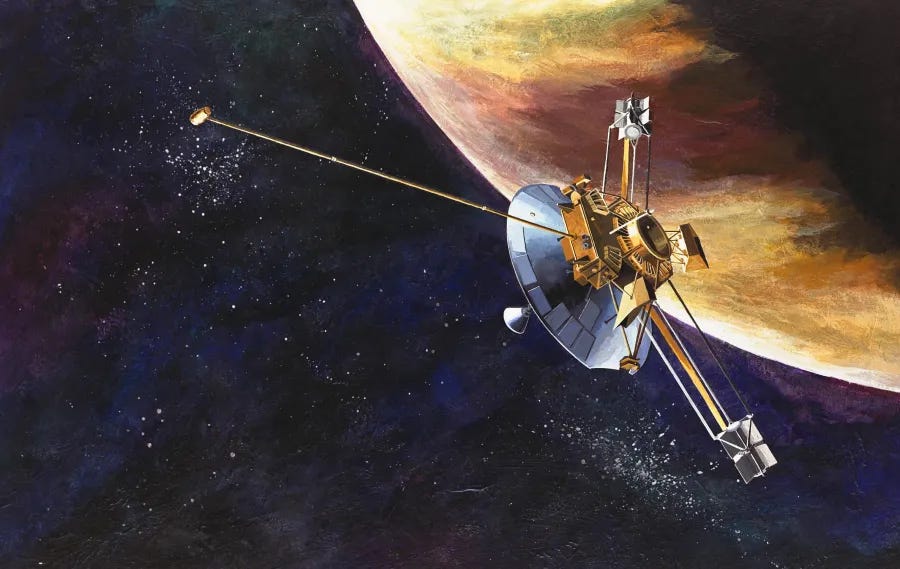
Picture the early 1970s, the dawn of interplanetary adventure, when NASA’s Pioneer 10 stole the spotlight as the first robotic pathfinder headed for the mysterious outer planets. From the moment it thundered off the launchpad atop an Atlas Centaur rocket. Its third stage a modified engine from the Surveyor moon lander.
Pioneer 10 was destined for the record books. This spacecraft wasn’t just on a mission; it was writing the playbook: the first to break Mars’ orbit, the first to brave the asteroid belt, the first to pierce Jupiter’s swirling storms, and, ultimately, the first man-made probe shot toward the stars, on a trajectory out of the solar system and into the cosmic unknown.
Powered by two compact nuclear generators (SNAP-19 RTGs) humming with about 140 watts during its Jupiter flyby, Pioneer 10 zipped through space at a then-unmatched 32,110 miles per hour.
After a couple of mid-course tweaks, the probe threaded its way through the asteroid belt; dodging more rocks than anticipated and measuring the soft glow of Zodiacal light. Teaming up with its sibling, Pioneer 9, it captured data on a particularly fierce solar storm, showing just how wild the Sun’s temper could get.
But the real drama unfolded as Pioneer 10 closed in on Jupiter. On November 26, 1973, it crossed into Jupiter’s magnetic domain, recording a sudden drop in solar wind and a hundredfold temperature spike.
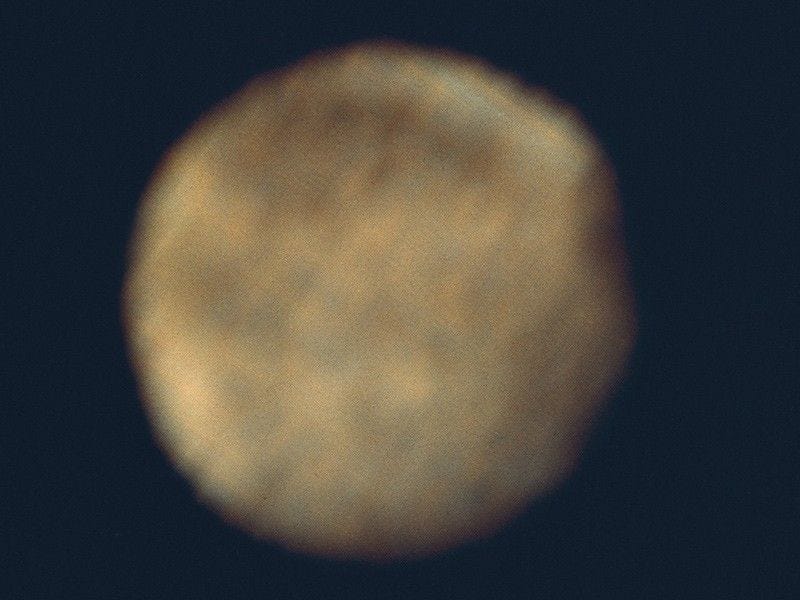
By December, Pioneer 10 was beaming back images better than Earth-based telescopes could dream of, capturing the planet’s iconic Great Red Spot and the swirling bands of its atmosphere. On December 4, it made its closest approach—racing past Jupiter at 78,000 mph, just 81,000 miles above the cloud tops, snapping hundreds of photos, and soaking up data from six of its eleven scientific instruments.
Not every moment was smooth sailing. Intense radiation fried its photopolarimeter before it could snap Io, but Pioneer 10 still managed flybys of Callisto, Ganymede, and Europa. It even ducked behind Jupiter for a radio experiment, peering into the giant’s secrets.
By journey’s end in January 1974, the probe had not only survived, but revealed plasma in Jupiter’s magnetic field and mapped the planet’s enormous magnetotail stretching all the way to Saturn. Still cruising strong, Pioneer 10 crossed Neptune’s orbit in 13 June 1983. The first of its kind to leave every planet behind, a true cosmic trailblazer.
What Happened After Neptune?
For more than twenty years, NASA kept its cosmic line open to Pioneer 10, routinely checking in until March 31, 1997, when the spacecraft was 67 astronomical units away; farther than any deep-sea call ever made.
Budget constraints ended those regular catch-ups, but Pioneer 10 wasn’t quite ready for a silent fade. As long as its nuclear heart—the RTG power source—held out, scientists would occasionally coax data from its Geiger tube telescope and charged particle sensors, chasing whispers from the edge of the solar system.
Pioneer 10 wore the crown as humanity’s farthest envoy until Voyager 1 took the lead in February 1998. Yet, Pioneer 10 kept going. NASA’s team caught a good signal in August 2000, and the probe sent its last full telemetry in April 2002.
Less than a year later, on January 23, 2003, a faint final signal, traveling 7.6 billion miles over more than eleven hours, reached Earth, a cosmic farewell. By then, the RTG’s power had ebbed, leaving the spacecraft’s radio silent. A final attempt to make contact in 2006 drew only static.
Not bad for a mission designed to last just 21 months. By November 2017, Pioneer 10 was a ghost ship, adrift about 11 billion miles from home, second in distance only to Voyager 1.
It’s now heading in the direction of Aldebaran, the red eye of Taurus, a stellar rendezvous set for two million years from now. Unlike the Voyagers and Pioneer 11, Pioneer 10’s course carries it upstream, straight into the nose of the heliosphere where the interstellar wind blows in.
And in case someone—or something—finds it, Pioneer 10 carries a golden greeting: a plaque etched with the images of a man, a woman, the solar system, and a cosmic map to Earth, using 14 pulsars as signposts.
Should intelligent life ever intercept this interstellar messenger, they’ll have all they need to figure out where this tiny relic came from and when it began its long, lonely journey.
Trailblazer Among the Planets: Pioneer 10’s Legacy
The legend of Pioneer 10 begins with a bold leap into the cosmic unknown. Launched in 1972, this plucky spacecraft became NASA’s first emissary to the outer planets, blazing a trail past Mars, threading through the asteroid belt, and racing by mighty Jupiter.
Its journey was a masterclass in trust. Engineers sent their robotic scout into a realm of countless hazards, from tumbling rocks to Jupiter’s punishing radiation. Though built for a 21-month adventure, Pioneer 10 lasted more than 30 years, signing off with a final whisper from 7.6 billion miles out in January 2003.
Pioneer 10’s flyby of Jupiter was a game-changer, delivering images and data that Earth-based gear could only dream of. Suddenly, Jupiter’s atmosphere, radiation, and magnetic mysteries were open books.
The mission also proved that radioisotope power could keep a spacecraft alive far from the Sun, clearing the runway for the deep-space missions that followed. But there was heart, too: a plaque on board turned Pioneer 10 into an interstellar ambassador, carrying humanity’s greeting to the stars.
Pioneer 10’s greatest legacy? Turning the outer solar system from distant dream into reachable reality. Every probe that has since chased the horizon—to Saturn, Uranus, Neptune, Pluto, and beyond—has soared through the door this trailblazer opened. In the grand story of space exploration, it’s proof that tomorrow’s greatest journeys always start with one small, daring step into the unknown.
In Case You Missed It
Photo Outlet
Every issue of Hangar Flying with Tog gets you a free image that I’ve taken at airshows:

Feel free to use these photos however you like. If you choose to tag me, I am @pilotphotog on all social platforms. Thanks!
Post Flight Debrief
Like what you’re reading? Stay in the loop by signing up below—it’s quick, easy, and always free.
This newsletter will always be free for everyone, but if you want to go further, support the mission, and unlock bonus content like the Midweek Sortie, consider becoming a paid subscriber.
Your support keeps this flight crew flying—and I couldn’t do it without you.
– Tog