

“Dark merlins are hunting machines, built for speed and aerodynamics.”
—GA-ASI President David R. Alexander
Mission Briefing
On 23 February 2026, General Atomics Aeronautical Systems christened its YFQ-42A drone with a name worthy of its promise—“Dark Merlin.” This wasn’t just a ceremonial gesture; it marked a pivotal transition as the craft left behind simple test flights and stepped boldly into the realm of true mission autonomy.
Now, “Dark Merlin” stands ready to prove itself not as a mere prototype, but as a future wingman in the evolving world of collaborative combat aviation.

When Dark Merlin Takes Wing
On February 23, 2026, General Atomics Aeronautical Systems revealed a name for its YFQ-42A drone: “Dark Merlin.” The choice is rich with meaning; the merlin, a nimble falcon, hunts in groups and is prized for its agility.
That’s no accident; it’s a nod to the vision of drones flying in formation with crewed aircraft, hunting together in the skies. But let’s set the record straight: this name isn’t yet stamped with the official approval of the US Air Force.
For now, “Dark Merlin” is a narrative anchor, a way to give personality to a prototype while the Air Force’s formal naming process remains down the runway.
That distinction matters, especially at this crossroads in the CCA (Collaborative Combat Aircraft) program. The Air Force hasn’t yet locked in the full structure of the fleet: industrial partners, production tempo, software standards, levels of autonomy, and budget priorities are all still in play.
Naming this drone “Dark Merlin” gives it a face at a moment when the service is still weighing how modular and flexible the next generation of airpower should be.
At its core, the CCA concept aims to solve a problem that’s plagued modern air forces: how to increase numbers, reach, and tactical options without endlessly ramping up the count—and cost—of piloted jets.
As part of the Next Generation Air Dominance vision, these drones are designed to fly alongside 5th generation fighters like the F-35A, and one day, their 6th generation successors.
The Air Force hopes to field a fleet of at least 1,000 CCAs in various roles: missile carriers, network extenders, electronic warriors, decoys, and scouts. Each designed to push risk onto unmanned platforms and keep human pilots where their judgment matters most.
But let’s not kid ourselves: the real challenge isn’t building a budget-friendly F-35 lookalike. It’s forging a team—a human-machine partnership—capable of outthinking, outmaneuvering, and outlasting anything a single aircraft could achieve, even in the chaos of tomorrow’s contested skies.
What Dark Merlin Brings to the Fight
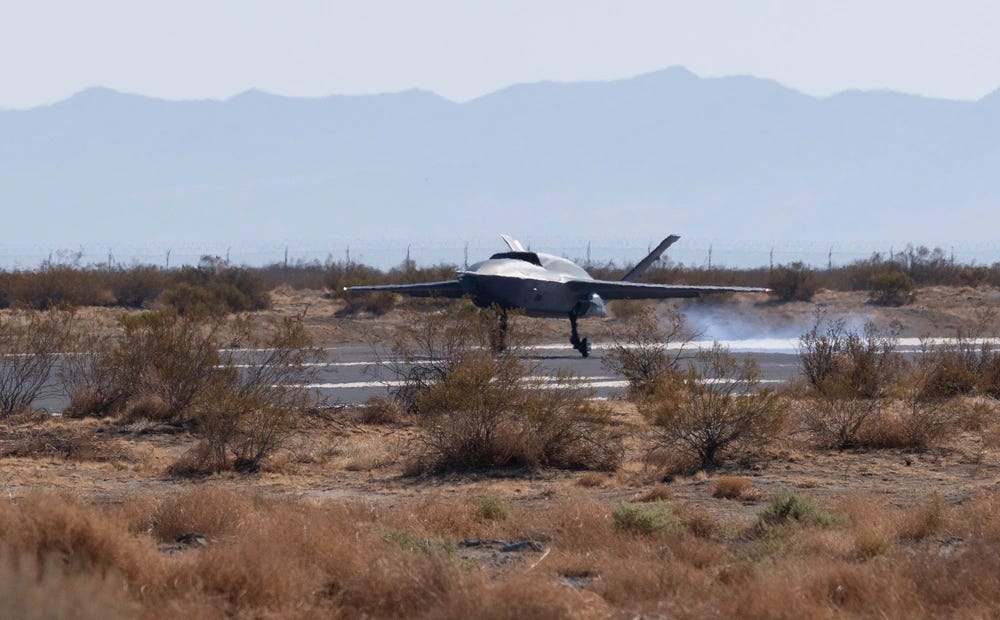
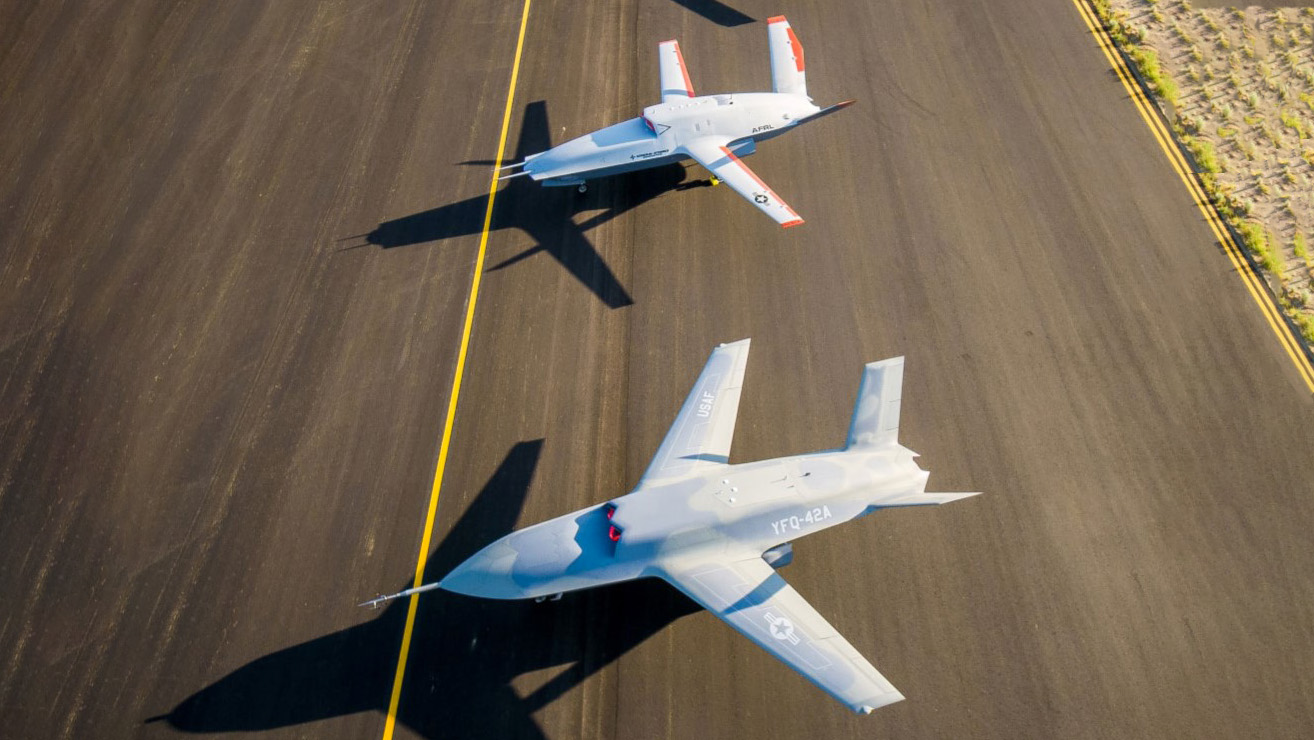
Step into the next chapter of air combat and you’ll find the YFQ-42A, a machine crafted not just for flying, but for thinking and fighting alongside its human counterparts. Born from the “genus-species” lineage that began with the XQ-67A Off-Board Sensing Station, the Dark Merlin takes the lessons of its predecessors and pushes them further.
With advanced digital engineering as its backbone, General Atomics Aeronautical Systems has reimagined what it means to field a collaborative combat drone, optimizing every curve and capability for the battlespace of tomorrow.
Look closer at the airframe, and you’ll spot a host of subtle evolutions. The engine’s serrated air inlet echoes the stealthy lines of the B-2 Spirit, while the fuselage and nose have shed the ‘shovel’ shape of the XQ-67 for something sleeker and more conventional.
The wings, swept with a sharper angle and broader surface, speak to a need for speed and agility, while the V-tails, shorter and more refined, hint at careful calibration for both stealth and maneuverability. Every adjustment is a response to the demands of the CCA program: reduce radar cross-section, enhance performance, and ensure survivability in contested skies.
Yet the true heart of the YFQ-42A isn’t just its steel and composites; it’s the sophisticated autonomy core that lets it act as a teammate, not just a tool. This digital brain, refined through years of dogfighting experience with the MQ-20 Avenger, is now proving itself in new ways.
In a recent milestone, Dark Merlin completed its first semi-autonomous flight using Collins Aerospace’s Sidekick Collaborative Mission Autonomy software, seamlessly integrated via the government’s Autonomy Government Reference Architecture (A-GRA).
Picture this: from the ground, a human operator cues up mission commands, sending them winging through secure links to the aircraft. The YFQ-42A executes each order with precision for over four hours, validating not only the reliability of Sidekick’s software, but also the flexibility and robustness of the A-GRA system.
This open, modular approach—MOSA, as the military calls it—means that autonomy software can be swapped or upgraded without tearing apart the airframe, ensuring the fleet stays competitive and adaptable as technology races forward.
This isn’t just about one drone, or even one program. The goal is to create a dynamic, competitive ecosystem where mission software moves swiftly between platforms, innovation is baked in, and the Air Force can avoid the trap of vendor lock. By separating software from hardware, the service accelerates its ability to adapt, outpace adversaries, and keep the technological edge sharp.
In the sky, the YFQ-42A is set to fly not just with the Next Generation Air Dominance platform—the future Boeing F-47—but also alongside today’s most advanced fighters, the F-22 Raptor and F-35 Lightning II.
With stealth in its bones and autonomy in its brain, Dark Merlin is poised to give warfighters the decisive advantage in the unpredictable air battles of the future—a true partner in the evolving dance of man and machine.
Dark Merlin and the Future of Coalition Air Combat
For the United States, Dark Merlin is more than a new piece of hardware. It’s a proving ground for the future of air combat. This isn’t just about flying another drone; it’s about answering a fundamental question: can the Air Force truly harness the power of human-machine teams on a scale that changes the nature of war?
With the YFQ-42A, part of the Collaborative Combat Aircraft (CCA) program, the Air Force aims to field a fleet of modular, cost-effective, and operationally relevant autonomous aircraft designed to operate alongside the most advanced fifth- and sixth-generation fighters.
General Atomics built Dark Merlin from the ground up with modularity and adaptable autonomy at its core. The goal is clear: integrate new mission systems rapidly, enable seamless teaming in the most demanding combat environments, and keep pace with the evolving technological landscape.
For Washington, this signals a possible breakthrough: finding a way to generate greater combat mass, maintain persistence, and offer tactical flexibility without relying solely on a handful of exquisite, crewed fighters. The CCA’s pursuit of “affordable mass” is especially relevant for sustained campaigns in the Pacific, where scale and endurance will be decisive.
Dark Merlin’s recent semi-autonomous flight showed more than just advanced engineering. It demonstrated that real-time operator control, mission adaptability, and robust reliability are within reach.
And this isn’t just a U.S. story. The CCA program is being discussed with allies, raising the prospect of shared autonomy standards, interoperable force packages, and future export opportunities. Imagine a future where Dark Merlin and its kin fly not just with American jets, but alongside allied aircraft across the globe, multiplying the reach and resilience of the entire coalition.
If Dark Merlin succeeds, it’s not just about drones joining the fight. It’s about forging a new era where software-driven wingmen become an everyday reality, redefining what deterrence and allied airpower look like on the world stage.
This Week in Aviation History
On 14 March 1921, the squadron claimed the title 95th Pursuit Squadron, and by 1924, the now-iconic kicking mule emblem was officially worn on their aircraft at Selfridge Field, Michigan. By 1935, the unit had transitioned to attack duties, and just before World War II, it became the 95th Bombardment Squadron.
As the storm of war gathered, the squadron patrolled America’s west coast in B-18 Bolos and B-23 Dragons, hunting for enemy submarines. Their vigilance paid off. They’re credited with sinking the first Japanese submarine off Oregon’s coast, marking their place in history before the wider conflict began.
The Saga of the 95th Reconnaissance Squadron
The story of the 95th Reconnaissance Squadron reads like a living chronicle of American airpower, stretching back to the dawn of aerial combat. Born at Kelly Field, Texas, on 20 August 1917, as the 95th Aero Squadron, this unit first took to the skies in the nimble French-built Nieuport 28.
Even in those early months, the squadron’s spirit was bold—they sailed for France, braving the unknown, and spent a bitter winter training for the crucible to come. On 8 March 1918, the 95th became the very first American squadron to fly combat missions in World War I, earning their motto, “First to the Front.”
Throughout the war, the 95th flew alongside the French Sixth and Eighth Armies, as well as the American Expeditionary Force’s First Army. It was during these sorties that the iconic kicking mule emblem appeared on their aircraft—a blue ring symbolizing their theater, the mule capturing their reputation for striking “swift and accurate.” By war’s end, the squadron had transitioned from the Nieuport 28 to the Spad XIII and the British S.E.5, racking up 230 patrols and earning credit for downing over 35 enemy aircraft and twelve observation balloons.
The years between the wars were marked by movement, redesignations, and a parade of new aircraft. The 95th was inactivated, reactivated, and shifted across assignments, flying a fascinating mix of machines—including the German Fokker D.VII, the PW-8, PW-9, P-1 Hawk, P-12, the P-26 Peashooter, and the A-17. On 14 March 1921, the squadron became the 95th Pursuit Squadron, and by 1924, their kicking mule emblem was officially recognized while based at Selfridge Field, Michigan.
Change was a constant companion. In 1935, the unit shifted to become an attack squadron, and by October 1939, they were redesignated as the 95th Bombardment Squadron.
As the world edged toward a second great conflict, the 95th found itself flying anti-submarine patrols along America’s west coast in B-18 Bolos and B-23 Dragons. It was here, on the eve of World War II, that the squadron made history once more—credited with sinking the first Japanese submarine off the coast of Oregon, a testament to their vigilance and skill.
After carving its name in North Africa, the 95th pressed forward with the Allied advance into Italy, making its home on the rugged airstrips of Sardinia and Corsica. By the autumn of 1944, the squadron was moving into France, alternating sorties from airfields across France and Austria as the war drew to a close.
Yet perhaps the most storied chapter from World War II came not over Europe, but in the Pacific—when six of the legendary Doolittle Raid’s sixteen crews hailed from the 95th Bombardment Squadron. All told, the 95th flew a staggering 601 combat missions in just over two years of relentless wartime operations.
After a brief pause, the squadron was reborn for the Korean War in 1952, taking to the skies in B-26 Invaders for light bombardment, interdiction, and armed reconnaissance. Post-war, the 95th traded its Invaders for B-66 Destroyers in Japan before standing down again in 1958.
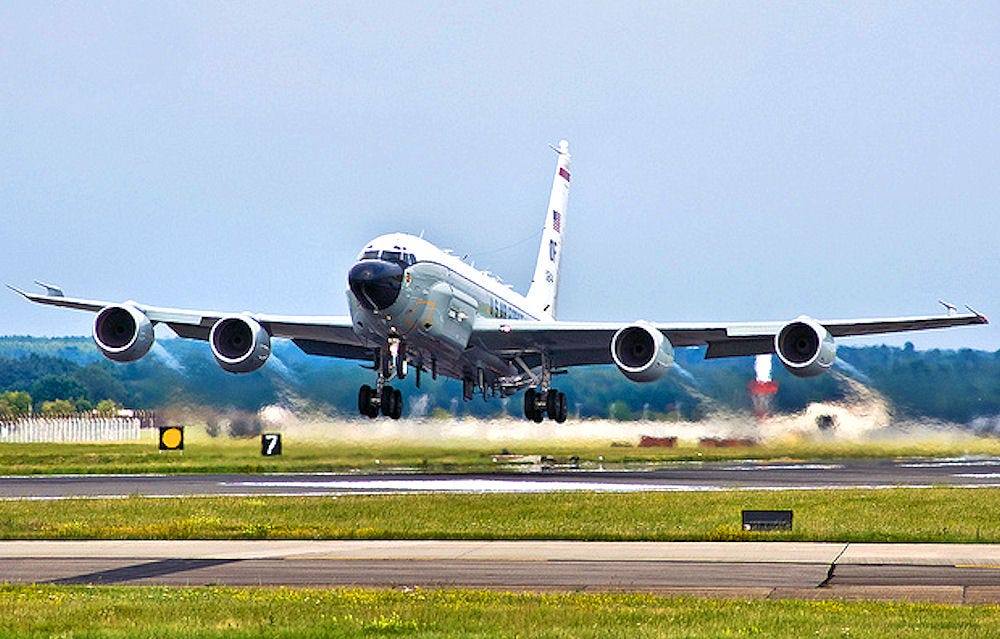
The squadron’s story reignited on October 1, 1982, this time as the 95th Reconnaissance Squadron, operating the U-2/TR-1 from RAF Alconbury in England. When Alconbury’s chapter ended in 1993, the history lived on: the RC-135 crews at RAF Mildenhall adopted the 95th’s storied name, ensuring its legacy endured.
Today, the 95th flies missions from Mildenhall and Souda Bay, Crete, still at the vanguard of reconnaissance, still writing new chapters in the skies above Europe and beyond.
Under the Hoods of Bolos and the Dragons
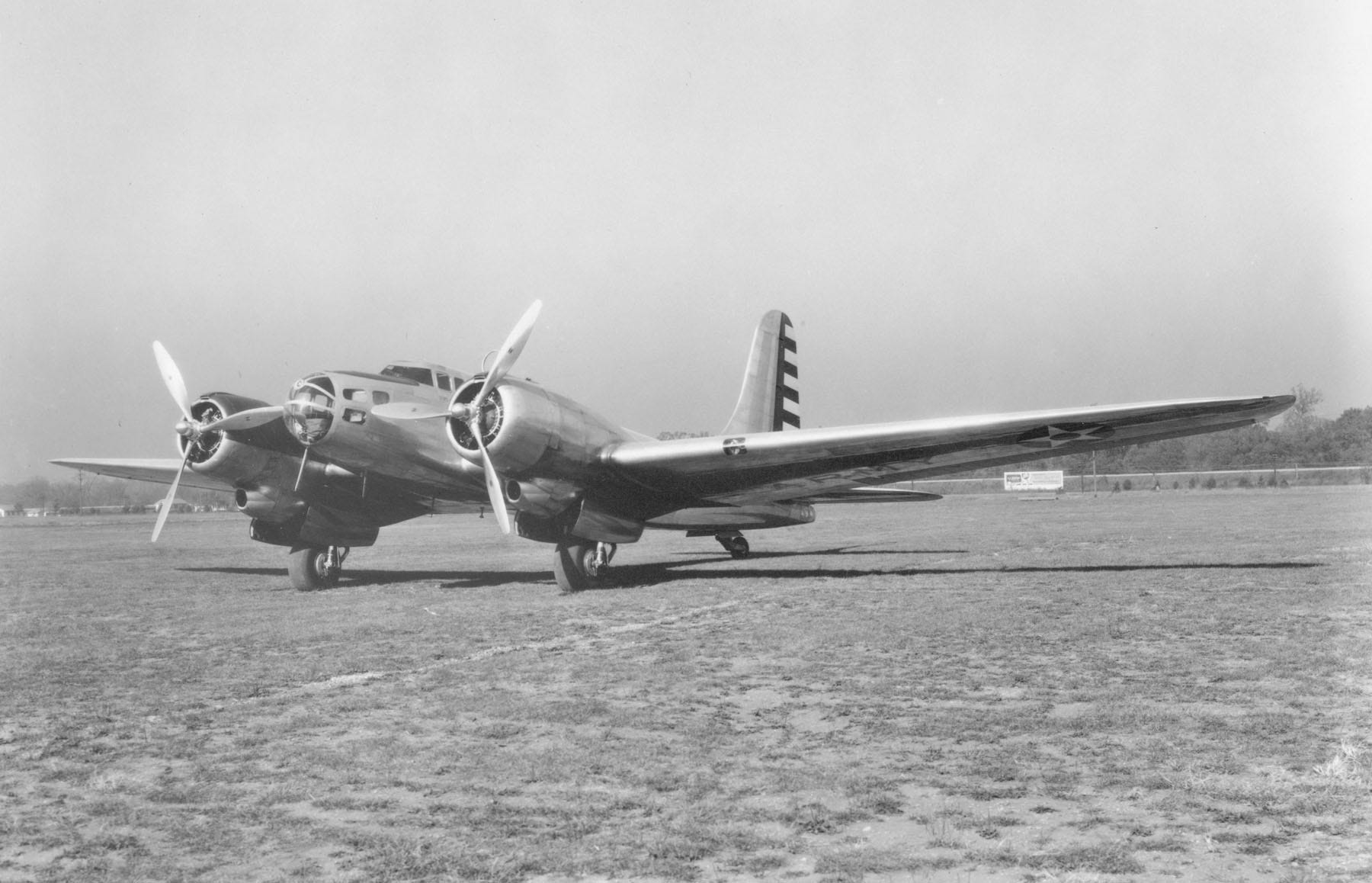
Let me give you a rundown of two of the birds that the 95th flew.
B-23 Dragon (Specifications)
TYPE: Medium Bomber
POWER: Two Wright R-2600-3 Radial piston engines with 1,600 hp. each
SPEED: Maximum - 282 mph, Cruising - 210 mph.
RANGE : 1,400 miles (with 4000 lbs of bombs)
SERVICE CEILING: 31,600 ft
WEIGHTS: Empty: 19,089 lbs, Combat: 26,500, Maximum: 32,400 lbs
MAXIMUM PAYLOAD: 4,400 lb. (1996 kg) of bombs carried internally
DIMENSIONS: Span 92 ft, Length 58 ft 4 3/4 in, Height 18 ft 5 1/2 in.
CREW: Five; Pilot, Co-Pilot, Radio Operator, Bombardier and Tail gunner
PRODUCTION TOTALS: 38 ; 15-18 converted into UC-67
Specification of Douglas B-18 Bolo
Armament: Three .30-cal. guns (in nose, ventral and dorsal positions), plus 4,500 lbs. of bombs carried internally
Engines: Two Wright R-1820-53s of 1,000 hp each
Crew: Six
Maximum speed: 215 mph at 15,000 ft.
Cruising speed: 167 mph
Range: 2,100 miles
Ceiling: 23,900 ft.
Span: 89 ft. 6 in.
Length: 57 ft. 10 in.
Height: 15 ft. 2 in.
Weight: 27,000 lbs. loaded
Serial number: 37-0469
The Legacy Carried Forward
The legacy of the 95th Reconnaissance Squadron isn’t just about age—it’s a story of transformation without ever losing its soul. Born in 1917 as the 95th Aero Squadron, it stands as one of the oldest Air Force units, its logbook filled with nearly every chapter of American air warfare. Over a century, the 95th has flown 25 types of aircraft, shifted through pursuit, attack, bombardment, and reconnaissance roles, and earned honors in every era from World War I dogfights to today’s intelligence-driven missions.
What sets the 95th apart is relentless adaptation. From launching biplanes in the Great War to orchestrating RC-135 operations above the Arctic Circle, the squadron has always evolved to meet the moment. Its history is stitched with valor—like providing crews for the legendary Doolittle Raid and operational relevance, whether in historic campaigns or cutting-edge exercises with allies.
In every transformation, the 95th demonstrates an enduring truth of airpower: aircraft may change, but the true mark of a unit is its ability to keep finding ways to serve, lead, and matter: no matter how the mission evolves.
In Case You Missed It
Photo Outlet
Every issue of Hangar Flying with Tog gets you a free image that I’ve taken at airshows:

Feel free to use these photos however you like, if you choose to tag me, I am @pilotphotog on all social platforms. Thanks!
Post Flight Debrief
Like what you’re reading? Stay in the loop by signing up below—it’s quick, easy, and always free.
This newsletter will always be free for everyone, but if you want to go further, support the mission, and unlock bonus content like the Midweek Sortie, consider becoming a paid subscriber.
Your support keeps this flight crew flying—and I couldn’t do it without you.
– Tog