

France’s flagship multirole fighter, the Dassault Rafale, is all set for a major upgrade, with an upgraded variant dubbed the “Super Rafale” or F5 standard just around the corner.
—Jack Buckby, New York-based journalist
Mission Briefing
Coming in 2030, the Rafale F5 isn’t just another upgrade. It’s a leap into a new era of air combat. This isn’t about tweaking old parts; it’s about transforming the Rafale into a true “system of systems,” where data, connectivity, and man-machine teamwork take center stage. Imagine sensors, data links, combat clouds, and loyal wingman drones all working in perfect synchrony. The result? Decisions come quicker, strikes reach farther, and pilots stay safer than ever before—a revolution in the making.
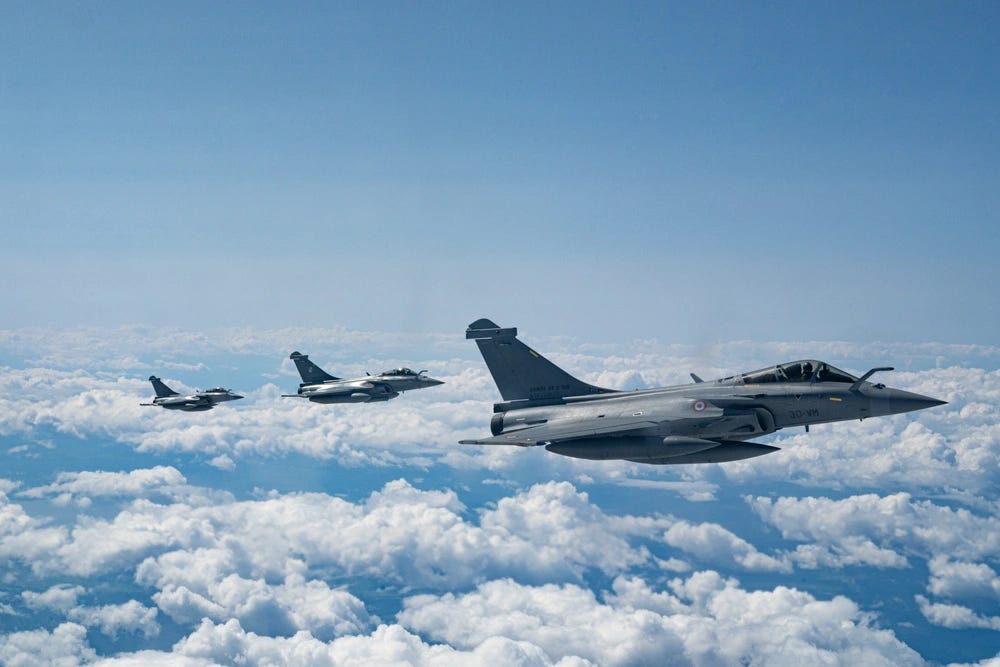
2030 Countdown: Rafale F5 Joins the Connected Battlespace
The Rafale story has always been one of thoughtful evolution. From the earliest F1 up through the F4, each new standard brought powerful upgrades: better sensors, new weapons, and smarter avionics.
Yet, through it all, the core philosophy of the airframe remained constant: a pilot’s machine, honed for adaptability, survivability, and punch. With the Rafale F5, that lineage takes a dramatic turn.
As outlined by France’s Directorate General of Armament, this isn’t just about aerodynamic tweaks or loading up more missiles. It’s about transforming the Rafale into a fully digital combat platform, ready for the battlefields of tomorrow.
Why this shift? The answer lies in the changing face of air warfare. In today’s high-intensity environments, survival isn’t just a matter of speed or stealth. It’s about who sees first, who shares information fastest, and who can coordinate action across a network of allies and assets.
The Rafale F5 is purpose-built for this new reality. It no longer flies as a lone wolf. It orchestrates and commands, acting as a central node in a complex combat web.
France is putting real muscle behind this vision. The 2024–2030 Military Programming Law earmarks over €13 billion for the modernization of its combat aviation, with the F5 standard and its “loyal wingman” drones at the core.
The beating heart of the F5 is native connectivity. Rafale F5s are designed to receive, process, and redistribute torrents of battlefield data, linking seamlessly with other jets, drones, ships, and command centers.
This networked approach builds on established data links like Liaison 16, ensuring NATO allies can still plug in. But the F5 goes further, adding sovereign, ultra-fast links with low detectability and resistance to jamming, allowing nearly uninterrupted data flow across platforms.
The result is a French “combat cloud”—a collaborative ecosystem where the Rafale doesn’t just see with its own sensors, but perceives the battlespace as the entire network does.
In practical terms, this means a Rafale F5 could launch missiles at a target it doesn’t directly detect, relying on data from a drone or another aircraft in the network. While this kind of “remote firing” began with the F4, it’s the centerpiece of the F5’s operational doctrine.
But such hyper-connectivity brings its own challenge: cognitive overload. The F5’s answer is a cockpit revolution. Instead of flooding the pilot with more data, the system distills it. Contextual screens, prioritized alerts, and intelligent, phase-dependent displays.
Onboard AI acts as a tactical partner, suggesting routes, target priorities, and engagement options. The pilot, still master of the mission, is no longer alone in the cockpit. He’s joined by a digital co-pilot, ready to meet the demands of a new era in air combat.
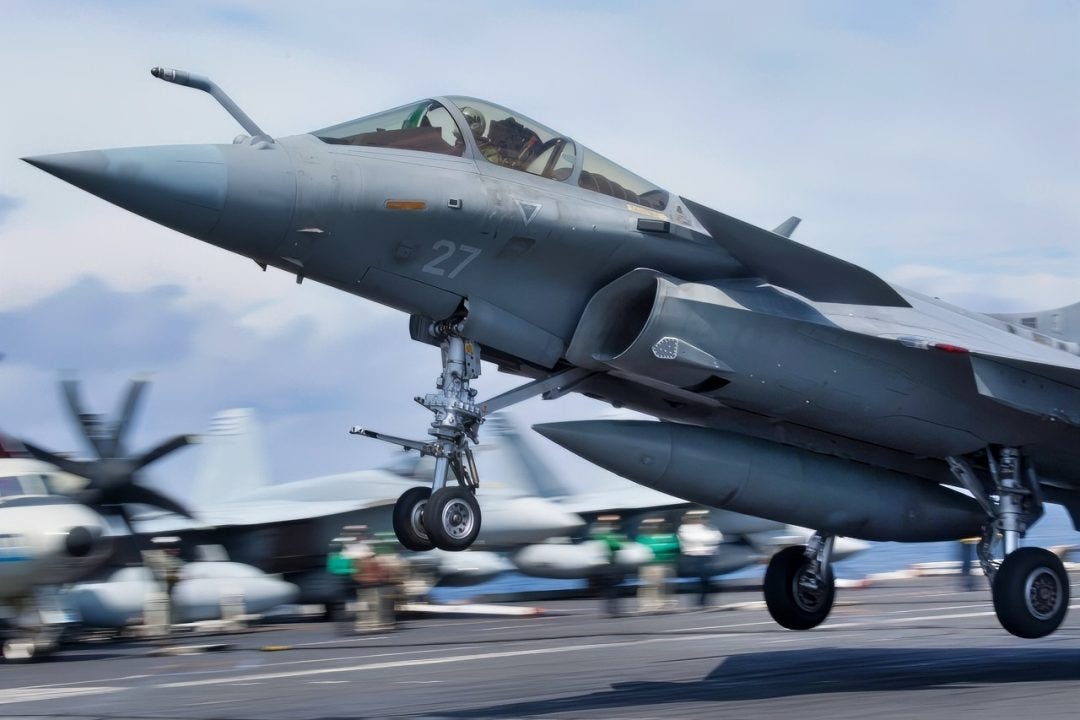
Meet the F5 Super Rafale
Dassault Aviation is going to develop and innovate the Rafale as more than just a fighter. It would be France’s answer to every mission the modern sky demands. The result is an “omni-role” marvel, equally at home dogfighting for air superiority, striking targets deep behind enemy lines, gathering crucial reconnaissance, or standing as a sentinel of nuclear deterrence.
Powered by twin jets, the Rafale can leap from the rolling deck of an aircraft carrier or launch from a quiet shore base, adapting to whatever the mission requires.
This versatility isn’t just theory. The Rafale has been sharpening its claws in real-world combat since 2007, first joining the French Navy in 2004 and the Air Force in 2006. Its export success tells the same story: more Rafales now fly in foreign skies than in France’s own fleet, a testament to its battle-tested reliability and broad appeal.
Now, with the F5—or “Super Rafale”—on the horizon, Dassault is taking the platform into the digital age. The F5 is built around a new generation of avionics, sensors, and networked connectivity that fundamentally redefines what a fighter can do.
At its heart remains the RBE2 AESA radar, whose reach already extends beyond 200 kilometers against large aerial threats. But the mission has shifted: it’s not just about seeing farther, but about identifying and reacting faster.
The OSF front optronic system has been enhanced for sharper, longer-range vision in any light, while the SPECTRA electronic warfare suite. It is one of the world’s most formidable suites, now anticipating and countering threats before they materialize. All these streams of information converge in a powerful multi-sensor fusion engine, using advanced algorithms to slash the critical seconds between detection and decision.
What truly sets the Rafale F5 apart is its role as the centerpiece in a collaborative combat network. It is designed to direct “Remote Carrier” drones—nimble, lower-cost machines that can scout, jam, deceive, or strike.
Imagine a Rafale F5 at the center of a digital phalanx, controlling a team of drones, each tailored for a specific role. These drones can probe enemy defenses first, drawing fire and exposing threats, allowing the Rafale to strike with precision and reduced risk.
From an industrial point of view, this approach bridges today’s capability with the future SCAF program, due after 2040, while ensuring the French military stays ahead of the curve. In a world where a single Rafale costs over €90 million, and a combat drone just a fraction of that, this new model offers not just power, but cost-effective resilience for the long campaigns ahead.
France’s Rafale F5 and the Coalition Kill Chain
For U.S. and allied air forces, the Rafale F5 isn’t simply a new French jet. It’s a signpost for the future of coalition warfare. Think of it as another vital node in the kind of networked air battle the U.S. is already shaping, with JADC2-style (Joint All Domain Command and Control) kill chains and seamless data flow.
The F5 is a true “system of systems,” where fused sensors, combat cloud operations, electronic warfare, and human-machine teaming work together to shave precious seconds off the detect-decide-strike cycle.
What makes the F5 so relevant for partners is its deliberate blend of interoperability and French independence. While it retains Link 16 for NATO connectivity, it layers in high-speed, resilient national links, which means it can play well with others without compromising sovereign control.
That’s a game-changer for coalitions, where success depends on sharing tracks, cueing weapons, and coordinating effects across jets, drones, ships, and command posts.
National Security Journal points out that F5’s trajectory is aimed straight at the heart of modern air combat: stronger sensors, tighter connectivity, sharper electronic warfare, and “loyal wingman” drones, plus new weapons and missions like SEAD. Even its supportability—built for easy maintenance and a small logistics footprint—makes it attractive for the dispersed, high-tempo operations coalitions expect.
Ultimately, the Rafale F5 reminds us that air superiority now belongs to the best-connected force, not just the fastest jet. In the skies ahead, those who wire their strengths together will lead the fight.
This Week in Aviation History
In February 1969, Grumman’s F-14 Tomcat soared to victory in the Navy’s fierce VFX fighter competition, setting a new standard for carrier-based aviation. The first Tomcat took to the skies on December 20, 1970, and by October 1972, it was standing guard with the U.S. Navy fleet.
Built for long-range air defense, the F-14’s signature move was its variable-sweep wings and foreplane—known as the glove vane—which let it morph its shape to fit the mission. Whether launching from a carrier deck, dogfighting at altitude, or skimming low for a strike, the F-14 adapted on the fly, always ready for the next challenge.
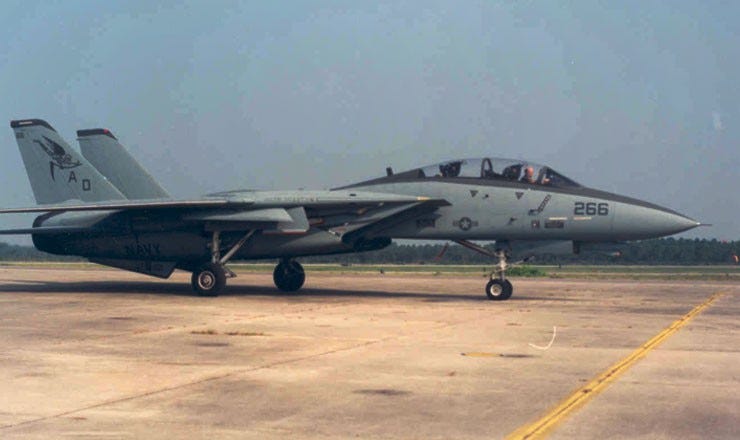
From Missileer to Tomcat: Forging America’s Fleet Defender
The story of the F-14 Tomcat is a tale of innovation rising from the ashes of earlier ambitions. Its roots stretch back to the 1950s, when the Navy dreamed up the Eagle-Missileer. It is a subsonic, long-endurance sentry equipped with a formidable pulse-doppler radar and a quiver of six Eagle missiles.
That early vision promised a guardian for the fleet, tracking and engaging multiple threats at a distance. Yet, the Missileer’s singular focus on air defense and its lack of speed doomed it. By the early 1960s, the program was shelved, a victim of changing priorities and technology’s relentless march forward.
The Navy’s next move was the F-111B, a swing-wing adaptation of the Air Force’s F-111. But heavy, underpowered, and out of step with carrier operations, the F-111B, too, was set aside.
What survived from these efforts was a powerful idea: the marriage of multi-target, long-range missile capability with an agile, carrier-capable fighter. The Eagle missile would evolve into the legendary Phoenix, and the Navy’s quest would find its champion in the VFX program.
In November 1967, Grumman Aircraft Engineering Corporation took a bold step, submitting an unsolicited proposal for what would become the VFX fighter. The Chief of Naval Operations quickly saw potential, commissioning a Navy Fighter Study that confirmed the design’s feasibility.
By June 1968, the Navy was ready to move forward. Five aerospace giants submitted their visions, but by January 1969, Grumman’s proposal stood above the rest. The contract for the first F-14A was inked in February 1969, and the Tomcat’s journey officially began.
The F-14 was built for the high seas and high stakes—a supersonic, twin-engine, two-seat marvel with variable-sweep wings, able to adapt its shape for dogfights, carrier landings, or high-speed intercepts. It was an all-weather hunter, designed to replace the canceled F-111B in the fleet air defense role and to gradually take over from the F-4J Phantom in broader fighter missions between 1973 and 1980.
What set the Tomcat apart was its powerful weapons suite: the Phoenix missile, evolved from the old Eagle, offered long-range, multi-target engagement. The modified AN/AWG-9 radar and missile control system made it possible to track and attack multiple threats at once, while the aircraft also carried Sparrows, Sidewinders, and an internal gun for close-in combat.
Maintenance and reliability were built into its DNA, with the Versatile Avionics Shop Tester (VAST) on hand to keep the electronics humming.
Development and production ran side by side. The first F-14 took flight in December 1970, though not without drama—the prototype crashed on its second flight, a stark reminder of the risks that come with pushing the envelope.
Undeterred, the Navy pressed on, ordering more Tomcats and preparing to field a new generation of fleet defenders. By October 1971, the Navy had exercised options for 48 more aircraft, bringing the total ordered to 86—each one a testament to lessons learned, setbacks overcome, and the unyielding drive to control the skies above the sea.
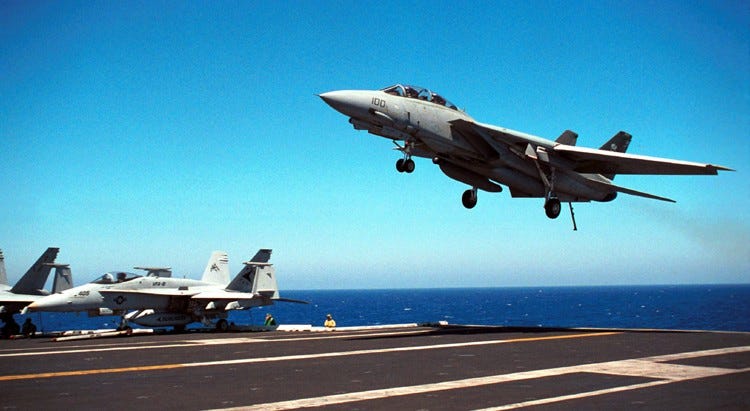
Inside the F-14
Let me give you a rundown of the features of Tomcat
Manufacturer: Grumman Corporation
Type: Carrier-based air superiority fighter.
Crew: Pilot and Radar Intercept Officer
Powerplant: Two Pratt & Whitney TF30-P-412A or 414A engines of 20,900 lb. static thrust each
Dimensions:
Length: 62 ft., 8 in.
Height: 16 ft.
Span (max spread): 64 ft., 1 in.
Span (fully swept): 48 ft., 2 in.
Span (overswept): 33 ft. 3 in.
Wing Area: 565 sq. ft.
Weight:
Empty: 40,100 lb.
Gross: 74,349 lb.
Performance:
Max Speed: 1,544 mph
Climb Rate: 30,000 ft./min.
Ceiling: 55,000 ft.
Range: 2,400 miles
Armament:
M-61 20mm cannon; four AIM-7 Sparrow, four AIM-9 Sidewinder, or six AIM-54 Phoenix and two AIM-9 air-to-air missiles.
Tomcat’s Enduring Mark
The F-14 Tomcat’s legend soars far beyond its unmistakable silhouette slicing through the sky. Born in the crucible of the Cold War, it was engineered to be the fleet’s shield—projecting power far from the carrier, thanks to a radar that could peer deep into hostile airspace and the muscle to knock down multiple adversaries before they could threaten the task force. This was a machine built not just to fly, but to command the vast, unpredictable ocean from the narrow deck of a carrier.
By the 1980s, the Tomcat wasn’t just a weapon. It was the face of American naval airpower. Its presence was felt in shadowy intercepts and tense standoffs on the world’s oceans, and its image graced posters, films, and the dreams of a new generation of aviators.
The two-person crew—pilot up front, Radar Intercept Officer behind—epitomized the era’s cutting edge: man and machine, linked by trust and instinct, wringing every ounce of performance from radar, missiles, and tactics at Mach speed.
As years rolled on, the Tomcat revealed a versatile spirit. No longer just the long-range interceptor, it became a multi-role workhorse, delivering precision strikes and close air support, adapting to new missions with the same determination it showed at launch.
Even now, in an age of stealth jets and digital networks, the Tomcat’s legacy endures. It stands as a testament to the enduring importance of reach, awareness, and readiness at sea. It is a gentle reminder that the right wings, in capable hands, can tip the scales of power for a generation.
In Case You Missed It
This one goes waaay back to the early days of the channel - enjoy!
Photo Outlet
Every issue of Hangar Flying with Tog gets you a free image that I’ve taken at airshows:
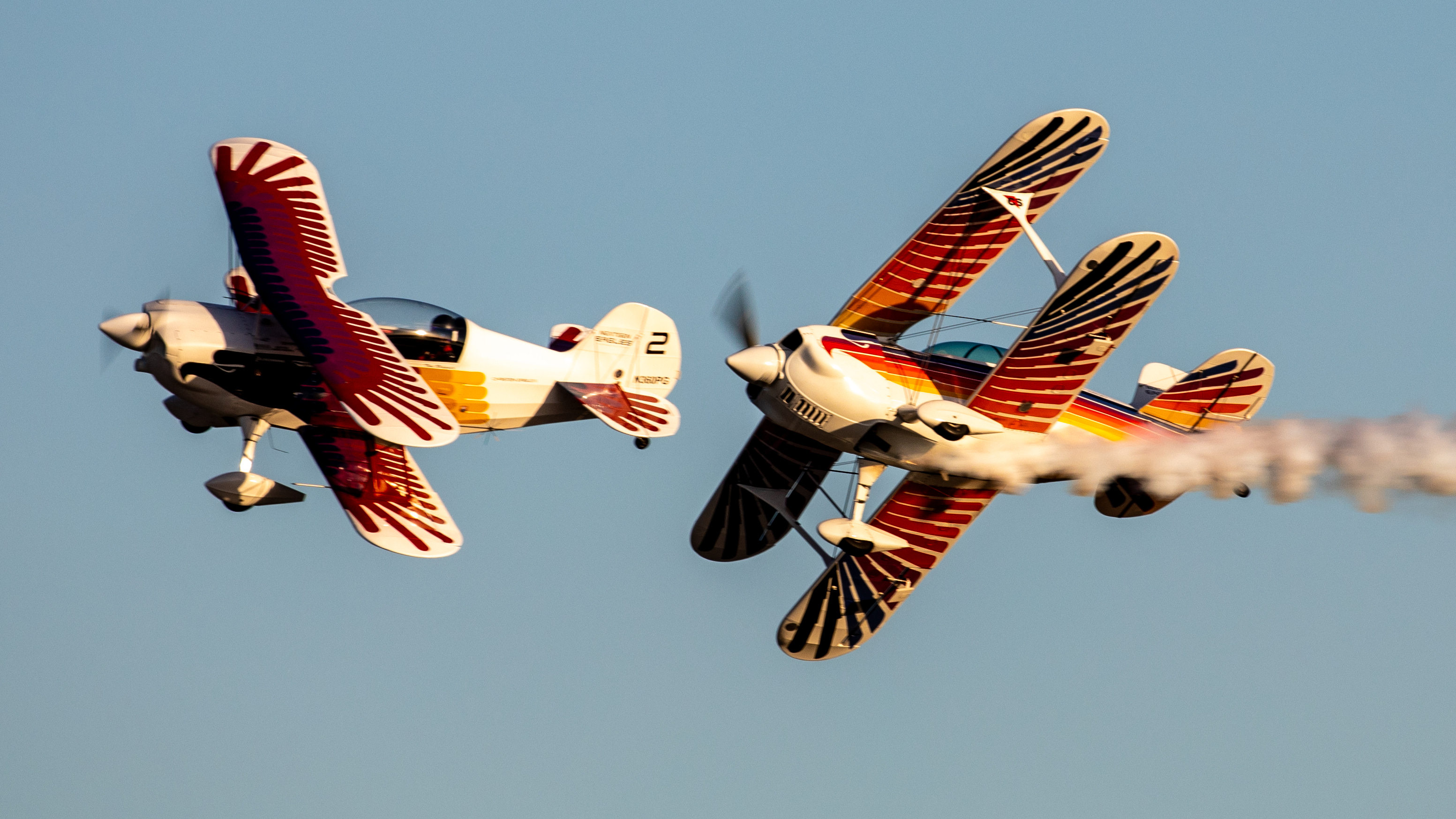
Feel free to use these photos however you like. If you choose to tag me, I am @pilotphotog on all social platforms. Thanks!
Post Flight Debrief
Like what you’re reading? Stay in the loop by signing up below—it’s quick, easy, and always free.
This newsletter will always be free for everyone, but if you want to go further, support the mission, and unlock bonus content like the Midweek Sortie, consider becoming a paid subscriber.
Your support keeps this flight crew flying—and I couldn’t do it without you.
– Tog