

Naval Strikes in the Strait of Hormuz and Remembering when Task Force 58 attacked the Japanese battleship Yamato.
Yamato’s destruction and modern Hormuz strikes are linked by the same enduring truth: the side that controls the air can cripple a naval threat before it ever fully enters the battle.
Beginning on March 4, 2026, Iranian forces have declared the Strait “closed,” threatening and carrying out attacks on ships attempting to transit the Strait.
—U.S. Congressional Report
Mission Briefing
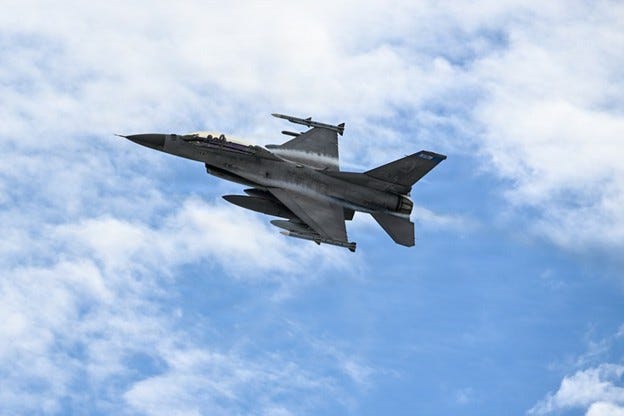
Soaring low over the shimmering waters of the Strait of Hormuz, F-15E and F-16 fighters unleashed the latest in guided bomb technology, striking their naval targets with precision. This daring operation, captured in sweeping detail, offers a rare glimpse into the evolving strategies and doctrines that shape modern aerial warfare.
The Older Fighters’ Comeback
One might think these birds are relics. After all, the F-15E took its maiden flight back in ’89, and the F-16 even earlier, in ’78. But let me assure you: these jets have aged like fine wine, reborn again and again through relentless modernization.
Climb inside a modern F-15E today and you’re surrounded by cutting-edge tech: the razor-sharp AN/APG-82 AESA radar, electronic warfare suites sophisticated enough to fool even the best enemy sensors, and secure data links connecting pilots to a web of information.
The latest F-16 Block 70s? They come loaded with sensors that rival those found on fifth-generation stealth fighters. But the real ace up their sleeve? Payload. The F-15E can haul more than 10,400 kilograms of ordnance—more than an F-35 flying in stealth mode. When you need to bring the rain on hardened targets, there’s no better workhorse.
And let’s talk cost. The F-35 is a marvel, no doubt, but it’s expensive to fly; over $33,000 an hour. The F-16? You can keep one in the air for less than a third of that. That’s why U.S. doctrine is crystal clear: use the stealth jets to slip past enemy defenses, kick open the door, and then send in the older platforms to deliver the heavy punches.
This layered approach is what keeps the F-15E and F-16 front and center in real-world ops. Stealth jets scout and disrupt, drones keep watch and strike as needed, and these classic fighters hit the targets that matter most. It’s a symphony of airpower—each player with a vital role.
Now, the Strait of Hormuz; that’s not just any patch of water. It’s the world’s energy chokepoint: a 33-kilometer-wide passage where up to 20 million barrels of oil flow each day. Any hint of trouble here, and the world feels it instantly. Iran knows this, and over the years they’ve packed the area with anti-ship missiles, sea mines, naval drones, and swarms of fast attack craft, all designed to tip the balance.
That’s why recent U.S. strikes zeroed in on those very threats: missile sites and related facilities along the coast. The goal? Stop trouble before it ever reaches open water. By taking out the weapons ashore, you keep the shipping lanes open and avoid a messy confrontation at sea. It’s classic aviator strategy: control the skies and you control the sea. That’s how you keep the world’s lifeblood flowing, one mission at a time.
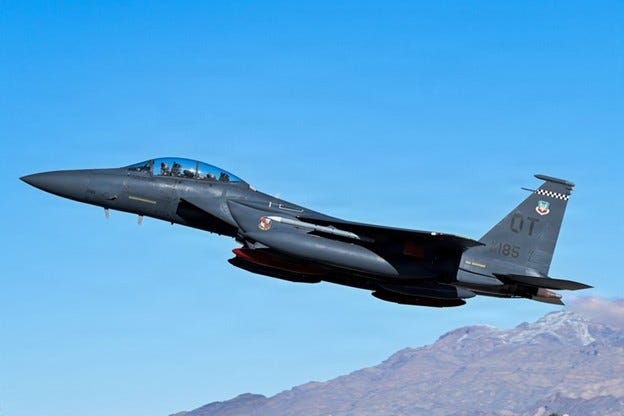
Under the Hoods of These Conventional Fighters
General Characteristics of F-15E
Primary function: Air-to-ground attack aircraft
Contractor: The Boeing Company
Power plant: Two Pratt & Whitney F100-PW-220 or 229 turbofan engines with afterburners
Thrust: 25,000 - 29,000 pounds each engine
Wingspan: 42.8 feet (13 meters)
Length: 63.8 feet (19.44 meters)
Height: 18.5 feet (5.6 meters)
Weight: 37,500 pounds ( 17,010 kilograms)
Maximum takeoff weight: 81,000 pounds (36,450 kilograms)
Fuel capacity: 35,550 pounds (three external tanks plus conformal fuel tanks)
Payload: depends upon mission
Speed: 1,875 mph (Mach 2.5 plus)
Range: 2,400 miles (3,840 kilometers) ferry range with conformal fuel tanks and three external fuel tanks
Ceiling: 60,000 feet (18,288 meters)
Armament: One 20mm multibarrel gun mounted internally with 500 rounds of ammunition. Four AIM-9 Sidewinder missiles and four AIM-120 AMRAAM or eight AIM-120 AMRAAM missiles. Any air-to-surface weapon in the Air Force inventory (nuclear and conventional)
Crew: Pilot and weapon systems officer
Unit cost: $31.1 million (fiscal year 98 constant dollars)
Initial operating capability: September 1989
Inventory: 219 total force
General characteristics of F-16 Fighting Falcon
Primary function: multirole fighter
Contractor: Lockheed Martin Corp.
Power plant: F-16C/D: one Pratt and Whitney F100-PW-200/220/229 or General Electric F110-GE-100/129
Thrust: F-16C/D, 27,000 pounds
Wingspan: 32 feet, 8 inches (9.8 meters)
Length: 49 feet, 5 inches (14.8 meters)
Height: 16 feet (4.8 meters)
Weight: 19,700 pounds without fuel (8,936 kilograms)
Maximum takeoff weight: 37,500 pounds (16,875 kilograms)
Fuel capacity: 7,000 pounds internal (3,175 kilograms); typical capacity, 12,000 pounds with two external tanks (5443 kilograms)
Payload: two 2,000-pound bombs, two AIM-9, two AIM-120 and two 2400-pound external fuel tanks
Speed: 1,500 mph (Mach 2 at altitude)
Range: more than 2,002 miles ferry range (1,740 nautical miles)
Ceiling: above 50,000 feet (15 kilometers)
Armament: one M-61A1 20mm multibarrel cannon with 500 rounds; external stations can carry up to six air-to-air missiles, conventional air-to-air and air-to-surface munitions and electronic countermeasure pods
Crew: F-16C, one; F-16D, one or two
Unit cost: F-16A/B , $14.6 million (fiscal 98 constant dollars); F-16C/D,$18.8 million (fiscal 98 constant dollars)
Initial operating capability: F-16A, January 1979; F-16C/D Block 25-32, 1981; F-16C/D Block 40-42, 1989; and F-16C/D Block 50-52, 1994
Inventory: total force, F-16C/D, 1017
What the Hormuz Strikes Meant for America and Its Allies
From the cockpit view, those recent strikes in the Strait of Hormuz are about far more than a single operation. They’re a message sent across the world’s shipping lanes. For the U.S. and its allies, hitting targets tied to Iran’s anti-ship and naval arsenal is a clear signal: we’re ready to defend this critical maritime chokepoint before a spark turns into a crisis.
With nearly a fifth of global oil flowing through these narrow waters, even minor instability can send shockwaves through energy markets and economies everywhere.
For America’s partners—especially Gulf states and Western nations relying on secure sea routes—the strikes offer more than just reassurance. They prove that Washington is willing to act, and that well-upgraded classics like the F-15E and F-16 still pack a serious punch when paired with precision munitions and sharp-eyed sensors.
The doctrine is practical: stealth jets might clear the way, but seasoned fighters deliver the heavy, persistent blows needed to keep the lanes open.
Beneath the roar of the engines, there’s a quieter undertone: the next round of conflict in this region may hinge less on air dominance and more on who can keep the oil flowing and the sea lanes open when the pressure mounts. That’s the real high-stakes game in play.
This Week in Aviation History
Carrier planes from Task Force 58 roar off the decks, hunting the mighty Yamato as it surges toward Okinawa with its escort of cruisers and destroyers. In wave after relentless wave, 386 aircraft hammer the Japanese fleet, pounding Yamato, Yahagi, and four destroyers beneath the waves of the East China Sea. But the skies are far from safe—off Okinawa, kamikaze pilots strike back, slamming into six Allied ships, among them the carrier Hancock and battleship Maryland. It’s a day when the fate of giants is decided by the fierce battles above and below the waves.
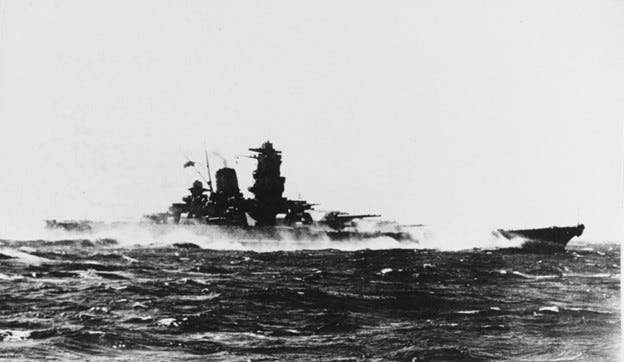
The Death of the Yamato
Let’s set the scene: April 6, 1945. The Yamato (pride of the Imperial Japanese Navy and the heaviest battleship ever built) steams out on Operation Ten-Go, a desperate, almost suicidal dash toward Okinawa.
Her orders are clear but grim: run straight into the teeth of the American fleet, low on fuel and with only a handful of escorts at her side. Japan’s strategic situation has grown dire, and Yamato’s mission is as much about honor as it is about hope.
But she never makes it. Over the horizon, Task Force 58—the U.S. Navy’s fast carrier strike arm under Admiral Marc Mitscher—waits with decks bristling with aircraft. On April 7, the skies fill with American carrier planes, launching wave after wave against Yamato and her escorts.
It’s the mature carrier system at its peak: scouts, fighters, bombers, and torpedo planes all working in perfect coordination, striking from far beyond the reach of the big guns below. The result is devastating; a hurricane of bombs and torpedoes rains down, and the Yamato, along with her consorts, is sent to the bottom before she ever threatens the Okinawa landings.
Yamato’s destruction is more than just the loss of a warship. She was built as a floating fortress, the embodiment of Japanese naval might, but her end proves a stark lesson: battleships, no matter how massive, cannot survive without air superiority in the age of carriers. When Yamato explodes and capsizes, it isn’t just steel and sailors lost. It’s the final curtain call for the era of battleship supremacy.
In the grand narrative of Okinawa, this strike became a defining moment. TF 58’s aviators didn’t just sink a legend; they changed the nature of naval warfare, closing the book on one age and opening another written in the contrails of carrier aircraft.
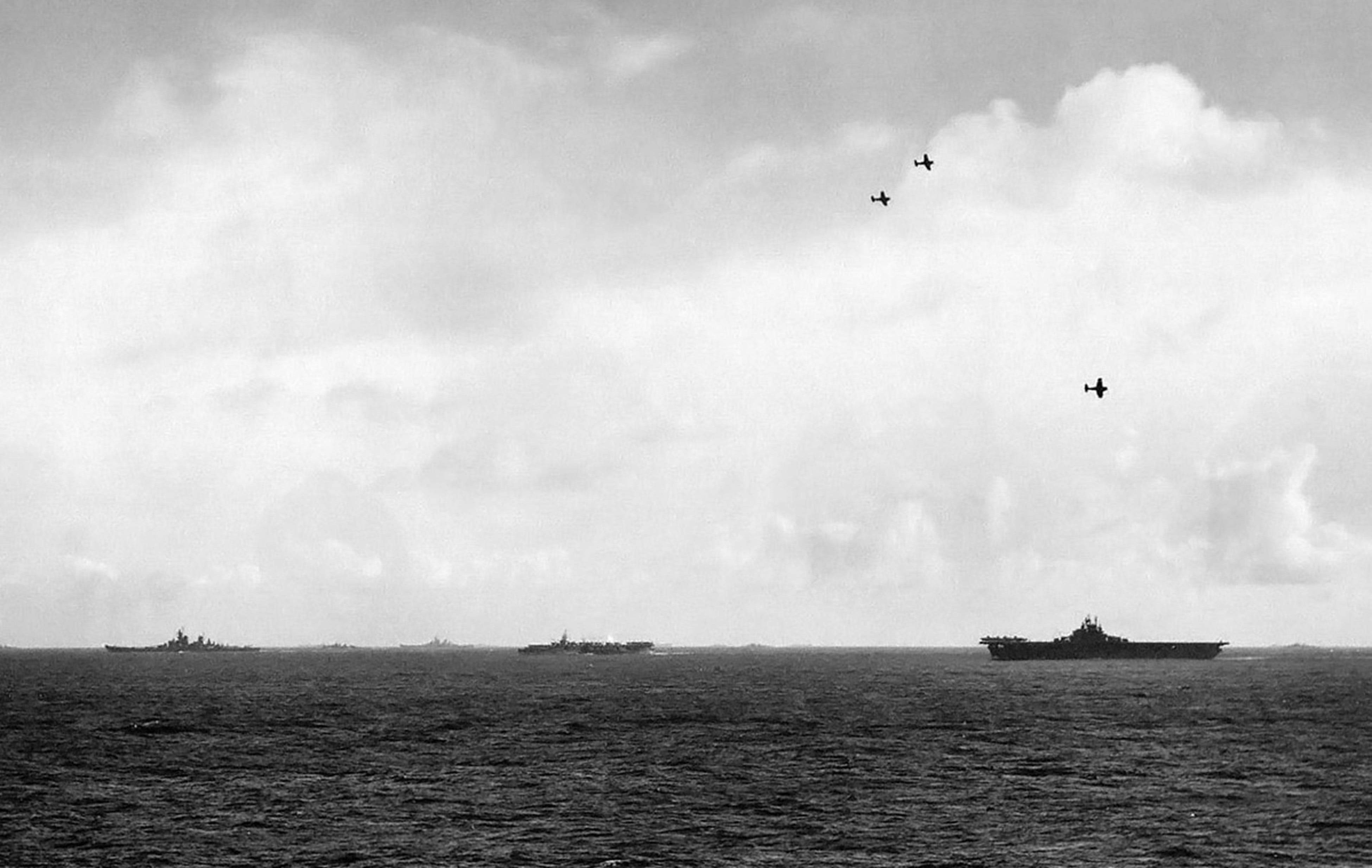
The Task Force 58
Task Force 58 or the Fast Carrier Task Force, became the steel fist of America’s Fifth Fleet under Admiral Raymond Spruance. Born in January 1944 and shaped by the vision of Admiral Marc Mitscher, TF 58 was more than just a collection of ships. Picture it: sleek fleet carriers, nimble light carriers, battleships, cruisers, destroyers, and an entire logistical train, all sailing as one.
But what made TF 58 legendary wasn’t just its sheer might; it was how seamlessly it combined scouting, fighter screens, strike aviation, anti-aircraft guns, and at-sea resupply into a single, mobile war machine. This was naval warfare, reimagined for the modern age.
As the U.S. pushed west across the Pacific, TF 58 became the spearhead—covering landings in the Marshalls, Marianas, Iwo Jima, and Okinawa, while striking deep at enemy bases, even reaching the Japanese Home Islands. Here, the carrier truly dethroned the battleship. No longer content to simply shepherd amphibious landings, TF 58 shaped the battlefield itself, softening targets and breaking enemy strength before the boots ever hit the sand.
The true test came in June 1944, at the Battle of the Philippine Sea. Under Mitscher’s command, TF 58’s aviators turned the skies into a shooting gallery, annihilating Japan’s carrier air power in the infamous “Marianas Turkey Shoot.” Hundreds of Japanese planes fell, carriers were lost, and the skilled aircrews who could never be replaced vanished from the war.
The outcome? Not just tactical victory, but strategic dominance—America now controlled the Marianas, opening the door to the final push toward Japan.
TF 58’s reach was breathtaking. In early 1945, its carriers launched the first air strikes on Tokyo since the Doolittle Raid, and, soon after, aircraft from its decks hunted down and destroyed the massive battleship Yamato, proving once and for all that the era of the battleship was over.
Task Force 58 wasn’t just a formation. It was the vanguard of a new kind of naval power: fast, coordinated, and able to strike first from oceans away. In its wake, it left no doubt; the future of naval warfare belonged to the carrier. For further reading, check out the Naval History and Heritage Command or the National Park Service.
The Legacy of Task Force 58 and Yamato’s Lost
The mighty battleship Yamato, the crown jewel of Japanese sea power, surges toward Okinawa on her final sortie. She’s an icon of naval might, bristling with guns and shrouded in thick armor, the very symbol of an era when battleships ruled the waves. But that day, the Yamato never even comes within range of her enemy’s guns.
Instead, she’s caught by the long reach of Task Force 58, the U.S. Navy’s Fast Carrier Task Force, a floating armada of carriers and their escorts commanded by Marc Mitscher. From over the horizon, wave after wave of carrier-based aircraft descend, pounding Yamato and her escorts with bombs and torpedoes. The great ship is overwhelmed, capsizing and exploding in a towering fireball before she ever has a chance to turn her guns on the enemy.
That moment was more than just the destruction of a ship. It was the thunderous end of an era. Yamato, once the pride of Japan’s navy, was built to dominate through brute strength and armor. But she fell not to another battleship, but to the coordinated might of carrier aviation, striking from far beyond the range of her big guns. Her sinking marked the collapse of an old doctrine, one that believed the heaviest armor and the biggest guns would always decide sea battles.
In contrast, Task Force 58 embodied a bold new future. With its seamless blend of carriers, fighters, bombers, scouting planes, and the logistical muscle to stay at sea for months, it showed what modern naval power looked like: fast, flexible, networked, and able to project force at staggering distances. Its victories in the Philippine Sea and against Yamato proved that from now on, naval battles would be won by those who controlled the skies.
This legacy still echoes today. The world’s great fleets are centered on carriers, not battleships, and every contest for the world’s sea lanes (from the Cold War to the present) reminds us: the first battle is for the air above the waves. Control that, and you control the sea.
In Case You Missed It
Photo Outlet
Every issue of Hangar Flying with Tog gets you a free image that I’ve taken at airshows:
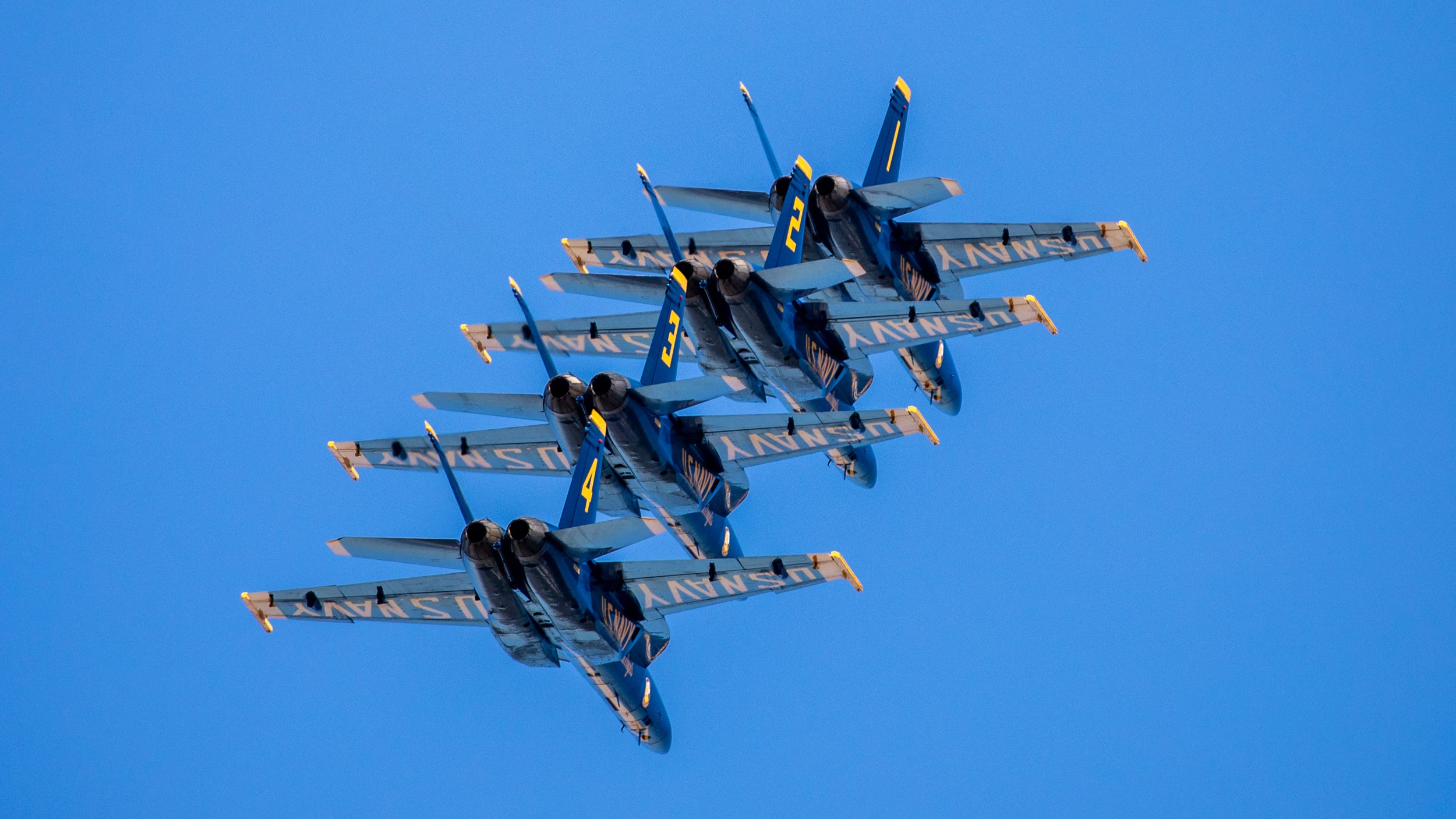
Feel free to use these photos however you like. If you choose to tag me, I am @pilotphotog on all social platforms. Thanks!
Post Flight Debrief
Like what you’re reading? Stay in the loop by signing up below—it’s quick, easy, and always free.
This newsletter will always be free for everyone, but if you want to go further, support the mission, and unlock bonus content like the Midweek Sortie, consider becoming a paid subscriber.
Your support keeps this flight crew flying—and I couldn’t do it without you.
– Tog