

MQ-28 Ghost Bat Meets the Eagle II and Remembering when Mitchell Sank the Ostfriesland
From Mitchell’s bombers over Ostfriesland to the Ghost Bat beside the F-15EX, airpower raises the same question: what happens when a new machine proves that the old order is no longer untouchable?
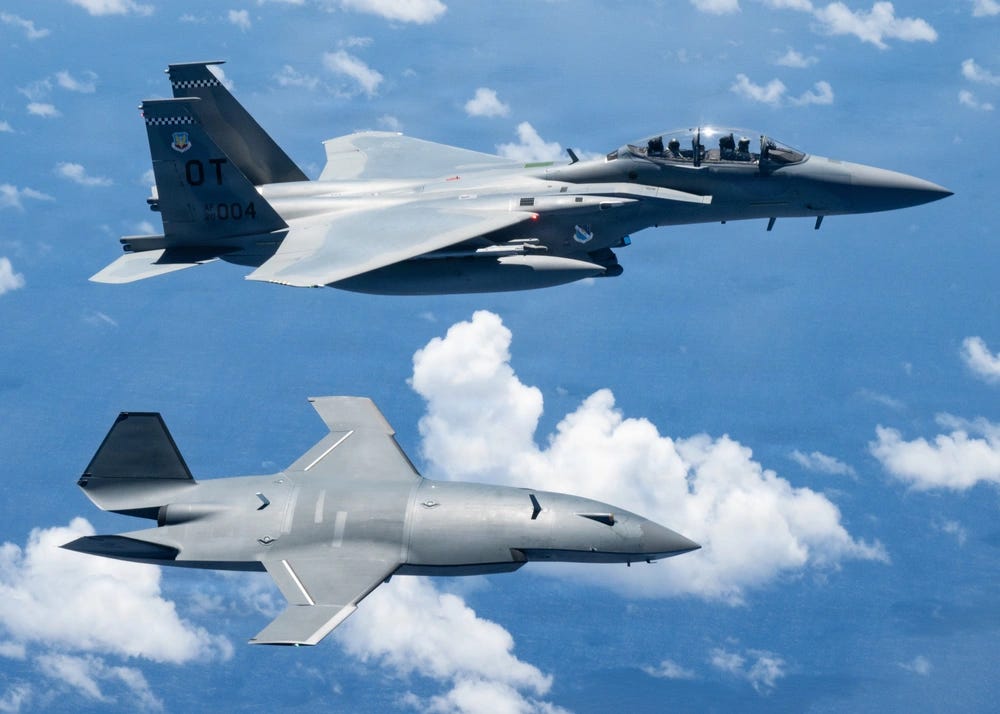
An MQ-28 Ghost Bat and U.S. Air Force F-15EX Eagle II participated in Exercise Valiant Shield 2026 over the Philippine Sea, demonstrating the future of human-machine teaming in the theater. Uncrewed systems act as a force multiplier, extending the reach and effectiveness of human pilots.
—— U.S. Pacific Air Forces
Mission Briefing
The MQ-28 Ghost Bat soared alongside the F-15EX, joining a daring proof-of-concept FARP mission in the thick of Valiant Shield 2026. In a scene straight out of an aviator’s tale, the Experimental Operations Unit pushed the edge of what’s possible high above the Pacific.
Eagle II’s Ghost Wingman
Sunlight glints off the wings as the MQ-28 Ghost Bat and the F-15EX Eagle II carve contrails across the endless blue canvas of the Philippine Sea during Valiant Shield 2026.
The Pacific Air Forces (PACAF) just dropped a fresh batch of photos—no dates, just pure cinematic energy—showing these two birds not just sharing airspace, but making real the bold vision Boeing teased in their concept art: manned and unmanned teaming up, side by side, in a new era of aerial collaboration.
PACAF’s social media post read like an aviator’s campfire tale: “An MQ-28 Ghost Bat and U.S. Air Force F-15EX Eagle II participated in Exercise Valiant Shield 2026 over the Philippine Sea, demonstrating the future of human-machine teaming in the theater.
Uncrewed systems act as a force multiplier, extending the reach and effectiveness of human pilots.” Translation? The Ghost Bat isn’t just tagging along. It’s multiplying what fighter jocks can do, pushing the boundaries of what’s possible when man and machine trust each other at Mach speed.
Now, the official word’s a bit cagey on whether the F-15EX crew, from the 85th Test and Evaluation Squadron, actually took the Ghost Bat’s reins mid-flight. But here’s a little inside baseball: Air Force pilots have already shown they can pilot drones from the cockpit during past trials. So, the idea that the F-15EX might have been calling the shots for its robotic wingman? Don’t rule it out.
Last month’s press release hinted at bigger plans: “The uncrewed MQ-28 will fly in concert with crewed fighter platforms, providing a critical opportunity for the joint force to refine tactics, techniques, and procedures for this next evolution of airpower.”
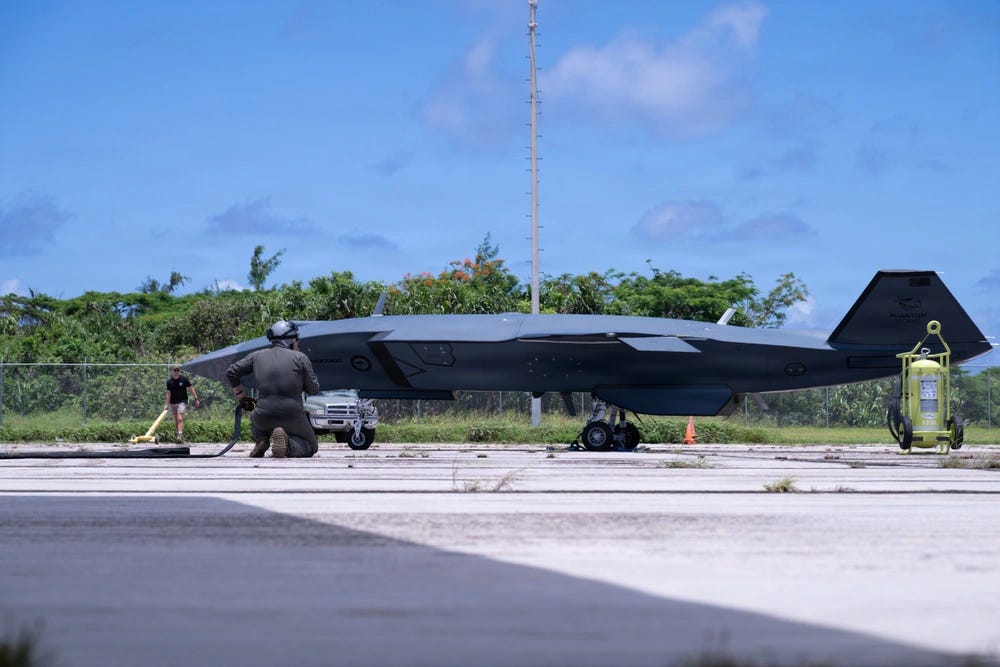
For this exercise, the Ghost Bat deployed out to Rota in the Northern Mariana Islands, showing up as a production-representative model, complete with an Infra-Red Search and Track system—think of it as a nose for trouble at 40,000 feet.
On June 28, things got even more interesting. The MQ-28 joined a proof-of-concept Forward Arming and Refueling Point (FARP) op for Collaborative Combat Aircraft, bolstered by a HC-130J Combat King II, Airmen from the 79th Rescue Squadron, the Royal Australian Air Force, and the Experimental Operations Unit (EOU).
The EOU, stood up just last year at Nellis, exists to fast-track these kinds of game-changing projects. Crafting the playbook for how manned and unmanned craft will fight and survive together.
With the EOU’s fingerprints all over this, and fresh off testing the YFQ-44A at Edwards, it’s clear Valiant Shield 2026 was more than a demo. It was a proving ground for tomorrow’s air combat. And with the Air Force now greenlighting production contracts for the FQ-42 and FQ-44, the curtain’s just rising on the next act of the man-machine saga.
Ghost Bat & Eagle II: The Next-Gen Wingmen Redefining Airpower
Imagine a wingman that never tires, never hesitates, and always has your six. That’s the Boeing MQ-28 Ghost Bat. Built as an uncrewed collaborative combat aircraft, the MQ-28 is all about smart human-machine partnership, serving as a true force multiplier in the skies. Its mission?
Fly alongside crewed jets, bringing game-changing persistence, operational punch, and survivability to some of the world’s toughest airspaces. Packed with autonomous tech, the Ghost Bat isn’t just fast. It’s affordable and deployable in numbers, taking on risky missions so pilots don’t have to.
What really sets the MQ-28 apart is its flexibility. With a modular design and Open Systems Architecture, it can swap out mission gear on the fly, loading up with third-party payloads or new systems as fast as threats change. The nose is fully missionized. Just pop it off, plug in what you need, and you’re ready for the next challenge. This adaptability means global forces can keep pace with rapid innovation and stay ahead of adversaries.
On the tactical front, the MQ-28 brings affordable combat mass to bolster both crewed and uncrewed missions. It acts as an airborne brain, fusing sensor data and payloads from across the force to boost intelligence, surveillance, reconnaissance, and early warning.
Sized like a trainer but with the wingspan of a stealth fighter, the MQ-28 can cover over 2,000 nautical miles, standing ready to extend the operational reach of any formation.
Economically, the MQ-28 is a game-changer, coming in at about a tenth of the cost of a traditional crewed jet. Digital production and advanced manufacturing keep it efficient, while a digital ecosystem ensures that upgrades and new features can be plugged in on the fly—sometimes independent of Boeing itself.
Now, meet its new partner: the F-15EX Eagle II. This is the most advanced Eagle yet, loaded with digital fly-by-wire controls, a glass cockpit, APG-82 AESA radar, JHMCS helmet, and a next-gen self-defense suite.
Thanks to its Open Mission System, the Eagle II is built for rapid upgrades, packing more speed, range, and a hefty 29,500-pound payload, plus the longest stand-off engagement range in the USAF arsenal.
In short, when the MQ-28 and Eagle II fly together, the sky is set for a whole new era of airpower.
A New Allied Airpower Team
The F-15EX Eagle II and Australia’s MQ-28 Ghost Bat slicing through the Pacific sky during Valiant Shield 2026. It is a scene that’s more than just a show of force over the Philippine Sea.
It’s a preview of how the U.S. and its allies are weaving together crewed jets, autonomous wingmen, and cutting-edge sensors to build a smarter, more connected fighting force.
For the U.S., this dynamic duo hints at a not-so-distant future where Collaborative Combat Aircraft amplify the reach, survivability, and firepower of crewed fighters.
Imagine an F-15EX not flying solo, but orchestrating a team of uncrewed partners; scouting ahead, jamming enemy radar, or adding muscle without putting extra pilots in the danger zone.
This flight was a milestone on the road to true human-machine teaming in the Indo-Pacific.
Allies got a front-row seat as the Australian-born Ghost Bat joined a U.S.-led exercise, working seamlessly with partners from Canada, Japan, and New Zealand. It was a taste of tomorrow’s coalition airpower—built together, not apart.
The Ghost Bat’s role in forward refueling drills also showed that autonomous aircraft can leapfrog close to the action, supporting the nimble, resilient posture needed across the vast Pacific.
Down the line, this flight won’t just be remembered for its striking formation, but as the dawn of a new era, where aviators and autonomous teammates take to the sky as a single, unstoppable force.
This Week in Aviation History
They say the sinking of the Ostfriesland was just a one-off spectacle, but the truth is, it was the grand finale to months of daring bombing experiments by the U.S. Navy and Air Service back in 1921. Picture a handful of sky cowboys, led by Billy Mitchell, determined to prove that air power could change the rules of war forever. The Ostfriesland’s dramatic end became a legend overnight—a banner moment for American aviation. Yet, behind that smoky spectacle, the real story is tangled up in debate and controversy, even now.
Mitchell’s War Against the Battleship
Let me take you back to the summer of 1921, when the skies above the Atlantic were alive with the ambitions of Billy Mitchell, the maverick aviator who believed airplanes could change the nature of war.
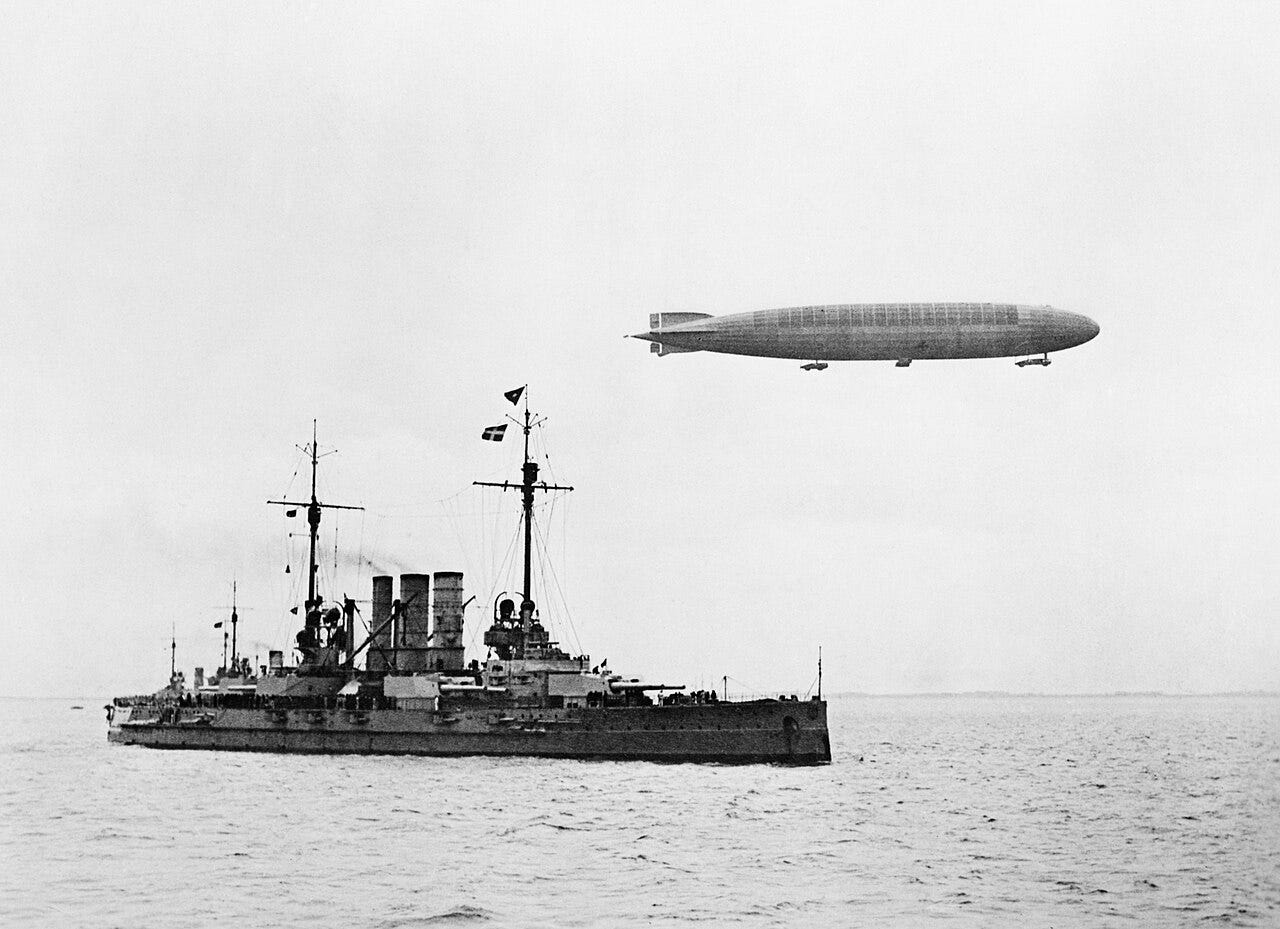
Mitchell, a master of both flying and political maneuvering, pulled strings in Congress to get his Air Service boys into the Navy’s highly controlled bombing tests. The Navy, ever wary of these upstart airmen, kept the rules tight and the targets strictly chosen: a captured German sub, the lumbering USS Iowa converted into a radio-controlled ghost ship, a battered destroyer, the cruiser Frankfurt, and the crown jewel—the mighty battleship Ostfriesland, fresh from the spoils of World War I.
The whole affair built up to a cinematic showdown. When Ostfriesland’s turn came, Mitchell wasn’t about to let the Navy’s cautious playbook slow him down. He ordered his flyers to unleash hell, first with one-thousand-pound bombs and then, in a bold final act, with six two-thousand-pound bombs raining down.
It was over in a flash—twenty minutes of thunder, and Ostfriesland slipped beneath the waves. There hadn’t even been a direct hit, but the shockwaves did the job. The Navy cried foul, arguing their engineers hadn’t even had a chance to poke around the battered hulk, but the headlines were already written: Mitchell’s planes had sunk a battleship, just as he’d promised.
Sure, the ship had been anchored, unable to run or shoot back, but that hardly mattered to a public dazzled by the drama.
As historian Alfred Hurley put it, the argument couldn’t drown out the simple, spectacular truth, Mitchell had made good on his boast. The aftermath was classic military politics.
The Joint Army Navy Board, charged with keeping peace between the services since Teddy Roosevelt’s day, issued a report that fell well short of Mitchell’s vision for an independent air force.
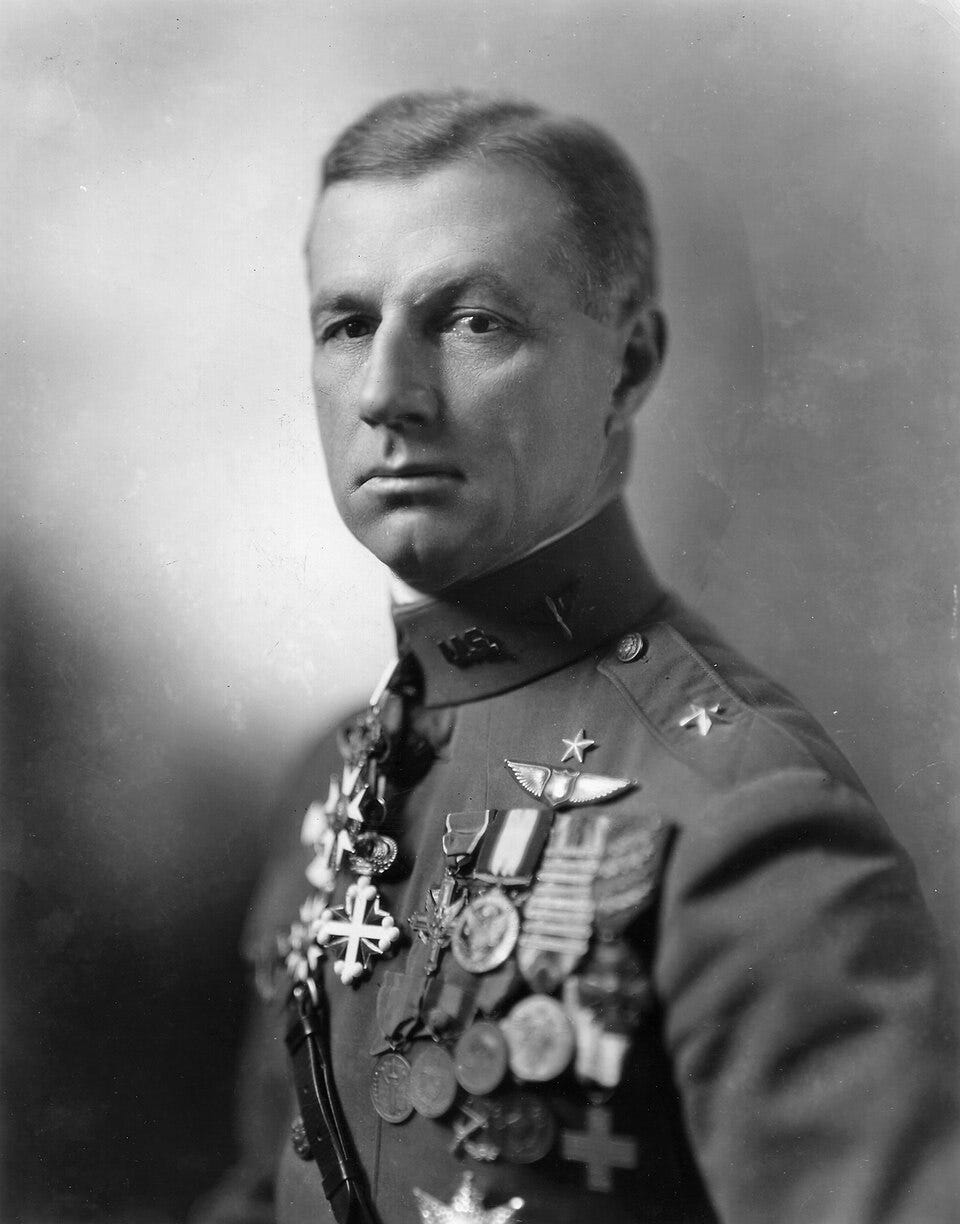
Unfazed, Mitchell penned his own defiant report and leaked it to the press, declaring that the age of the battleship was over, and that anywhere a ship could go, an airplane could follow, spellbound by the promise of a new era in warfare
The Aftermath
How much did Mitchell’s bold moves really shape the rise of air power, the dream of strategic bombing, and the quest for an independent air force? Military historians still wrestle with that question.
Some, like Alfred Hurley, see Mitchell not as a master theorist, but as a prophet, a relentless promoter, and, ultimately, a martyr for his cause. Hurley admits Mitchell’s flaws, even some blunders, but can’t help admiring the man.
Others, like James J. Cooke, are less generous. Cooke says that too many have glossed over Mitchell’s faults, painting him as a heroic “knight of the air” when, in truth, he was far more complicated.
Rondall R. Rice goes further, calling Mitchell openly insubordinate and deserving of his court-martial, baffled by the reverence today’s Air Force leaders still show him.
But what about Mitchell’s true influence on America’s approach to strategic bombing? Thomas H. Greer, in his study of air doctrine, points out that the real changes between the late 1920s and mid-1930s came from leaps in airplane technology and crucial inventions like the Norden Mark XV bombsight, which let pilots aim with pinpoint accuracy.
Doctrine mattered too, and that’s where the Air Corps Tactical School (ACTS) enters the scene. Founded in 1920 at Langley Field and later moved to Maxwell Field in Alabama, ACTS started out teaching “limited area” bombing, but soon pivoted to championing high-altitude, daylight precision strikes.
The focus was on hitting “choke points”—the industrial heart of the enemy—rather than carpet bombing cities, in part because the American public recoiled at the thought of mass civilian casualties.
So while Mitchell’s showmanship set the stage, the real groundwork of strategic bombing doctrine was laid by evolving technology, thoughtful debate, and a new generation of airmen determined to prove that the future of warfare belonged to those who mastered the skies.
The Day Airpower Sank an Era
The mighty German battleship Ostfriesland, anchored and unmanned, facing a squadron of Army Air Service bombers led by Billy Mitchell. The ultimate showman of the skies.
With a thunder of heavy bombs and a few well-placed near misses, Mitchell’s flyers sent the battleship rolling over and down to the ocean floor, proving in spectacular style that even these steel giants were not safe from the reach of air power. Sure, it wasn’t a real battle—no crew, no guns firing back—but the image was unforgettable. Suddenly, the battleship, long the pride of naval might, looked vulnerable.
The shockwaves rippled far beyond the sinking itself. Mitchell’s bold strike fueled fierce debates about national defense, the role of aviation, and whether air or sea would rule the future.
It gave his campaign for an independent air force new wings and forced skeptics to reckon with a changing battlefield. The tests spurred fresh thinking about bombing tactics, bombsight technology, and just how exposed warships were from above.
Of course, battleships didn’t vanish overnight; admirals still clung to them, even as aircraft carriers began to steal the spotlight.
The real legacy of Ostfriesland wasn’t an instant revolution, but a powerful warning: when technology evolves, the old rules don’t always hold.
From Mitchell’s daring raid to today’s high-tech aerial teams, one lesson endures; airpower’s future is always a challenge to yesterday’s assumptions.
In Case You Missed It
Photo Outlet
Every issue of Hangar Flying with Tog gets you a free image that I’ve taken at airshows:
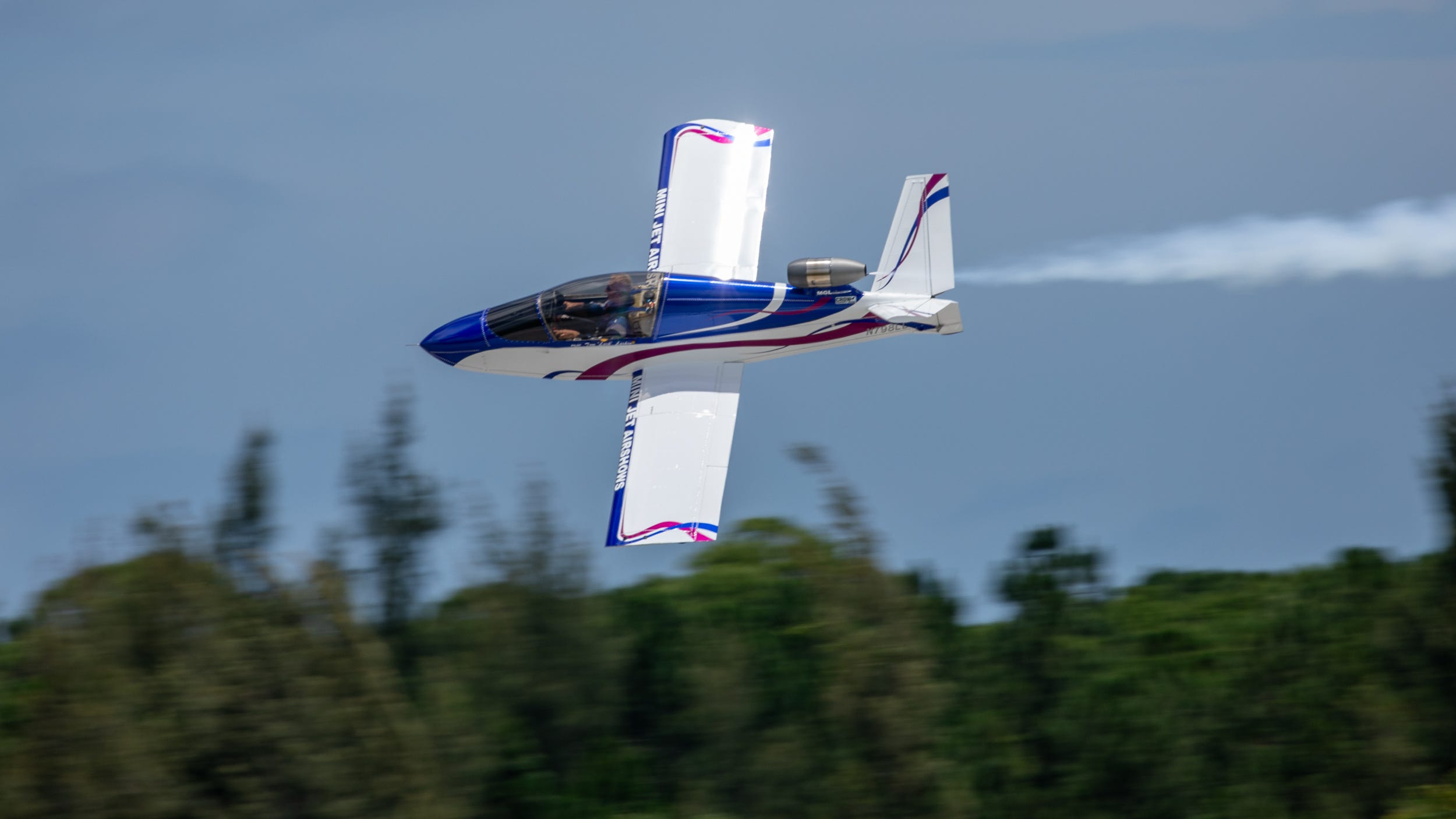
Feel free to use these photos however you like. If you choose to tag me, I am @pilotphotog on all social platforms. Thanks!
Post Flight Debrief
Like what you’re reading? Stay in the loop by signing up below—it’s quick, easy, and always free.
This newsletter will always be free for everyone, but if you want to go further, support the mission, and unlock bonus content like the Midweek Sortie, consider becoming a paid subscriber.
Your support keeps this flight crew flying—and I couldn’t do it without you.
– Tog