

MQ-25 Stingray Gets the Green Light and Look Back at the Battle of Midway
The Battle of Midway showed the power of carrier aviation; the MQ-25 Stingray shows why extending that power still matters today.
“Today during the Senate Armed Services Committee Hearing, I announced the MQ-25A Stingray is moving into the production phase. Integrating unmanned refueling extends the lethality of our Carrier Strike Groups and equips our force with a decisive advantage to fight and win against any adversary.”
—Acting Secretary of the Navy Hung Cao
Mission Briefing
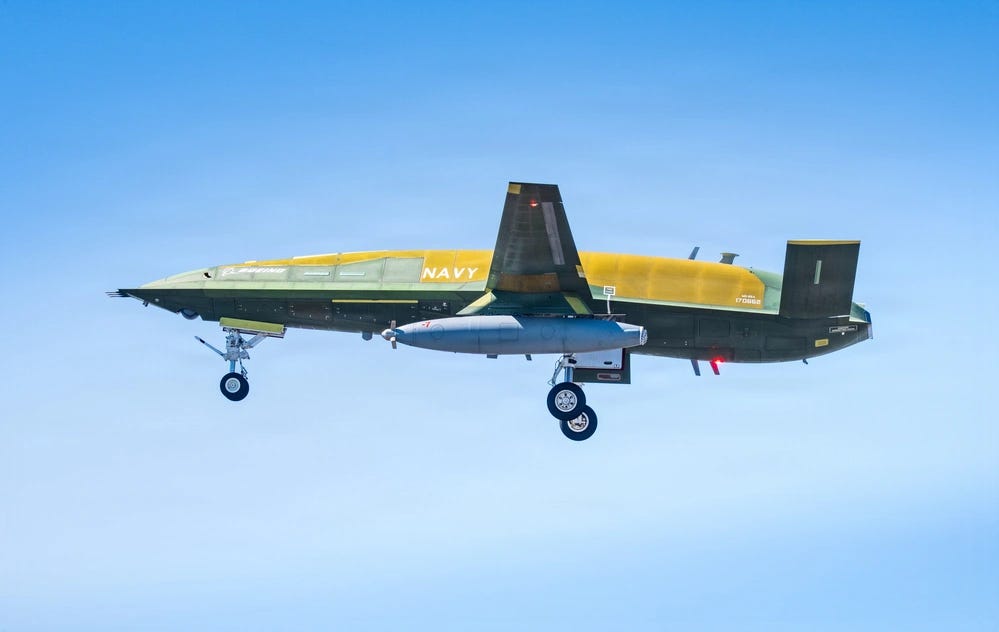
After its maiden voyage, the Navy’s MQ-25 Stingray soared past Milestone C—earning the green light for low-rate initial production. In true sky-pioneer fashion, this uncrewed tanker is now cleared to roll off the line and join the fleet.
Stingray Cleared for the Carrier Tanker Fight
In the marbled halls of the Senate, Acting Secretary of the U.S. Navy Hung Cao steps up to the mic, eyes bright with the kind of excitement only aviators and dreamers know. At a Senate Armed Services Committee hearing, he drops a bombshell—one with the thrum of jet engines behind it: The MQ-25 Stingray, the Navy’s uncrewed aerial tanker, has just hit Milestone C.
Translation? The Stingray has been greenlit for Low-Rate Initial Production. The ink is barely dry on its first official flight, which happened less than a month ago, on April 25.
The Navy’s own Portfolio Acquisition Executive Aviation office is already prepping the paperwork. This summer, they’ll award the first LRIP contract. Three aircraft to start, with the option to tack on three more in Lot 2, and five in Lot 3.
The MQ-25 isn’t just another drone; it’s a force multiplier. “Unmanned refueling extends our reach against any adversary,” Cao tells the senators, his words echoing through the chamber.
“Moving the MQ-25A Stingray to Milestone C and into production is arming our warfighters with a capability that increases the lethality of our Carrier Strike Groups. This is a decisive advantage that delivers our warfighters what they need to fight and win.”
Vice Adm. John E. Dougherty IV, the Navy’s aviation acquisition chief, chimes in, underscoring how the Stingray will keep carriers agile, lethal, and always ready. “Milestone C approval represents an important step for this program. MQ-25A will provide persistent aerial refueling and unlock greater capacity across the air wing, ensuring our carrier strike groups remain lethal, flexible, and forward ready.”
You can almost hear the applause from the Boeing team. Troy Rutherford, their MQ-25 program VP, calls it a “historic milestone,” promising to get this “game-changing unmanned aircraft” out to the fleet and into the heart of carrier operations.
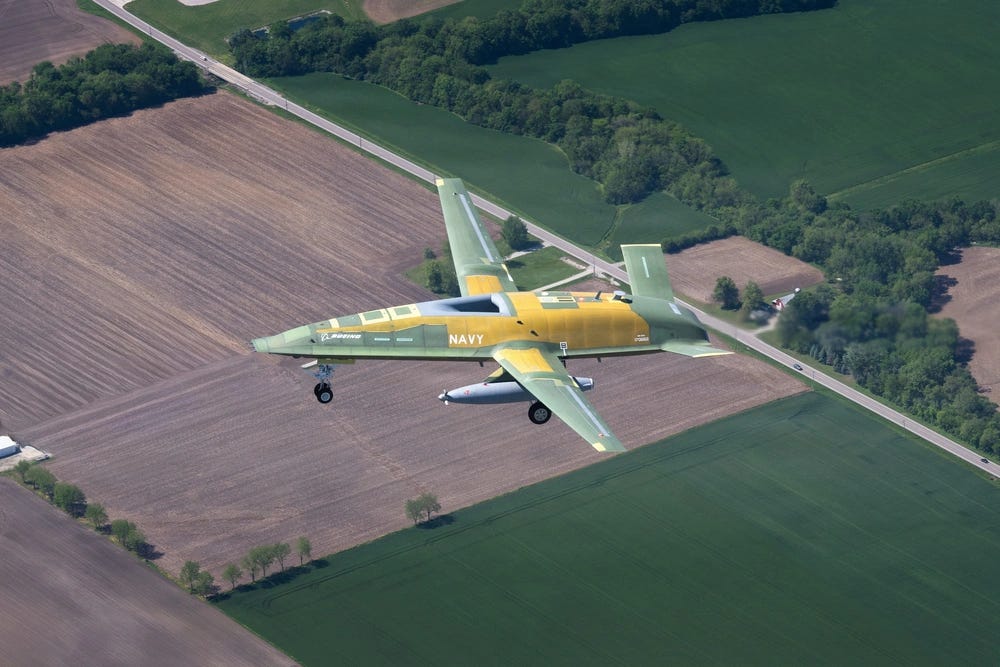
Let’s rewind to April 25, 2026. After years of anticipation, the MQ-25A Stingray finally lifts off for its maiden operational flight from MidAmerica St. Louis Airport, Mascoutah, Illinois.
For two hours, the Stingray soars, guided by both Boeing and Navy pilots at the controls of the UMCS MD-5 ground station. Lockheed Martin’s high-tech system humming in the background. A company-owned TA-4J Skyhawk and a Navy UC-12M Huron tag along as chase planes, keeping a watchful eye.
This flight marks nearly seven years since the original T1 prototype’s first sortie back in 2019. Now, the production MQ-25 flies with the same Cobham ARS pod found on the Navy’s F/A-18s, meaning it can deliver up to 16,000 pounds of fuel 500 nautical miles out to sea. For the Navy, it’s not just a milestone. It’s a leap into a new era of carrier air wing endurance and reach.
The Carrier-Based Unmanned Aircraft
Imagine this: the MQ-25 Stingray is about to make history as the world’s first operational, carrier-based unmanned aircraft, designed to refuel the Carrier Air Wing and Carrier Strike Group right from the deck at sea.
By weaving this persistent, sea-going tanker into the air wing, the Navy will unlock longer missions and free up strike fighters for what they do best, carrying out combat missions far from home.
This isn’t just another drone; the MQ-25 is laying the runway for a future where manned and unmanned aircraft work together seamlessly, pioneering the Navy’s next chapter in carrier aviation.
The plan? Eventually, every NIMITZ and FORD-class carrier will be MQ-25 ready. The journey begins with test flights at Boeing’s Illinois facility, then heads to Patuxent River, Lakehurst, and Eglin AFB, as the Navy puts this game-changer through its paces.
Specifications:
Primary function: Aerial refueling
Contractor: Boeing
Propulsion: Rolls-Royce AE3700N
Length: 51.0 ft
Wingspan (wings spread): 75.0 feet
Wingspan (wings folded): 31.3 feet
Height (wings spread): 9.8 feet
Height (wings folded): 15.7 feet
Stingray Extends the Carrier’s Reach
The U.S. Navy, long master of the seas and sky, now faces a new frontier. Not a battle for air superiority, but a challenge of distance and endurance. Enter the MQ-25 Stingray, the Navy’s cinematic leap from manned might to autonomous innovation.
It’s the world’s first operational carrier-based drone, not just another gadget but a flying lifeline, built to keep the fleet’s most precious assets—its strike fighters—soaring further, longer, and with more punch than ever before.
Imagine yourself on the deck of a carrier, wind whipping past as jets roar to life. In the old days, F/A-18 Super Hornets handled refueling, siphoning their own combat potential to keep others airborne.
But now, the Stingray rolls out from the hangar, wings gleaming in the sunrise, ready to take on the grunt work. Suddenly, more Super Hornets are free to do what they were born for: striking deep, defending the fleet, and making every mile of ocean count.
With the MQ-25, the Navy isn’t just solving a logistics problem. It’s rewriting the rules. This drone can deliver up to 16,000 pounds of fuel 500 nautical miles out, a game-changer for a carrier in hostile waters.
Allies watch and take note: here is a shield that stretches further, a sword that stays sharper, a partner who doesn’t tire. In places where distance and danger once set the boundaries, the MQ-25 pushes them back.
But look closer, and you’ll see more than a refueling drone. This is the quiet revolution. The first step to an air wing where manned and unmanned fly side by side, each learning from the other, each expanding the art of what’s possible on a floating city at sea.
Today, it’s just fuel. Tomorrow? It could be anything. The MQ-25 is the bridge to that future—silent, steady, and utterly transformative.
This Week in Aviation History
It’s June 1942, and somewhere in the vast blue heart of the Pacific, American and Japanese warships clash in a five-day spectacle that would flip the script on the whole Pacific War. The air is thick with tension, engines roar, and history is rewritten in the wake of dogfights and thunderous explosions.
Strategic Background and the Role of Communications Intelligence
Imagine slipping on your flight goggles and soaring back to the spring of 1942, when the world was a chessboard and the Pacific Ocean was the grand arena. Japan’s ambitions were sky-high: they wanted to carve out a vast empire in East Asia and the Southwest Pacific, kicking the United States out of the driver’s seat.
The master plan? Crush the US Pacific Fleet and capture the tiny speck called Midway Atoll, a remote outpost more than 3,200 miles from San Francisco, perched on the edge of nowhere. From there, Japanese bombers could strike Pearl Harbor again, tightening their grip on the Pacific and, they hoped, forcing the Americans to the peace table.
Midway, a lonely set of islands in the far reaches of the Hawaiian archipelago, had quietly become a linchpin. The US had annexed it in the 1800s, but by 1940, it was buzzing with construction crews and military planners fortifying it for the storm they saw coming.
After the shock of Pearl Harbor in December 1941—when Japanese destroyers lobbed shells at Midway’s Naval Air Station—the Americans beefed up their presence. By June 1942, the atoll bristled with PBY Catalinas, B-17s, and 4,000 determined personnel, all bracing for the fight they knew was on the horizon.
The battle exploded from June 3rd to 7th, a five-day clash across an oceanic expanse as big as the continental US. Warships dueled at distances where you could barely see the enemy, trading steel and fire over 50 to 150 miles.
But behind the scenes, the real secret weapon was codebreaking. American cryptanalysts, hunched over their desks, had cracked Japanese messages and learned of an attack on a place called “AF.”
With a clever ruse involving a fake water shortage, they confirmed AF was Midway. Armed with this intel, Admiral Chester Nimitz readied the US Navy for a counterpunch that would echo across history.
The Battle of Midway
Slide into the cockpit with me and let’s fly back to the dawn of 3 June 1942. The Pacific sky is endless, and somewhere below, a PBY seaplane from Midway is on patrol. Suddenly, the crew spots a shadow on the ocean—the Japanese Midway Occupation force, lurking southwest of the atoll.
Throughout the day, more glimpses come in: enemy ships are out there, but the prized Japanese carriers remain like ghosts in the mist. B-17 Flying Fortresses and PBYs scramble from Midway, dropping bombs on the ships they can find.
Anti-aircraft fire erupts in angry bursts, forcing the crews to veer away before they can really see what damage they’ve done. Reports trickle in, maybe a cruiser or two have been hit, maybe a transport, but nobody’s sure.
When night falls, the game changes. Four PBY-5As, loaded with Mark XIII torpedoes, slip out for a daring nighttime attack. The first of its kind by these patrol planes. Explosions flash on the dark water. Did they hit anything? Maybe one or two enemy ships took a beating, but the details are lost in the Pacific night.
Dawn breaks on June 4, and the war drums get louder. Japanese carrier planes swoop in, unloading on the US base at Midway. The Marines dig in and take heavy losses, but the base itself, battered but not broken, stands ready.
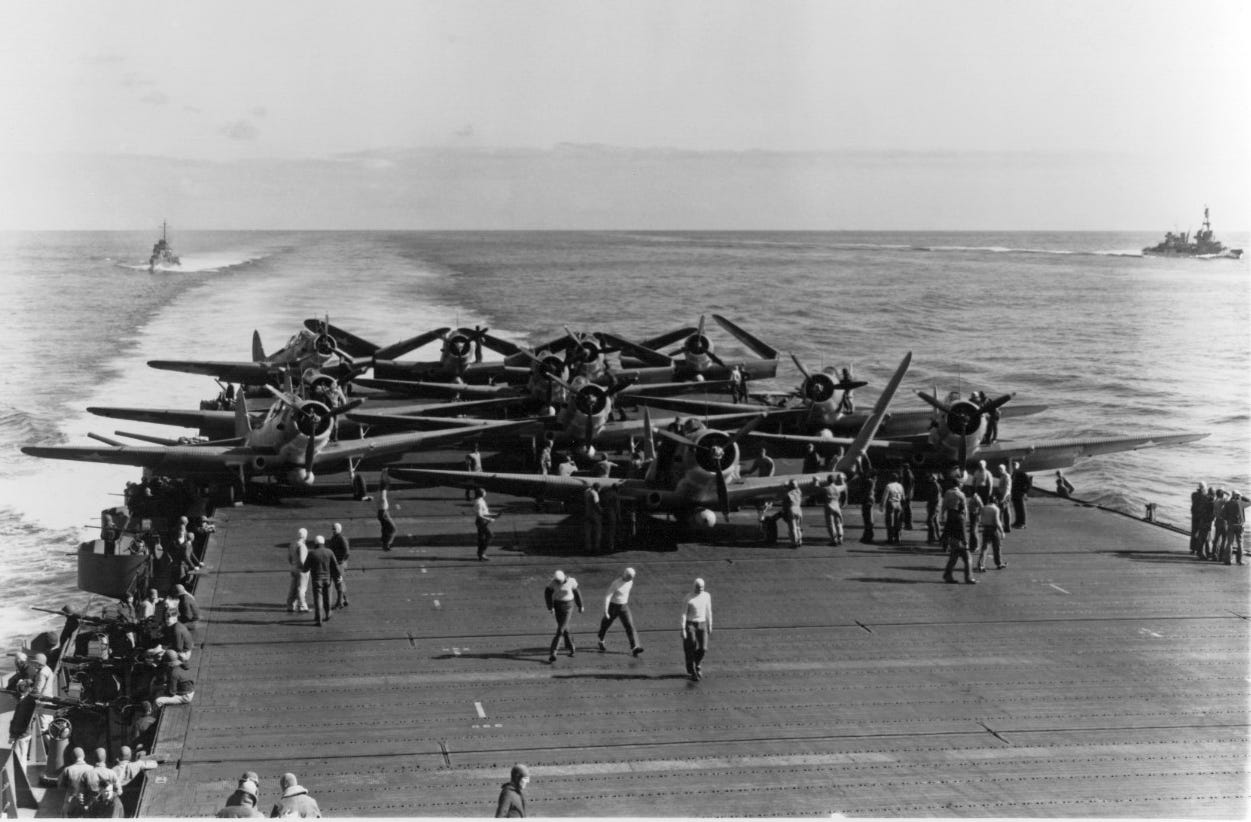
Out to the east, the US carrier fleet—Yorktown, Enterprise, Hornet—is poised like a coiled spring. Then, as the Japanese planes head home, the tables turn. The US Navy’s torpedo bombers roar off the decks, drawing enemy fighters away.
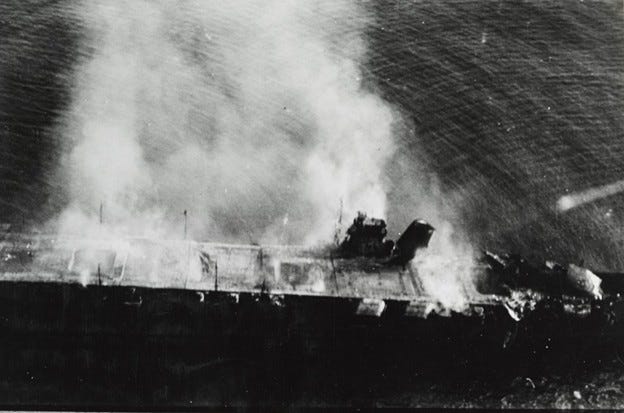
In their wake, Dauntless dive bombers plunge from the sky, smashing Japanese carriers Kaga and Akagi, then wrecking Soryu. Only the carrier Hiryu remains. She fights back desperately, launching two strikes that pound Yorktown, but the Americans are relentless. By evening, Dauntlesses from Enterprise find Hiryu and finish her.
June 5: Rear Admiral Spruance chases the retreating Japanese fleet west as Akagi and Hiryu are scuttled. Yorktown’s battered crew refuses to give up. On June 6, Enterprise and Hornet’s SBDs hammer the fleet again, sinking Mikuma and damaging more ships.
But a lurking Japanese submarine sneaks in, torpedoing Yorktown and the destroyer Hammann. At dawn on June 7, Yorktown finally slips beneath the waves, ending one of the most dramatic chapters in naval history.
Midway: The Carrier Battle That Turned the Pacific Tide
The legend of Midway isn’t just about the spectacle of four Japanese carriers slipping beneath the waves. Picture it: June 1942, the Pacific’s vast blue stretching in every direction, and the fate of the war hanging by a thread.
After the gut-punch of Pearl Harbor, Midway was the moment the tide turned. A showdown that stopped Japan’s island-hopping cold and put the wind back in America’s sails. The Naval History and Heritage Command calls Midway one of World War II’s most crucial clashes, and the National WWII Museum agrees: this battle rewrote the script for the Pacific theater.
But Midway’s true legacy? That ran deeper than the dogfights. This was a test of brains, nerve, and new tech. American codebreakers cracked the enemy’s plans before a single bomb dropped, proving that sometimes, victory starts in a stuffy room with headphones, not just out on the sea.
Aircraft carriers took center stage, trading blows from beyond the horizon; it was the pilots and their warbirds, not old-school battleships, that shaped the outcome. When Japan lost Akagi, Kaga, Soryu, and Hiryu, their carrier force was gutted. The U.S. lost the Yorktown, but kept enough punch to go on the offensive.
Midway was also about guts under pressure. Pilots launched into the unknown, sailors and commanders made split-second calls, intelligence officers gambled on half-seen signals. The war didn’t end there, but its course was forever changed. Japan’s expansion hit a wall, and the long, hard push through Guadalcanal and the Solomons began.
The real takeaway? Wars—then and now—aren’t won by machines alone. It takes sharp minds, grit, sacrifice, and bold moves in the heat of the moment. That’s what bridges the decks of 1942’s carriers to the high-tech command centers and contested skies of today.
In Case You Missed It
Photo Outlet
Every issue of Hangar Flying with Tog gets you a free image that I’ve taken at airshows:
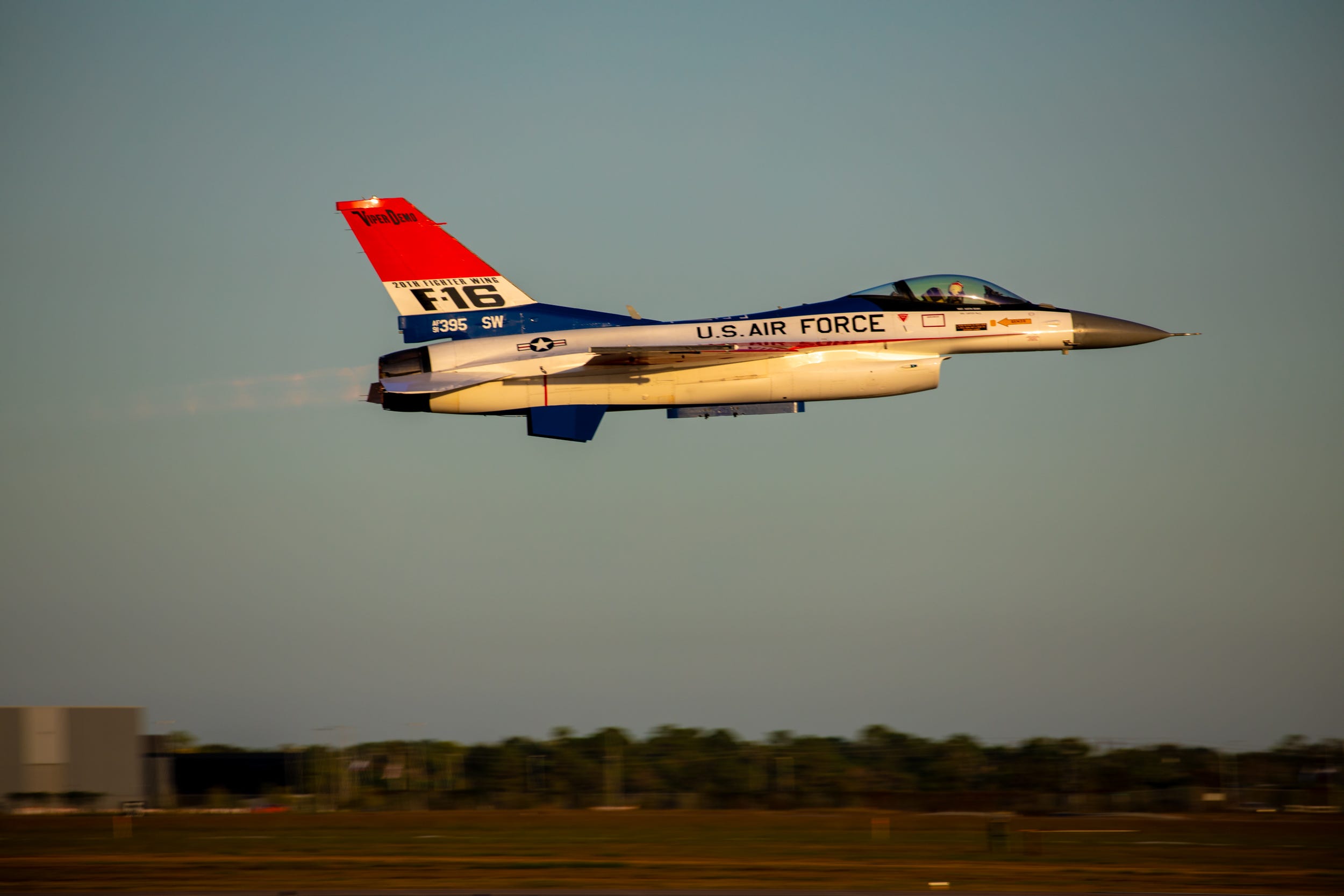
Feel free to use these photos however you like. If you choose to tag me, I am @pilotphotog on all social platforms. Thanks!
Post Flight Debrief
Like what you’re reading? Stay in the loop by signing up below—it’s quick, easy, and always free.
This newsletter will always be free for everyone, but if you want to go further, support the mission, and unlock bonus content like the Midweek Sortie, consider becoming a paid subscriber.
Your support keeps this flight crew flying—and I couldn’t do it without you.
– Tog