

MQ-25 Stingray Completed its First Flight and the Maiden Flight of S-64 Skycrane
From Sikorsky’s flying crane to the Navy’s unmanned tanker, specialized support aircraft keep expanding what military aviation can carry, sustain, and reach.
“Achieving this first flight underscores the strong partnership between the Navy and our industry partners.”
—Rear Adm. Tony Rossi
Mission Briefing
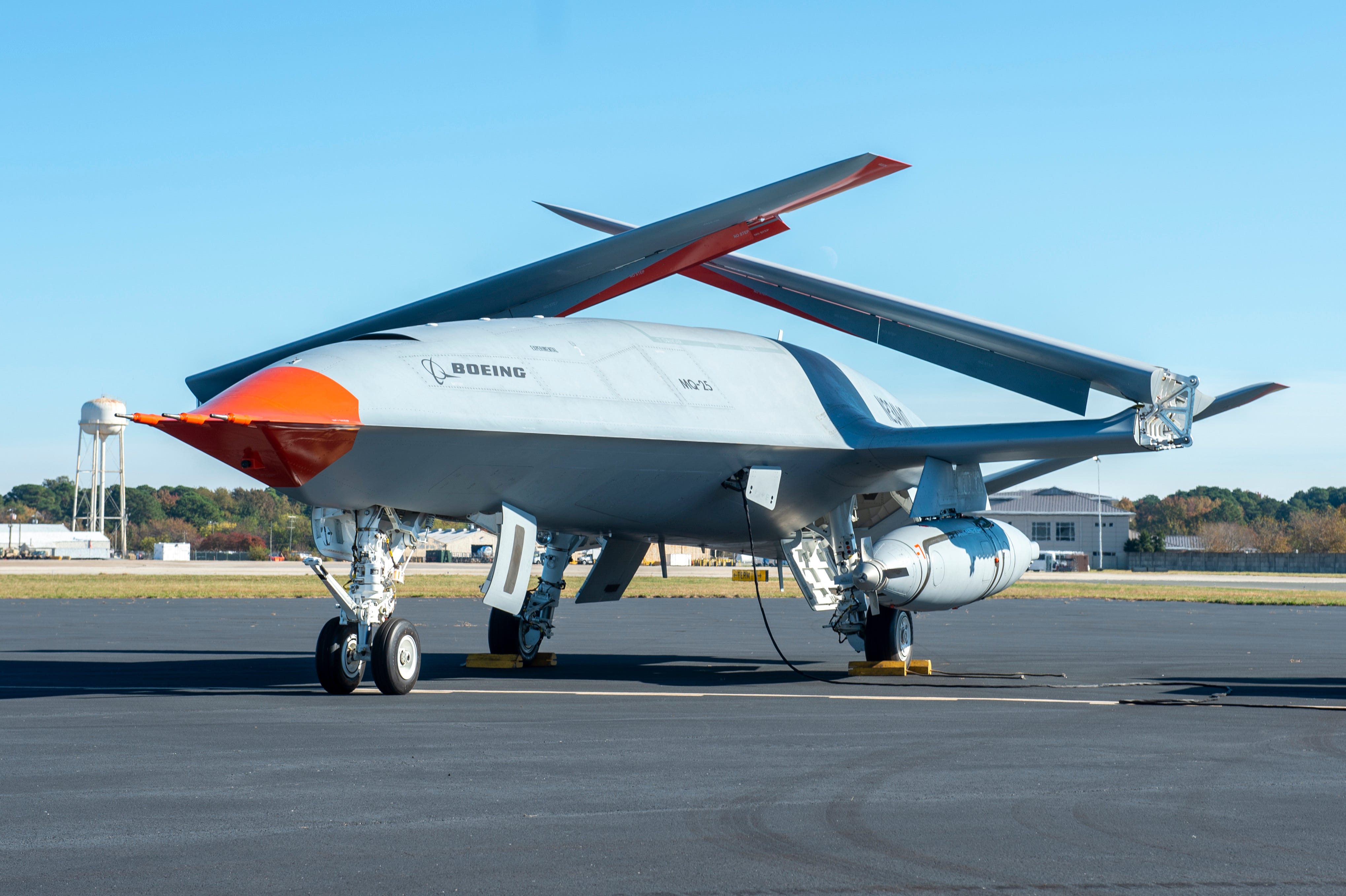
The first real-deal MQ-25 Stingray just soared into the skies for its maiden voyage—a major leap in the Navy’s quest to bring drone refueling to aircraft carriers. Picture this: a new era of aviation unfolds, with unmanned jets lining up to keep the action going at sea.
A Key Step Toward Carrier-based Unmanned Aerial Refueling
It’s a crisp spring morning at MidAmerica St. Louis Airport, and the future of carrier aviation is about to take flight. The U.S. Navy’s production model MQ-25 Stingray, a sleek, unmanned aerial refueling aircraft, revs up on the runway.
Nearly seven years after its predecessor, the T1 test asset, first kissed the clouds. On April 25, 2026, with anticipation thick in the air, the MQ-25 finally lifts off, trailed by a trusty Boeing TA-4J Skyhawk and a Navy UC-12M Huron, both playing the essential role of chase planes. It’s a cinematic moment: a new chapter for naval aviation, unfolding right before our eyes.
But getting here wasn’t just a matter of flipping a switch. The MQ-25’s first flight had been slated for late 2025, but, like any good adventure, there were a few plot twists. The maiden attempt on April 22 was aborted for reasons still under wraps.
Just another reminder that even cutting-edge tech has its dramatic pauses. Since January, Boeing and NAVAIR have been putting the aircraft through its paces with taxi trials. Those high and low-speed dashes down the tarmac where every system is poked, prodded, and verified. The MQ-25, sporting upgrades like a retractable EO/IR turret, has steadily moved from ground testing to taking on the skies.
The action isn’t slowing down, either. With this first flight in the logbook, the program now shifts into full-on flight test mode, with the Navy’s VX-23 and UX-24 squadrons teaming up to put the Stingray through its paces.
These units, seasoned in both manned and unmanned testing, will orchestrate a series of rigorous evaluations. Everything from system integration checks to new aerial refueling trials, ensuring the aircraft is truly carrier-ready.
All this feeds into the Navy’s vision of achieving Initial Operational Capability by fiscal year 2027, with nine Stingrays set to blaze the trail during testing. The lessons learned from the MQ-25’s journey—every engine start, aborted takeoff, and successful flight—are already shaping the next era of unmanned carrier aviation, where the sky’s the limit and the story’s just getting started.
Fueling the Fight: Inside the MQ-25 Stingray
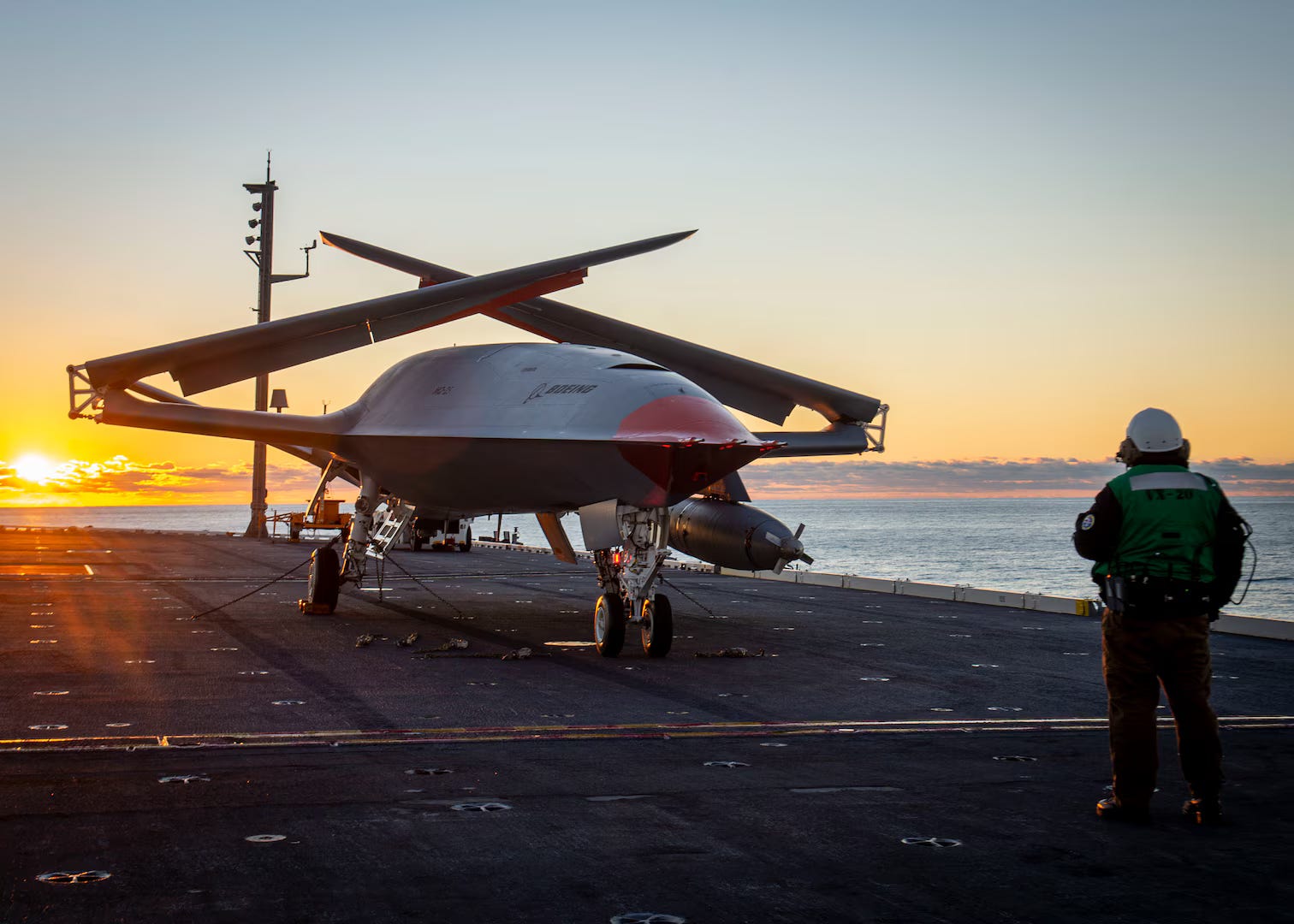
Think of the MQ-25 as a two-part marvel: there’s the futuristic drone itself—the Air System—and the Unmanned Carrier Aviation Mission Control System, or UMCS, which acts as mission control for carrier launches, recoveries, and everything in between.
The Navy’s PMA-268 crew is at the helm, orchestrating both elements like seasoned conductors, making sure every piece fits just right for seamless carrier integration.
Right now, the MQ-25 is deep into flight testing, building on lessons from its trusty forebear, the T1 test jet. Back in 2019, the first T1 flight opened the door to a whirlwind of discoveries, helping engineers fine-tune systems and software for a fast-paced development cycle.
Boeing came on board in 2018 with a contract to build four engineering models, and by 2020, three more test aircraft were greenlit. The MQ-25 T1 didn’t just taxi around either. By summer 2021, it was already topping off Super Hornets, F-35Cs, and E-2Ds midair.
Then, in December 2021, the MQ-25 took its talents to the USS George H.W. Bush, proving unmanned flight ops are ready for the big stage. The MQ-25’s journey is already rewriting what’s possible for carrier aviation.
General Characteristics
Primary function: Aerial refueling
Contractor: Boeing
Propulsion: Rolls-Royce AE3700N
Length: 51.0 feet
Wingspan (wings spread): 75.0 feet
Wingspan (wings folded): 31.3 feet
Height (wings spread): 9.8 feet
Height (wings folded): 15.7 feet
The Stingray Effect: Extending the Carrier Air Wing’s Reach
For the U.S. Navy, the MQ-25 Stingray isn’t just a high-tech tanker drone. It’s the stealthy solution to one of carrier aviation’s most pressing headaches: how to reach farther, faster, and safer.
As threats like anti-ship missiles and advanced air defenses push carriers farther from shore, the MQ-25 steps in to extend the reach of the carrier air wing. By taking the refueling burden off crewed fighters, this drone lets the F/A-18 Super Hornets get back to doing what they do best—flying strike missions—while pushing the boundaries of how far Navy jets can go on a single hop.
But the Stingray’s impact goes beyond American decks. Wherever U.S. carriers sail; from the Indo-Pacific to the Mediterranean or the Red Sea. So goes the reach of America’s allies.
With the MQ-25 in play, allied air wings can fly farther and linger longer, making coalition carriers a tougher challenge for any adversary and a bigger reassurance for any partner.
Its maiden flight in April 2026 wasn’t just a milestone for the Navy; it was a hint that unmanned systems aren’t just sidekicks anymore. They’re taking center stage. The MQ-25 isn’t about replacing pilots; it’s about letting them fly farther and smarter. As the Stingray proves itself at sea, the real question becomes not if drones have a place on the carrier deck, but just how many roles they’ll take on next.
This Week in Aviation History
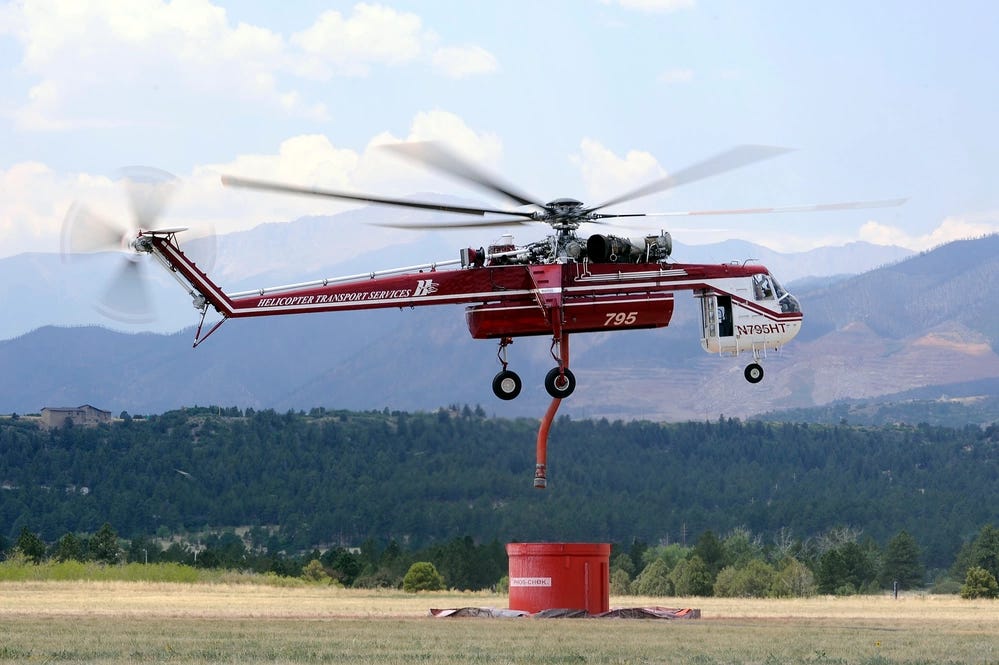
On a breezy day on 9 May 1962, the Sikorsky S-64 Skycrane took to the skies for its very first flight over Stratford, Connecticut. Picture this: an audacious machine, more powerful than its predecessor, swapping out the old piston engine for a sleek new turbine. The U.S. Army was so impressed, they snapped up six for testing and soon put in a hefty order for dozens more, dubbing them the CH-54A Tarhe and CH-54B. But the story didn’t end with the military. Sikorsky also crafted a handful of S-64Es and Fs for civilian use. The Skycrane’s debut was pure aviation cinema, marking the rise of a true heavy-lifting legend.
The Skycrane’s Maiden Flight
After the experimental S-60 flying crane proved its mettle, Sikorsky got the green light from the top brass to dream bigger, launching the development of the S-64 Skycrane. This new bird wasn’t just an upgrade. It was a leap, trading the old piston engines for powerful turbines and promising more muscle for heavy lifting.
The mission? Haul hefty cargo with speed and safety, thanks to its clever external load system. But Sikorsky’s team didn’t stop there; they designed a detachable pod slung underneath for moving troops or other internal loads, making the Skycrane even more versatile.
The S-64’s story kicked off with its maiden flight on May 9, 1962, a mere 13 months after Sikorsky’s board gave the go-ahead. By July, the prototype was already strutting its stuff at Fort Benning, Georgia, ready for Army evaluation. All funded straight out of Sikorsky’s pocket up to that point.
The Army was clearly impressed, purchasing six Skycranes for $13 million and giving them the military moniker CH-54A Tarhe. Four of these choppers would soon find themselves in Vietnam, flexing their muscle in the thick of the war. The Germans showed interest too, picking up a couple for testing, but eventually decided to stick with a different bird—the CH-53A, which had an internal cabin.
The Skycrane kept evolving. What began as the S-64A soon morphed, after the Army’s production order and a slew of upgrades (like wider rotor blades), into the CH-54A for the Army and the S-64E in Sikorsky’s books. Years down the line, as new missions emerged, the design evolved again into the CH-54B/S-64F. The Skycrane earned its FAA Type Certificate in July 1965, and by 1969, the beefed-up CH-54B model was rolling off the production line, cementing its legacy as a true heavy-lift legend in aviation history.
The Flying Workhorse That Redefined Heavy Lift
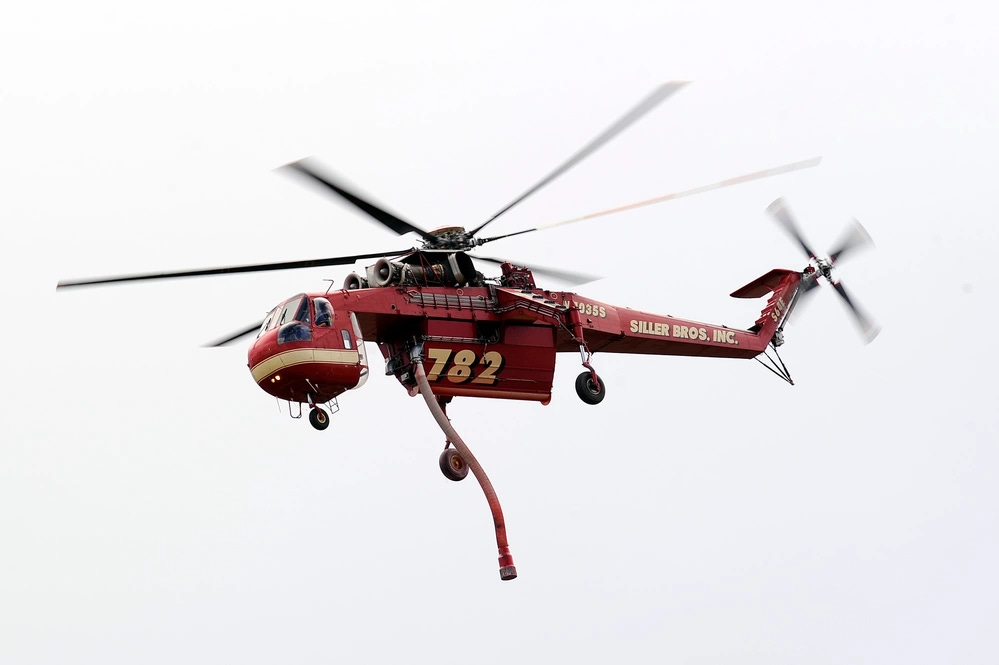
Imagine the S-64 Skycrane rolling out onto the tarmac. A machine that looked more like a flying crane than a traditional helicopter, thanks to its bold, minimalist design. Instead of a standard cabin, Sikorsky stripped things back to basics: just a sturdy “stick” fuselage with no frills, purpose-built for external cargo hauling.
Powering this beast were two roaring Pratt & Whitney JFTD-12 turbine engines, paired with an impressive 72-foot-wide rotor system borrowed from the S-56/S-60, but with some cinematic upgrades: a sixth blade and a beefier blade chord, giving it even more muscle in the sky.
Landing gear got a makeover, too. Gone was the old setup. The Skycrane sported tricycle gear with the nose wheel up front and main wheels behind, a smart tweak learned from the S-60 days to make ground maneuvering around heavy loads far easier.
A tail skid stood guard in case things got wild during nose-up landings. The cockpit setup was pure aviation theater: nestled below the main structure, it housed not just the usual pilot and copilot, but also a third, aft-facing pilot whose job was to command the ship when locking onto or releasing cargo. Add two mechanics to the mix—there for those long missions out in the wild—and you had a five-person crew ready for anything.
One quirk that set the Skycrane apart was its exposed dynamic system—no cowlings covered the guts above, since speed wasn’t the name of the game and easy maintenance trumped aerodynamics. The transmission had its own trick: a three-degree tilt to the left, keeping the chopper level while hovering over a payload, even if it meant the cockpit sat at a quirky angle during cruise.
The aft-facing cockpit was designed with precision in mind, ditching the old rotating seat from the S-60 in favor of a dedicated fly-by-wire station—a pioneering move in helicopter design. Pilots could switch between fine control via SAS servos or take full charge with trim servos connected to the front sticks, letting everyone in the cockpit know what was happening and step in if needed.
And for the grand finale: a 20,000-pound capacity cargo hoist, giving the Skycrane the muscle to raise and lower massive loads at a single point, all while hovering effortlessly in place. This was no ordinary helicopter. It was a flying workhorse, built for the heavy-lifting legends of the skies.
The Helicopter That Turned Lift Into an Art Form
The Sikorsky S-64 Skycrane carved out a legend much grander than its bare-bones silhouette might suggest. Debuting on May 9, 1962, this machine was a radical departure from tradition; a helicopter that ditched the classic fuselage in favor of a raw, exposed frame built purely for lifting. Sikorsky envisioned it as a heavy cargo lifter, built for swift and efficient external-load missions, a design that would go on to reshape how the Army thought about helicopters.
In Army hands, the CH-54 Tarhe proved that helicopters could do so much more than ferry troops or rescue the wounded. It became the go-to for hauling everything from vehicles and artillery to downed aircraft and massive bridge sections, all into rugged terrain where no runway could be found. Drawing on lessons from the earlier S-60, Sikorsky’s Skycrane became the backbone of heavy lifting as the H-54A/CH-54A.
But the Skycrane’s story didn’t end on the battlefield. Thanks to Erickson, it was reborn as the Air Crane, a civilian heavy lifter and firefighting hero, upgraded with modern avionics and improved range to stay relevant well into the twenty-first century.
What the Skycrane really taught the world is that you don’t need sleek looks or firepower to make history in the skies. All you need is a clear mission, sheer muscle, and the guts to stand out. From the S-64 to today’s high-tech support craft, aviation’s unsung heroes keep quietly carrying the future forward.
In Case You Missed It
Photo Outlet
Every issue of Hangar Flying with Tog gets you a free image that I’ve taken at airshows:
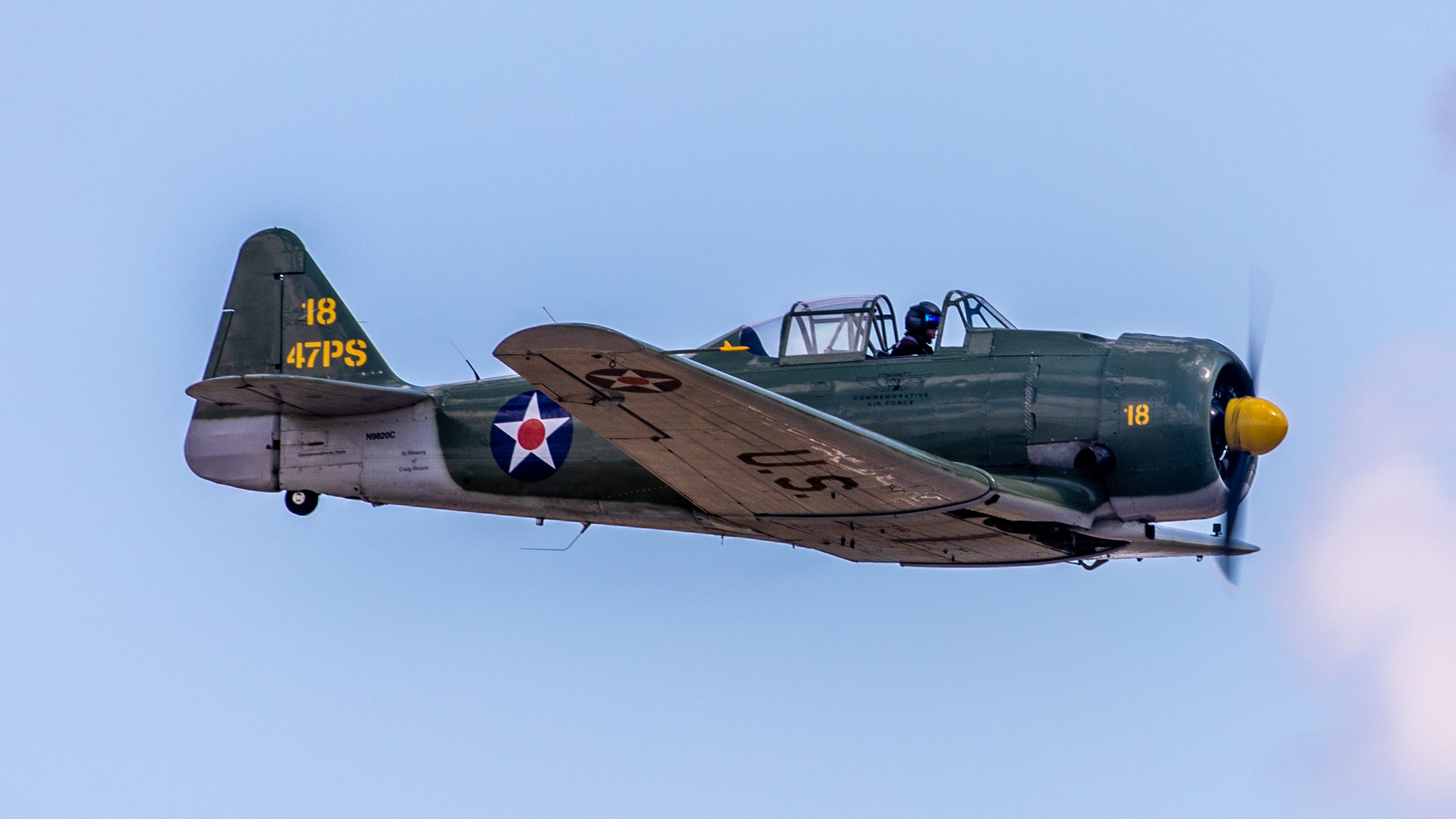
Feel free to use these photos however you like. If you choose to tag me, I am @pilotphotog on all social platforms. Thanks!
Post Flight Debrief
Like what you’re reading? Stay in the loop by signing up below—it’s quick, easy, and always free.
This newsletter will always be free for everyone, but if you want to go further, support the mission, and unlock bonus content like the Midweek Sortie, consider becoming a paid subscriber.
Your support keeps this flight crew flying—and I couldn’t do it without you.
– Tog