

MQ-20 Avenger Under Lightning’s Command and When Gemini IV Learned to Walk in Space
Gemini IV proved that astronauts could operate beyond the spacecraft; the F-35/MQ-20 test suggests fighter pilots may soon operate beyond the cockpit.
“The MQ-20 successfully exchanged critical autonomous responses with the F-35, and the F-35 was able to send autonomy commands to the MQ-20 via a Bashi Pilot Vehicle Interface, directing the MQ-20 to execute tactical maneuvers, adjust waypoints, and pass ADS-B track data to the F-35.”
—GA ASI (General Atomics Aeronautical Systems)
Mission Briefing
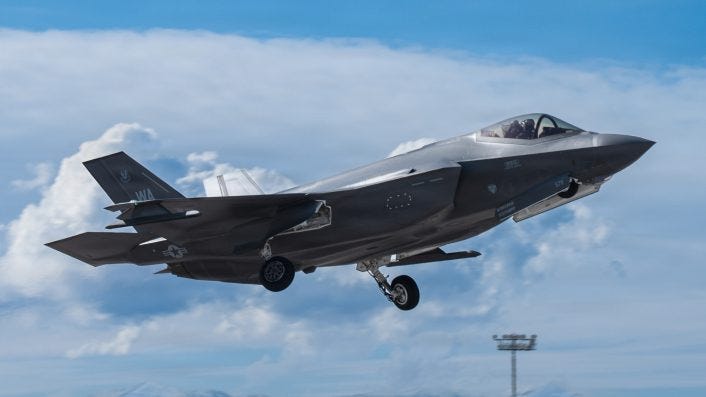
An F-35 Lightning II pilot, tablet in hand, calls the shots mid-flight, sending commands straight to the MQ-20 Avenger. It’s man and machine teaming up in real time—a dramatic leap in tactical autonomy you have to see to believe.
When F-35 Takes the Avenger
The sleek, futuristic form of the MQ-20 Avenger drone finally paired up with the legendary F-35 Lightning II fighter jet, a partnership years in the making.
General Atomics Aeronautical Systems, the brains behind the MQ-20, has pulled off a milestone in aviation innovation, quietly announcing this breakthrough after a string of successful tests with the F-22 Raptor.
The company is keeping some cards close to the vest, not revealing exactly when this Manned-Unmanned Teaming (MUM-T) demonstration took place, but the implications are crystal clear: the future of air combat is arriving fast.
It took a squadron of collaboration to make it happen. Picture the F-35 Joint Program Office, 309th Software Engineering Group, the 461st and 370th Flight Test Squadrons, Lockheed Martin, and Autonodyne all in the mix.
Each one playing a part in orchestrating this aerial symphony. At the heart of the demonstration was General Atomics’ TacACE (Tactical Autonomy Ecosystem) software, riding on the backbone of the Autonomy Government Reference Architecture (A-GRA), providing the MQ-20 with cutting-edge autonomous decision-making.
Just like in previous test flights, the MQ-20 Avenger stepped in as a stand-in for what’s soon to be the next generation of Collaborative Combat Aircraft (CCA), working to accelerate the arrival of these game-changing platforms for the U.S. Air Force. GA-ASI is already hard at work producing and testing the YFQ-42A CCA, the first of its kind for the program’s Increment 1 phase—think of it as the next chapter in the story.
Here’s where it gets exciting: the F-35 pilot, instead of gripping a traditional flight stick, is on the ground, tablet in hand, seamlessly sending tactical autonomy commands to the MQ-20.
The commands are routed through TacACE and transmitted to the drone via Beyond Line of Sight communications. No need for the pilot to even leave the tarmac. Previous F-22 tests never made it clear whether pilots were on the ground or airborne, but this time, the company confirms the F-35 stayed earthbound during the command relay.
The demonstration wasn’t just a show. It was a proof of concept for the hardware, software, networks, and systems that bring MUM-T to life.
The MQ-20’s TacACE responded to the F-35’s commands in real time, executing tactical maneuvers, adjusting waypoints, and sharing critical ADS-B track data back to the pilot via the Bashi Pilot Vehicle Interface, a flexible, tablet-based system designed to work across different aircraft platforms.
This latest leap marks another giant step toward realizing a world where unmanned Collaborative Combat Aircraft fly as loyal wingmen, extending sensor reach, increasing survivability, and taking on the risky missions so pilots don’t have to. The future of air power just got a little closer, and it’s looking cinematic from here.
The Lightning and the Avenger
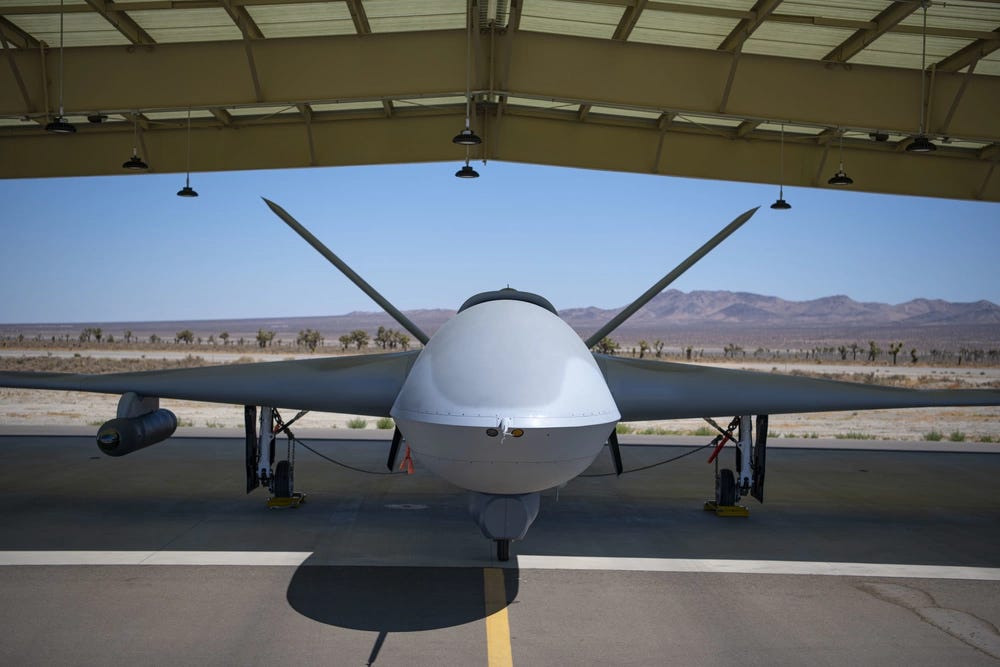
The Avenger ER, a jet-powered marvel, streaking across the sky with high-speed agility and endurance to match. This is no ordinary remotely piloted aircraft.
It’s a next-gen, multi-mission powerhouse, built for wide-area surveillance, rapid-response strike missions, and just about any demanding scenario the military or civilian world can throw at it.
With operational and transit speeds that leave the Predator B-series in the dust, the Avenger ER redefines what flexibility and survivability look like in the skies, responding at a moment’s notice and repositioning in record time.
Under its sleek skin, a commercial Pratt & Whitney turbofan engine roars to life, delivering over 5,000 pounds of thrust. That means it can leap off runways under 5,000 feet long and stay airborne for more than 20 hours, cruising above 50,000 feet at up to 400 KTAS.
Whether it’s carrying a formidable internal payload of precision munitions or loading its wings with a sensor array, the Avenger ER brings next-level versatility to the fight.
Meanwhile, in the same battlespace, the F-35 Lightning II holds its own as the quarterback of the skies. This isn’t just a fighter jet. It’s the connective nerve center of modern warfare, seamlessly integrating operations across air, land, sea, space, and cyber domains.
The F-35’s advanced sensors and communications suite turn it into a force multiplier, able to share critical information with every asset in the network, enhancing the effectiveness and survivability of every platform it connects with.
In today’s contested environments, air dominance hinges on secure, high-tech teamwork. The F-35’s role as a node in the 21st-century security network means it’s not just fighting battles. It’s shaping the future of joint operations, leading the charge and helping every asset return home safely.
How the F-35 is Leading the Next Generation of Networked Airpower
An F-35 Lightning II, not just flying solo, but commanding the MQ-20 Avenger, orchestrating moves with a few taps on a tablet. This isn’t your classic fighter jet calling the shots. It’s a cutting-edge, fifth-gen aircraft acting as mission control for an autonomous wingman, relaying commands through secure data links and satellites.
In a world where battlefields are swarming with advanced air defenses, long-range missiles, and electronic jamming, this kind of human-machine teamwork isn’t just cool—it’s critical. Sending pilots alone into that chaos is risky and costly.
For the U.S. and its allies, this test is a glimpse into the future: Collaborative Combat Aircraft, where seasoned aviators and intelligent drones hunt together. Today’s F-35 could evolve from a stealth striker into an airborne quarterback, managing a team of loyal unmanned partners and stretching the reach of every coalition air force.
The strategic takeaway? Airpower is shifting from a contest of standalone jets to a symphony of networked teams. Victory will favor those who fuse human skill and AI muscle into cohesive, adaptive formations.
Years from now, we might look back on this F-35 and MQ-20 test as the spark that launched a new era, where pilots don’t just fly, they lead intelligent swarms across the skies.
This Week in Aviation History
Imagine the scene: June 1965, Gemini IV rockets into orbit with James McDivitt and Ed White at the helm for a four-day adventure above the Earth. Midway through their mission, White makes history, stepping out into the void for America’s first-ever spacewalk. It was a bold leap that set the stage for a new era in space exploration.
Blast Off: Gemini IV Walks into Space
Gemini IV thundered off the pad at Cape Canaveral’s Complex 19 right on the dot, carving a path into orbit by 10:22 a.m. Within minutes, astronauts Jim McDivitt and Ed White were circling Earth, their craft arcing between 162 and 282 kilometers above the clouds.
Early on, they tried to rendezvous with the rocket’s spent second stage, but after burning through nearly half their fuel, mission control called it off—there were bigger milestones ahead.
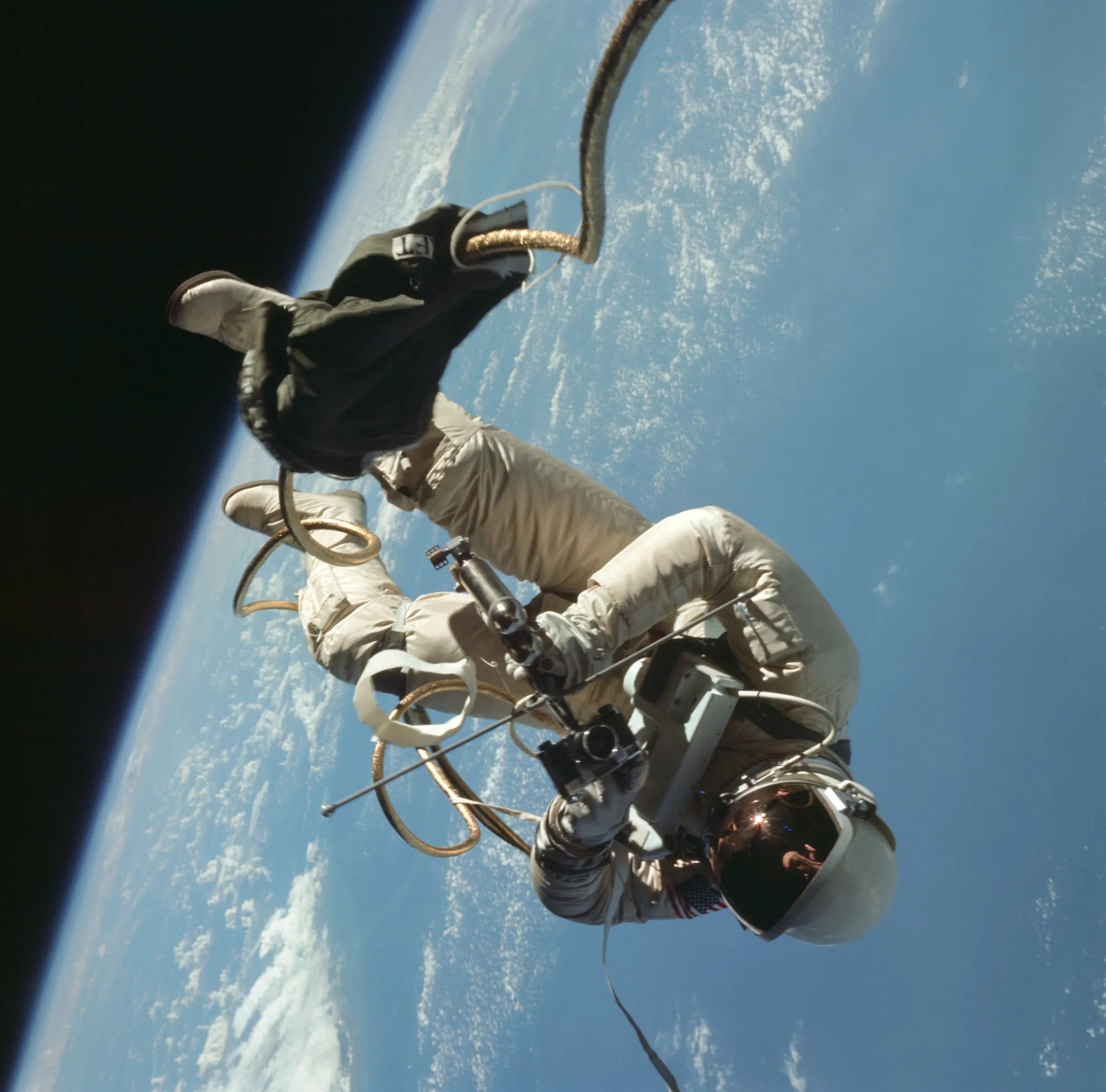
One of those milestones came fast. Ed White, suited up and pressurized, waited as McDivitt brought the cabin pressure down to zero. At 2:34 p.m., they swung open the hatch. Two minutes later, White emerged, propelled by a small gas gun, drifting tethered in the black: America’s first spacewalk.
The gun’s fuel ran dry in just three minutes, so White tugged on his tether and twisted, floating and maneuvering in the void for a full 23 minutes before climbing back inside.
Closing the hatch wasn’t easy, but the duo finally got it sealed and repressurized the cabin.
For the next 30 hours, they cruised in drifting flight to save precious fuel. When a computer glitch nixed the planned computer-guided landing, McDivitt and White had to rely on old-school techniques, initiating a zero-lift, ballistic reentry like the Mercury days.
The retrofire started the 62nd orbit; splashdown followed 16 minutes later in the Atlantic, a little off target but safe. Recovery choppers whisked the crew to the U.S.S. Wasp, and the capsule soon followed.
During their nearly 98-hour journey, McDivitt and White conducted eleven experiments on everything from cosmic rays to heart function. Except for the cancelled rendezvous and missed computer reentry, they checked off every box, sealing Gemini IV’s legacy as a mission of firsts and feats.
Inside the Gemini IV Mission
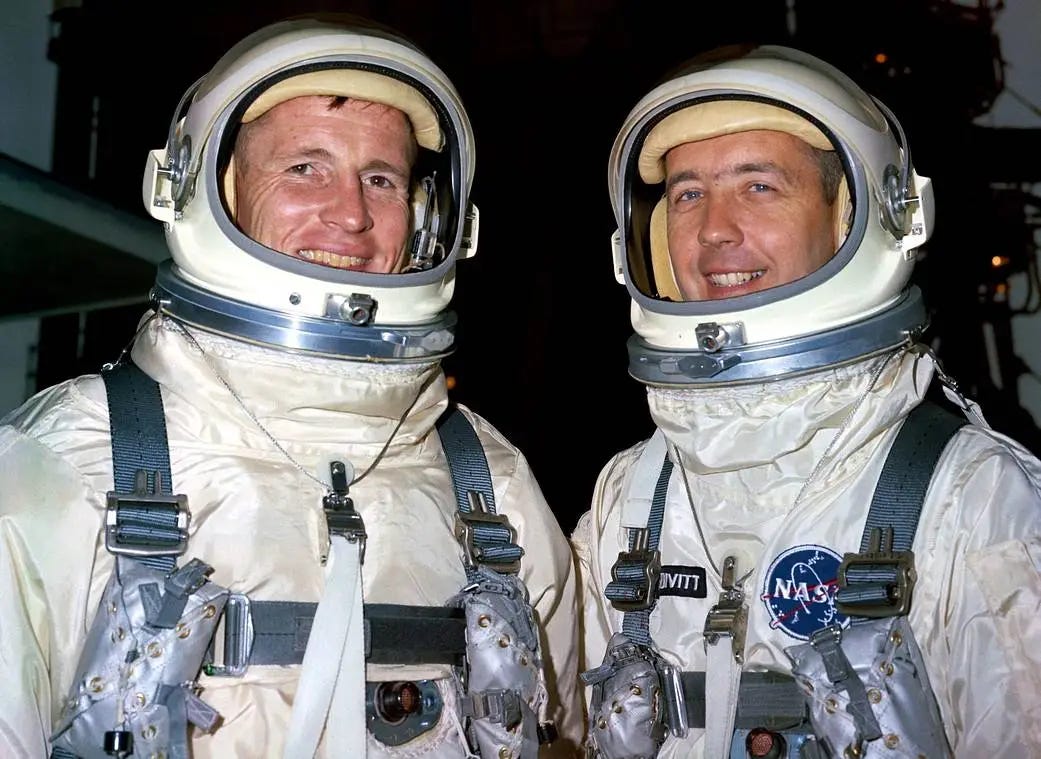
Jim McDivitt joined NASA’s second astronaut class in 1962, stepping into the fast lane of the space race. He took command of Gemini IV in June 1965, steering the mission into the history books. Later, as Apollo 9’s commander, McDivitt helped shepherd the first test flight of the full Apollo spacecraft—Lunar Module included—marking a giant leap for lunar ambitions.
Ed White, McDivitt’s Gemini IV crewmate and fellow Group 2 recruit, made spacewalking history on that same flight, gliding into the void as America’s first spacewalker. White’s cool confidence became an inspiration for generations of aviators and explorers.
Tragically, fate intervened: White, assigned to the very first Apollo mission, lost his life in the Apollo 1 fire of 1967. Both men left indelible marks on the legacy of human spaceflight, forever remembered for their courage and pioneering spirit.
Mission Facts
Crew: James A. McDivitt Jr. (Command Pilot) and Edward H. White II (Pilot)
Backup Crew: Frank F. Borman II and James A. Lovell Jr.
Payload: Gemini 4
Mass at launch: 3,574 kg
Launch Date: Jun. 3, 1965, 10:15:59 a.m. EST (15:15:59 UT)
Launch Site: Complex 19, Cape Canaveral, United States
Launch Vehicle: Titan II
Revolutions Completed: 62
Duration: 97 hours, 56 minutes, 12 seconds (4 days, 1 hour, 56 minutes, 12 seconds)
Landing Date: Jun. 7, 1965, 12:12:11 EST (17:12:11 UT)
Landing Site: Western Atlantic, 27.73° N, 74.18° W
Recovery Ship: U.S.S. Wasp
Gemini IV: Pioneers of the High Frontier
Gemini IV wasn’t just a four-day ride around the Earth. It was a crucial leap into the unknown, straight out of an aviator’s wildest dreams.
Commander James McDivitt and pilot Ed White blast off into legend, ready to test if humans could really settle into the cosmic frontier. Then comes the showstopper: Ed White cracks open the hatch, and for the first time, an American drifts free above Earth’s curve; tethered by just eight meters of lifeline, a pistol-grip thruster in hand.
For 23 minutes, he floats, spins, and steers like a barnstormer in zero-g, until the fuel runs dry and it’s just muscle and guts keeping him tethered to home.
But this wasn’t just a spectacle; it was a dress rehearsal for the future. Gemini IV taught NASA hard lessons: better tools, sharper plans, tighter comms, and nerves of steel for the crews.
It paved the runway for Apollo and those lunar bootprints, and it gave birth to spacewalking as a craft, a skill that would one day build the International Space Station and send us back to the Moon.
The mission even broke ground at Houston’s new Mission Control, setting the stage for every mission since. In the grand story of space, Gemini IV is where America first learned: space isn’t just a distant horizon; it’s a frontier where human hands can truly get to work.
In Case You Missed It
Photo Outlet
Every issue of Hangar Flying with Tog gets you a free image that I’ve taken at airshows:
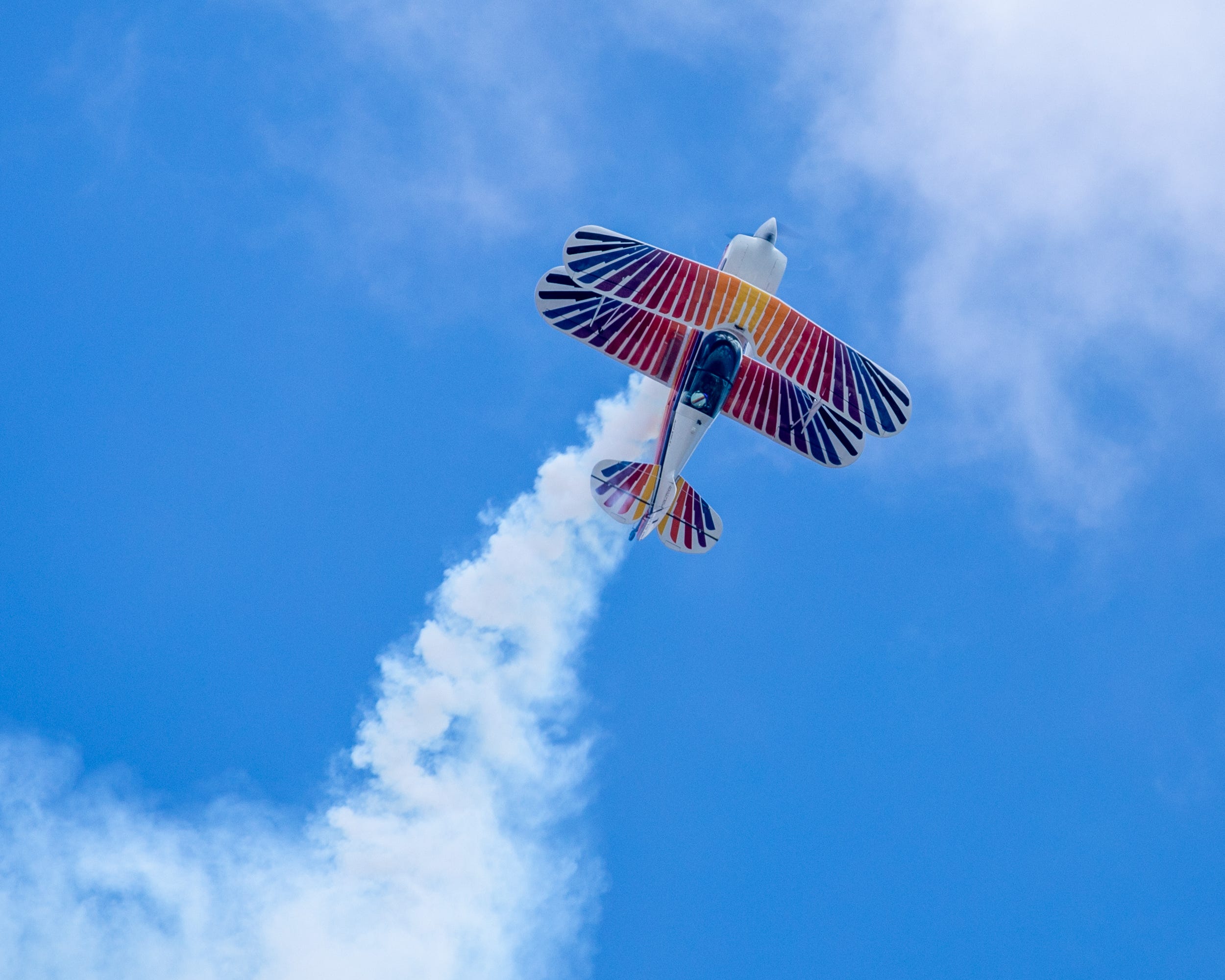
Feel free to use these photos however you like. If you choose to tag me, I am @pilotphotog on all social platforms. Thanks!
Post Flight Debrief
Like what you’re reading? Stay in the loop by signing up below—it’s quick, easy, and always free.
This newsletter will always be free for everyone, but if you want to go further, support the mission, and unlock bonus content like the Midweek Sortie, consider becoming a paid subscriber.
Your support keeps this flight crew flying—and I couldn’t do it without you.
– Tog