

Mirage 2000-5 Over Ukraine and YB-52 Stratofortress’ Maiden Flight
From the YB-52’s first flight to the Mirage 2000-5 over Ukraine, airpower history keeps proving the same lesson: a well-adapted aircraft can remain useful far beyond its original moment.
“The effectiveness of intercepting enemy drones and missiles on this aircraft is 98%. These are impressive numbers.”
—Unnamed Ukrainian Air Force Pilot
Mission Briefing
Most folks talk about the F-16 like it’s the only bird in the sky for Ukraine—a natural choice, given how common and well-studied it is, plus it fits neatly into the NATO flock. But let me tell you, that’s just one part of the story. What Ukraine really needed, and fast, was a machine fit for daring missions in skies crawling with danger—something more than just a jack-of-all-trades, but a master of survival. This is where Mirage 2000-5 comes into play.
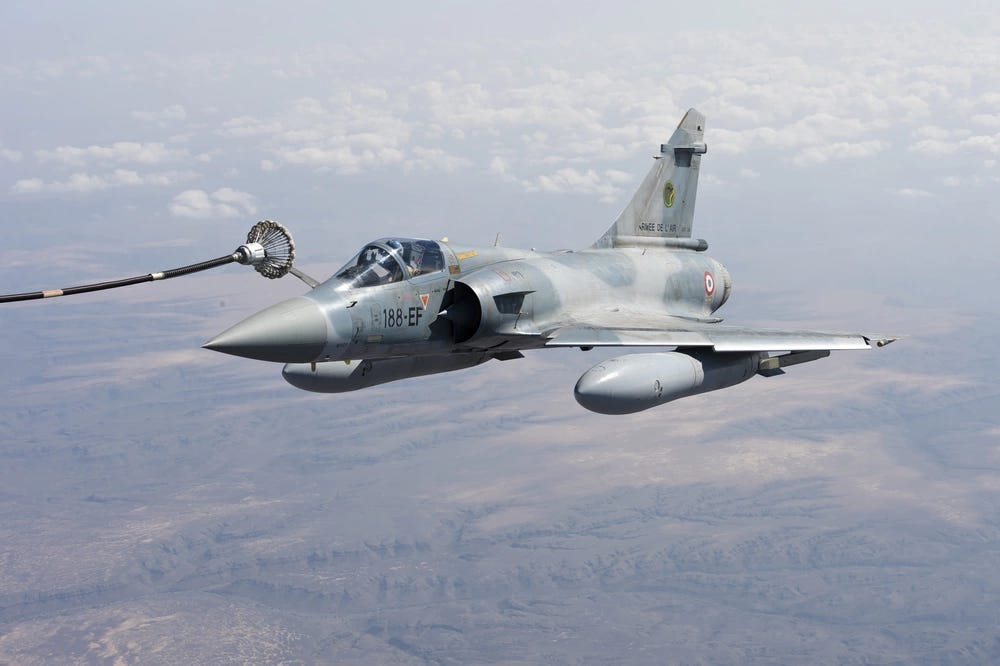
Mirage 2000-5 Enters the Picture
Back in March 2026, the Ukrainian Ministry of Defense didn’t mince words. They made it clear that the Mirage 2000-5 was more than just a flashy addition to their hangars. No, sir.
These jets became key players in knocking out cruise missiles and swatting down attack drones, right when the skies were thick with danger. Russia, since 2024, has been waging a relentless campaign, unleashing waves of Shahed drones, decoys, cruise missiles, and even the occasional ballistic missile.
Imagine, on March 24, 2026, Ukraine reported facing 999 drones in a single day. The largest drone barrage since the war began. That’s not just a statistic; that’s the kind of day that tests the very soul of a nation’s air defense.
Now, in a fight like this, you don’t want to burn through your rarest, hardest-to-replace resources on every threat. You want an aircraft that can handle the dirty work: intercept the slow movers, patrol the front, dash across the map, and still be ready to strike the ground with pinpoint accuracy.
The Mirage 2000-5 isn’t a luxury; it’s a force multiplier. It takes on missions that would otherwise drain the fleet’s most precious assets, freeing them up for the truly hairy jobs.
But let’s not get carried away. The Mirage 2000-5 isn’t a silver bullet, nor does it replace the F-16. The F-16 is still the long-game play for Ukraine. More airframes, better supply lines, a broader arsenal, and the promise of a uniform NATO-aligned fleet sourced from friendly skies across the West.
The Mirage, by contrast, is here in smaller numbers. Its support network is tighter. You can’t just ring up the factory for spare parts; production lines are history. What you see is what you get.
Yet, that’s precisely what makes the Mirage 2000-5 so valuable. It fills a gap, plain and simple. It’s the right tool at the right time, giving Ukraine the ability to intercept missiles and drones and to drop French precision munitions. All without having to wait for the perfect solution. In war, urgency can outweigh doctrine, and sometimes a good answer right now beats the best answer next year.
There’s a lesson here, too, about the folks at Dassault who built these machines. The Mirage 2000-5 isn’t fresh off the assembly line. It hails from another era, a different style of air war.
And yet, look at it now: flying hard in a conflict bristling with modern threats, from enemy fighters to electronic jamming and long-range missiles. No one’s pretending it’s invincible. What it proves is that a well-kept, thoughtfully upgraded jet can still pack a punch decades after its first flight.
While everyone else dreams about the next generation—combat clouds, AI, and sixth-gen superjets—Ukraine is living a harsher reality, where the best jet is the one that can take off, survive, hunt, and hit its mark.
So here we are, the Mirage 2000-5, small in number, limited in some ways, but making a mark that most wouldn’t have dared predict a year ago. The real story isn’t about this fighter winning the war single-handedly. It’s about how, in a grinding war of attrition, a seasoned old warrior with the right upgrades can become the ace up your sleeve.
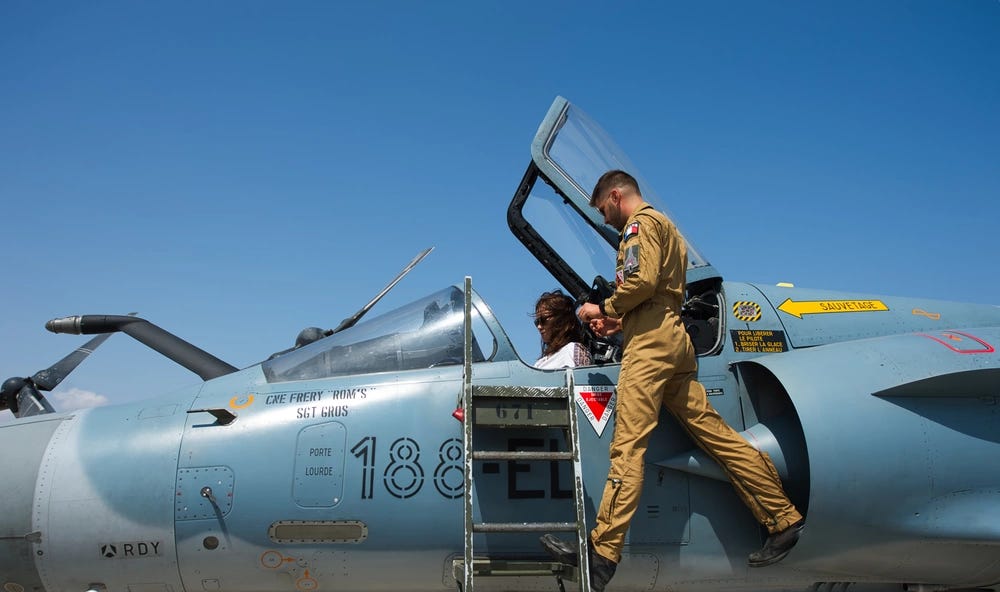
Why did they choose the Mirage?
The real twist in Ukraine’s air war isn’t about showing off the Mirage 2000-5 as some prestige trophy. They’re calling it what it is: a hunter of cruise missiles. That’s not just talk, either.
This Mirage isn’t the same old fighter from days gone by. With its updated RDY radar, modern avionics, real-time data link, and a set of French missiles, it’s a serious upgrade over Ukraine’s older MiG-29s. These features make it a specialist at taking down tough but not supersonic targets. Think cruise missiles and attack drones zigzagging through the chaos.
Ukrainian defense officials have pointed out how the Mirage can lock onto even the sneakiest drones: Shahed, Geran, Gerbera and so on. And that’s no small feat. Tracking a lumbering bomber or a darting fighter is one thing, but catching a low, slow, or tiny drone—often hidden in a wave of incoming threats—demands top-notch radar, fast data processing, and the right missiles at the pilot’s fingertips. The Mirage’s tech lets a lone pilot juggle all of that, firing off shots quickly when every second counts.
The proof, as they say, is in the flying. One Mirage pilot told the Ukrainian Air Force in November 2025 that his jet scored a 98% hit rate against drones and missiles; a number to take with a pinch of salt, sure, but a sign that in real battles, crews trust this plane.
A big part of that trust comes down to the Mirage’s weapons. Ukrainian jets carry MICA missiles, which work at long or close range and aren’t just for dogfights. They’re perfect for picking off stealthy drones and missiles, too. This gives Ukraine mobile air defense that doesn’t try to replace big ground-based systems, but rather complements them, filling gaps when needed.
Even the older Magic 2 missile is getting its moment; great for close-up encounters with targets that radiate heat. It might not sound glamorous, but in a war where Russian attacks are constant and cheap, that’s exactly what Ukraine needs: practical, reliable tools.
What does it mean to the US Allies?
The story of France’s Mirage 2000-5s arriving in Ukraine is more than just another headline about fighter jets changing hands. It’s a sign that the days of waiting around for the perfect, one-size-fits-all solution are over.
Now, allies are cobbling together a quick-reaction, layered airpower force out of whatever tried-and-true jets can fill the gaps; right now, not next year.
The Mirage isn’t just for show, either. It’s already out there hunting Russian cruise missiles and drones, and it’s flexing into precision strike missions with those French AASM Hammer bombs.
This jet doesn’t replace the F-16; it runs alongside it, plugging holes as a mobile air-defense layer and doubling up as a strike platform, all in a war where the enemy throws everything and the kitchen sink at you.
There’s a lesson here for the U.S. and its partners: real alliance strength isn’t about having only the shiniest new jets, but about getting older, upgraded birds like the Mirage into the mix fast enough to actually make a difference.
Ukraine’s Ministry of Defense has hammered home that Mirages can bag cruise missiles and drones—including those Shahed types—and use a mix of NATO-standard weapons, proving how adaptable Western arsenals can be when speed matters more than perfection. In the end, the Mirage’s combat debut is both a wake-up call and a blueprint: future airpower may hinge more on how fast we can blend proven machines and munitions into a real fighting force before the next storm breaks.
This Week in Aviation History
On the morning of 15 April 1952, Boeing’s ace test pilot “Tex” Johnston and Air Force Lieutenant Colonel Guy Townsend pushed all eight engines of the YB-52 Stratofortress to the max and let her loose down the runway. That was the moment the legendary bomber prototype truly came alive, roaring into aviation history with every ounce of power unleashed.
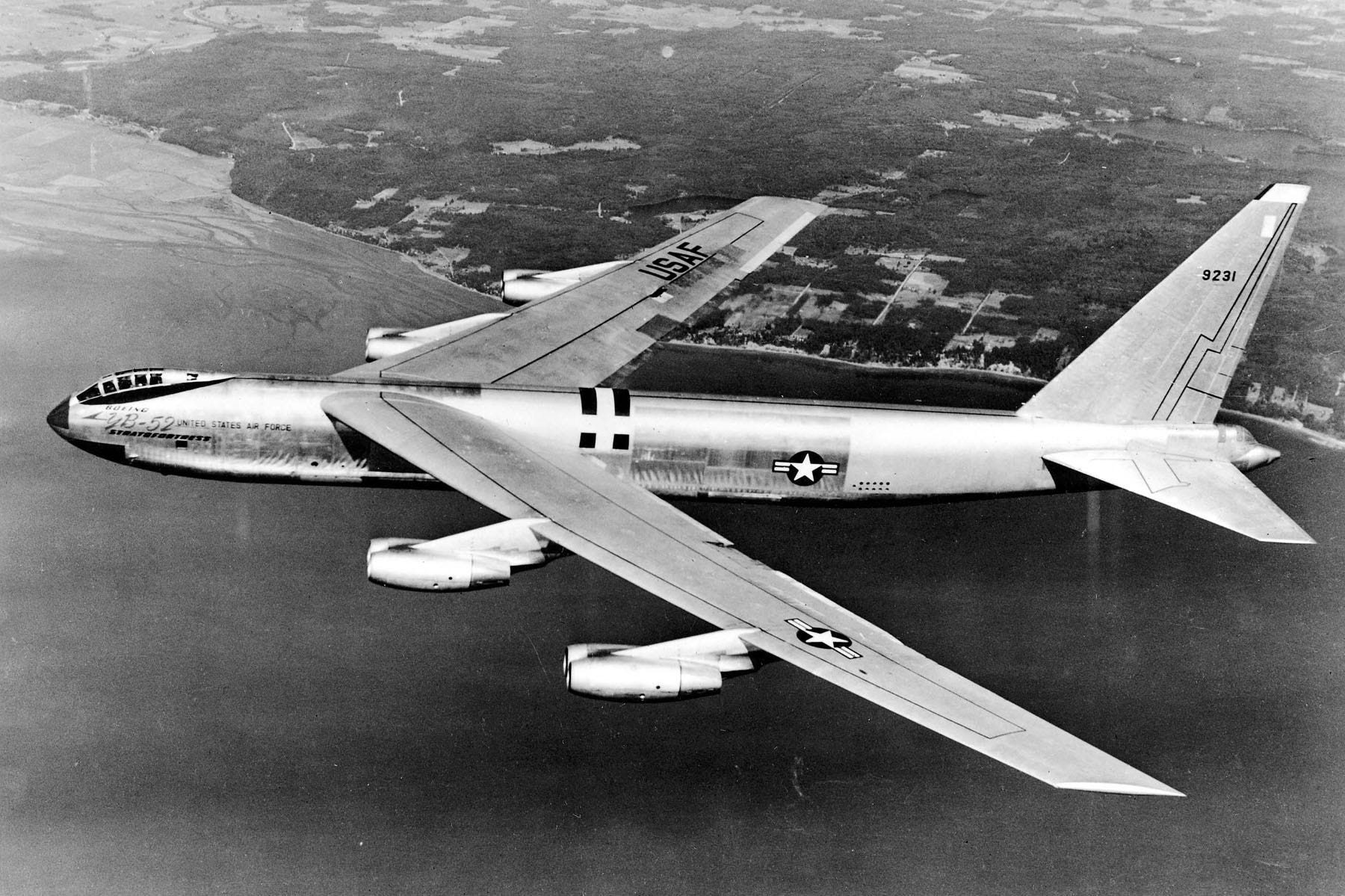
YB-52’s Initial Flight Has Begun
The YB-52, an eight-engine beast, charges down the runway with its wings arching skyward, easily carrying a whopping 235,000 pounds on its first flight.
Once she hit V2, that magic takeoff speed, the big bomber lifted gracefully off the ground—helped along by those wings set at a six-degree angle—and at precisely 11:08 a.m., she was airborne, launching a new chapter in aviation history.
For the first forty minutes, Tex Johnston and Guy Townsend kept her circling over Seattle, ticking through system checks, making sure every dial and gauge lined up just right.
Then, satisfied, they pointed the Stratofortress up to 25,000 feet and headed off toward Larson Air Force Base at Moses Lake for more rigorous testing, keeping her aloft for a record-breaking 3 hours and 8 minutes: the longest maiden flight Boeing had ever clocked at that point.
Tex radioed back that the YB-52 flew exactly as the engineers had promised, a rare treat in the test pilot’s world.
The YB-52 was originally meant to be the second of two XB-52 prototypes, but so many changes and upgrades were worked in that she deserved a new name. The first XB-52 should’ve flown first, but an accident during ground tests left her grounded.
Both prototypes featured that signature tandem cockpit—pilot and co-pilot sitting one behind the other—just like the B-47 before them. The wings, swept back and perched high on the fuselage, carried four pairs of turbojets in twin pods, cleverly placed to keep the plane balanced and the airflow clean.
Add to that the unique landing gear, four main struts with two wheels each, able to pivot for crosswind landings, and you’ve got a design that let those wings flex and fly unlike anything else in the sky.
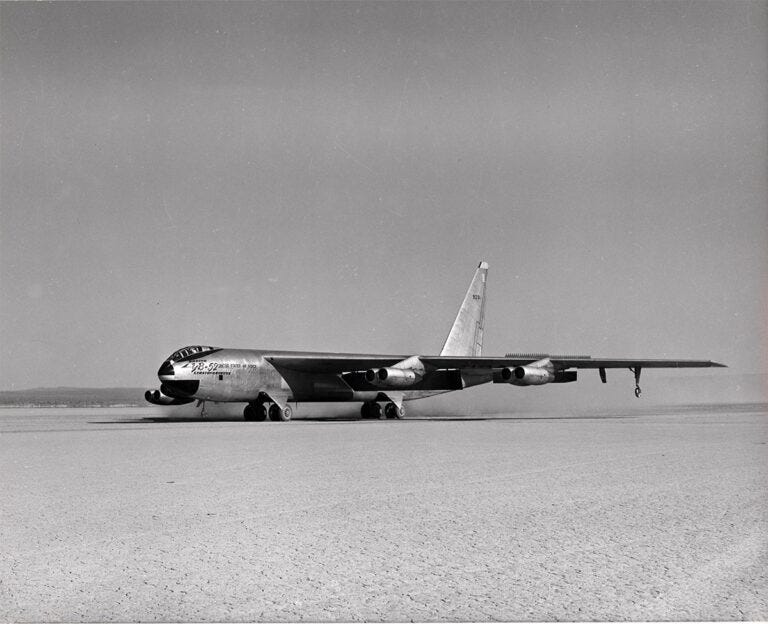
The Anatomy of the Stratofortress
The Stratofortress stretched a majestic 152 feet from nose to tail, with wings reaching a staggering 185 feet across. It is so broad that her vertical fin could be folded over to the right just to squeeze into a hangar.
Standing tall at nearly 50 feet, she cast a shadow that covered 4,000 square feet of ramp. Those wings weren’t just for show, either: they angled back at nearly 37 degrees, set at a 6-degree angle of incidence, with a hint of dihedral for stability.
Empty, she tipped the scales at 155,200 pounds, but fueled and loaded, she could take off at a mighty 405,000 pounds.
Under the hood, the YB-52 packed eight Pratt & Whitney Turbo Wasp YJ57-P-3 turbojet engines: cutting-edge for their day, with a two-spool design and 16-stage compressor.
Each engine delivered a steady 8,700 pounds of thrust, making this bomber a true heavyweight champion. These powerplants were over 15 feet long, three and a half feet wide, and weighed in at 4,390 pounds apiece.
She wasn’t just big, she was fast. The YB-52 cruised at 519 miles per hour, could hit 611 at altitude, and boasted a jaw-dropping range of over 7,000 miles. Neither the YB-52 nor her sister prototype carried any weapons in those early days. They were all about testing and proving the concept.
Boeing built 744 Stratofortresses between 1952 and 1962 in Seattle and Wichita. The final model, the B-52H, entered service in 1960, and the very last one rolled out in 1962: number 61-0040, still flying for the Air Force after more than 21,000 hours aloft.
Most earlier models are long gone, but 76 B-52Hs are still in service, with legends like Ghost Rider even returning from the Boneyard. As for the old YB-52 prototype, she went to the Air Force museum, but by the mid-60s, even she was consigned to history and scrapped.
Stratofortress’ Enduring Contrail
The YB-52 Stratofortress wasn’t just a successful prototype. It was the opening act for one of aviation’s greatest legends. When she first took to the skies in April 1952, she brought the Air Force into a new era as its first all-jet, intercontinental heavy bomber, setting the stage for a platform that would shape American power and strategy for generations.
The B-52 didn’t just serve as the backbone of Strategic Air Command; she proved her mettle in Vietnam’s Arc Light and Linebacker II, then kept on flying into new missions; everything from globe-spanning strike runs to post-Cold War operations.
What makes the B-52 story so remarkable is its adaptability: setting records, taking on fresh missions, and modernizing with every twist in doctrine and technology. Boeing still calls her a cornerstone of U.S. deterrence, and the Air Force isn’t letting go anytime soon; upgrades are keeping this old warbird ready for whatever comes next.
So, that first flight in 1952 wasn’t just the launch of a bomber; it was the birth of a living legend, a saga that continues to evolve as the world changes.
As we move into an age of standoff weapons, networked warfare, and renewed big-power rivalry, the Stratofortress keeps doing what it does best: combining range, payload, and unmistakable presence to make sure American airpower is always heard, loud and clear, wherever it’s needed most.
In Case You Missed It
Photo Outlet
Every issue of Hangar Flying with Tog gets you a free image that I’ve taken at airshows:
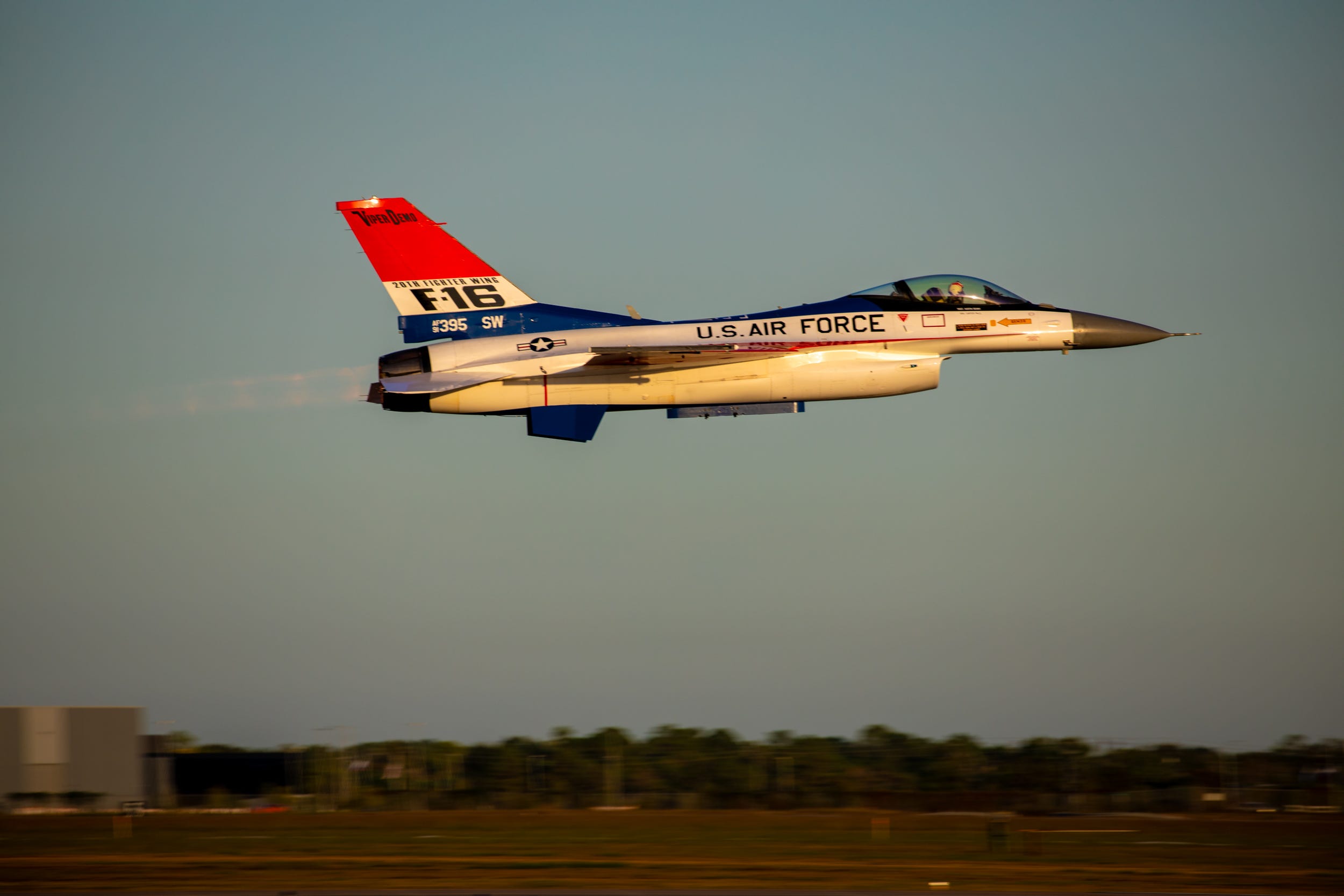
Feel free to use these photos however you like. If you choose to tag me, I am @pilotphotog on all social platforms. Thanks!
Post Flight Debrief
Like what you’re reading? Stay in the loop by signing up below—it’s quick, easy, and always free.
This newsletter will always be free for everyone, but if you want to go further, support the mission, and unlock bonus content like the Midweek Sortie, consider becoming a paid subscriber.
Your support keeps this flight crew flying—and I couldn’t do it without you.
– Tog