

“An Iranian drone was shot down as it ‘aggressively approached’ an American aircraft carrier in the Arabian Sea on Tuesday.”
—US Central Command spokesman Captain Tim Hawkins
Mission Briefing
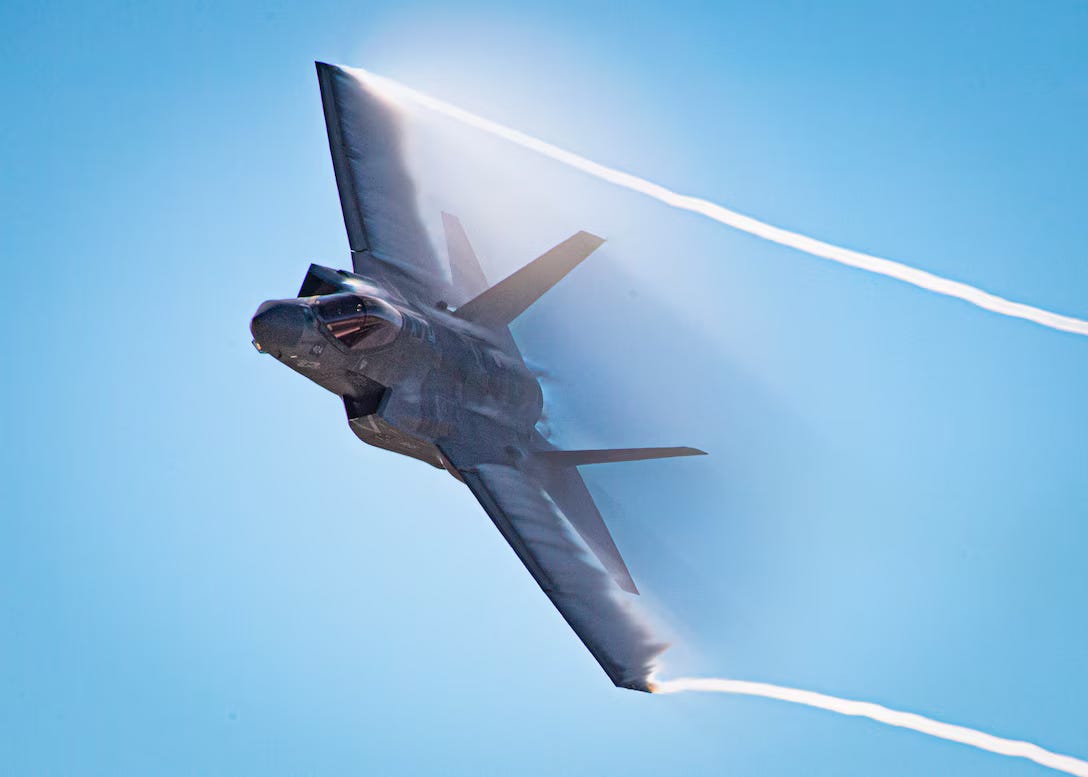
On 3 February 2026, the calm of the Gulf of Oman was shattered as a U.S. Navy F-35C, poised atop the deck of the nuclear-powered USS Abraham Lincoln, locked onto a shadow moving fast across the horizon—a Shahed-139 drone, Iranian and uninvited, closing in with unknown intent. Eight hundred kilometers from the Iranian coast, steel met silence as the stealth fighter sent a message skyward: on this sea, the line between peace and provocation is razor thin, and vigilance never rests.
The Encounter in the Arabian Sea
In the opening days of February 2026, the air above the Gulf and Arabian Sea thrummed with tension, the stakes rising with every headline out of Washington and Tehran. The reasons were as layered as the clouds overhead: Iran’s nuclear ambitions, its regional maneuvering, and the unmistakable uptick in American military muscle flexing across these strategic waters.
Patrolling the heart of this chessboard was the USS Abraham Lincoln, the mighty nuclear-powered carrier, its decks bristling with the cutting-edge F-35C Lightning IIs. Since late January, the Lincoln and her air wing had kept to a steady watch, ranging some 500 to 800 nautical miles off Iran’s southern coast. It is a calculated show of presence and resolve.
It was here, in these contested skies, that the drama unfolded. It is a Shahed-139 drone, built by Iranian engineers and capable of both surveillance and loitering strikes, pushed into the carrier group’s orbit.
Its purpose, cloaked in ambiguity, was later framed by Iranian sources as a lawful reconnaissance mission over international waters. But for the crew aboard the Lincoln, the drone’s persistence, despite clear warnings, broke the thin line between curiosity and threat.
The decision to bring the drone down was guided not just by tactical instinct, but by the longstanding principles of international law: a nation has the right to protect its ships and sailors from imminent danger, especially in these tense corridors where seconds matter and intentions can be deadly. U.S. officials described the act as a measured response—one that prioritized the security of the carrier and her crew above all uncertainty.
The ripple effects were immediate. News of the encounter sent crude oil prices climbing by a dollar a barrel, a stark reminder that these waters are not just a military flashpoint, but a lifeline for the world’s energy supply. The Strait of Hormuz, narrow and vital, suddenly felt even tighter as investors braced for the unknown.
In this modern age, where drones and stealth fighters trade shadows over open seas, every move echoes far beyond the horizon—reminding us that the front lines of security and commerce are often the same.
The Anatomy of the Legends: The F35C and the USS Abraham Lincoln
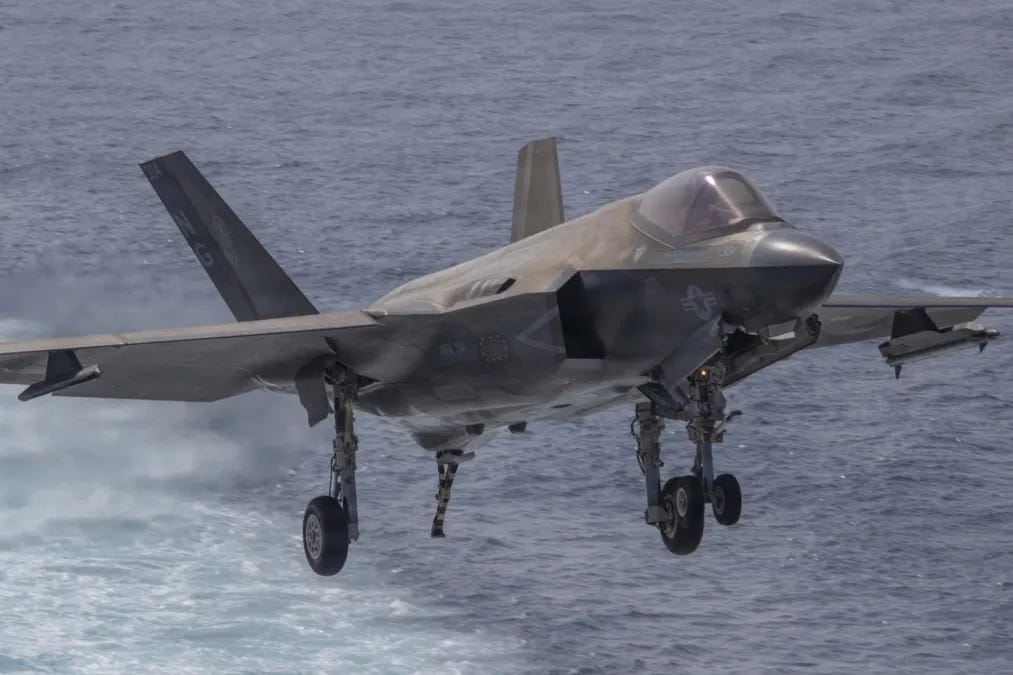
The F-35C Lightning II stands at the cutting edge of naval aviation. It is a fifth-generation marvel crafted for the unique demands of carrier operations.
Forged for the flattop’s rolling decks, this American stealth fighter weaves invisibility, advanced sensors, and seamless data sharing into a single, lethal package, all to keep a vigilant watch over the vast airspace surrounding a carrier strike group.
When the order came to intercept the approaching drone, it was the F-35C that answered the call—a testament to the premium placed on the safety of the carrier and her thousands of crews.
By deploying such an advanced aircraft for this task, commanders signaled both restraint and resolve: neutralizing a potential threat without inviting escalation, all while demonstrating the technological edge that keeps the carrier’s guardians a step ahead in the world’s most contested waters.
Specifications
Length: 51.5 ft / 15.7 m
Speed: Mach 1.6
Wingspan: 43 ft / 13.1 m
Wing area: 668 ft2 / 62.1 m2
Combat radius (internal fuel): >600 n.mi / 1,100 km
Range (internal fuel): >1,200 n.mi / 2,200 km
Internal fuel capacity: 19,200 lb / 8,708 kg
Max g-rating: 7.5
Weapons payload: 18,000 lb / 8,160 kg
Propulsion: F135-PW-100
Thrust*: 40,000 lb Max / 25,000 lb Mil
Let us now take a closer look at its mothership, the USS Abraham Lincoln
Keel Laid: November 3, 1984 Christened: February 13, 1988 Commissioned: November 11, 1989 Builder: Newport News Shipbuilding Co., Newport News, Va. Propulsion system: two Westinghouse A4W nuclear reactors, four steam turbines, four shafts, 260,000 shp (194 MW). Lengths, overall: 1.092 feet (332.85 meters) Flight Deck Width: 252 feet (76.8 meters) Area of flight deck: about 4.5 acres (18211.5 m2) Beam: 134 feet (40.84 meters) Draft: 37.7 feet (11.3 meters) Displacement: approx. 101,000-104,000 tons full load Speed: 30+ knots Planes: 90 fixed wing and helicopters Crew: Ship: 3,200 ; Air Wing: 2,480
Armament:
- four MK-38 Mod 2 25mm Machine Gun Systems (MGS) - two Rolling Airframe Missile (RAM) launchers - two MK-29 ESSM launchers - two MK-15 20mm Phalanx CIWS
Homeport: San Diego, CA.
Allied Networks, Shared Defended Space
The downing of an Iranian Shahed-139 drone by an F-35C launched from the USS Abraham Lincoln may seem like just another tense encounter on the high seas, but beneath the surface, it speaks volumes about the new realities of airpower. This was more than a stealth fighter flexing its muscles; it was a fifth-generation guardian performing a mission that’s become routine—countering the persistent threat of unmanned aircraft over contested waters.
Gone are the days when carrier air wings simply prepared for high-stakes strike missions. Now, their pilots routinely scan the skies for elusive drones, racing against compressed timelines as these small, affordable threats test the nerves and readiness of entire strike groups.
The F-35C’s rapid interception illustrates how air superiority has evolved: it’s not just about dominating the skies, but about shielding the fleet and preserving freedom of maneuver in the face of proliferating, unpredictable hazards.
Every drone approach, especially from a platform as widely fielded as Iran’s Shahed series, forces difficult choices: warn, jam, outmaneuver, or, as in this case, shoot. For America’s allies and partners, there’s a clear lesson: success at sea depends on seamless teamwork and the ability to scale up detection, decision, and defense.
As drones grow smarter and more numerous, the true edge will belong to those who can turn split-second danger into a routine shield; protecting the fleet, time after time.
This Week in Aviation History
As the path to the Japanese homeland became clear, the stage was set for the invasion of Iwo Jima in February 1945, with Admiral Raymond Spruance’s Fifth Fleet and Vice Admiral Marc Mitscher’s Fast Carrier Force unleashing fierce air and naval bombardments starting February 10.
Under the codename Operation Detachment, the Fourth and Fifth Marine Divisions—led by Lieutenant General Holland M. Smith—stormed ashore on February 19, braving volcanic sands and entrenched defenders. After a month of brutal fighting, the island was finally secured on March 16, marking a pivotal chapter in the Pacific campaign.
The Battle for Iwo Jima
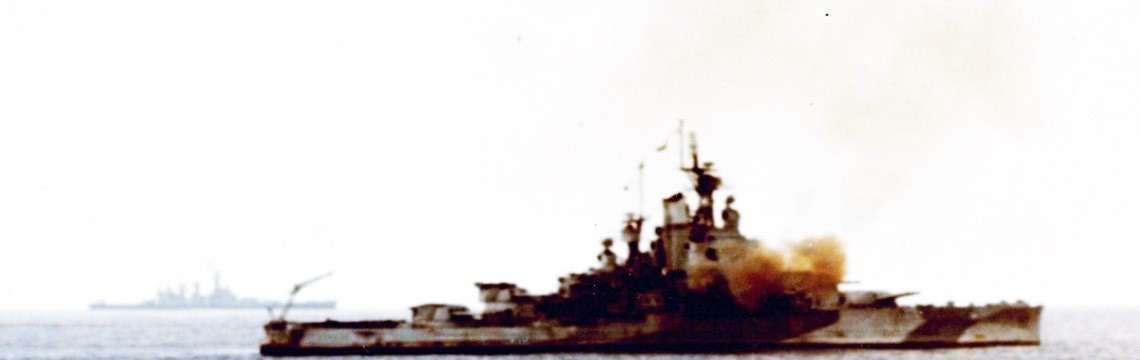
As dawn broke on February 16, 1945, the horizon off Iwo Jima was lined with the thunderous might of Task Force 54, under Rear Admiral William H.P. Blandy.
Six battleships—Arkansas, New York, Texas, Nevada, Idaho, and Tennessee—alongside five cruisers, including the storied Pensacola and Salt Lake City, drew closer to shore than doctrine usually allowed, bringing their guns to bear on the black volcanic sands and the forbidding heights above the landing beaches.
Despite limited time, poor visibility, and the daunting challenge of entrenched Japanese defenses, these warships unleashed a torrent of fire meant to soften the island’s iron grip.
But Iwo Jima would not yield easily. On D-Day, February 19, the naval gunfire grew even fiercer as three more battleships—North Carolina, Washington, and West Virginia—joined the barrage, along with cruisers Indianapolis, Santa Fe, and Biloxi.
Nearly 14,000 tons of shells rained down, shattering blockhouses and lighting up the labyrinth of caves and tunnels. Yet, when the Fourth and Fifth Marine Divisions, led by Lieutenant General Holland M. Smith, stormed ashore, they met an enemy still fiercely dug in and ready to fight for every inch.
The Marines’ advance was a grim, grinding ordeal. Armed with flamethrowers, bazookas, demolition charges, and grenades, they battled through a honeycomb of underground fortifications, facing Japanese soldiers who emerged from hidden tunnels to ambush and then vanished beneath the earth.
General Smith would later call Iwo Jima “the most savage and costly battle in the history of the Marine Corps.” The island was finally declared secure on March 16, but not before thousands of Marines had paid the ultimate price.
Strategically, Iwo Jima was the key to the air war against Japan. Just 700 miles from the home islands, it became a vital base for P-51 fighters and B-29 bombers, offering both a launching point for raids and a desperately needed emergency landing strip for crippled bombers returning from missions.
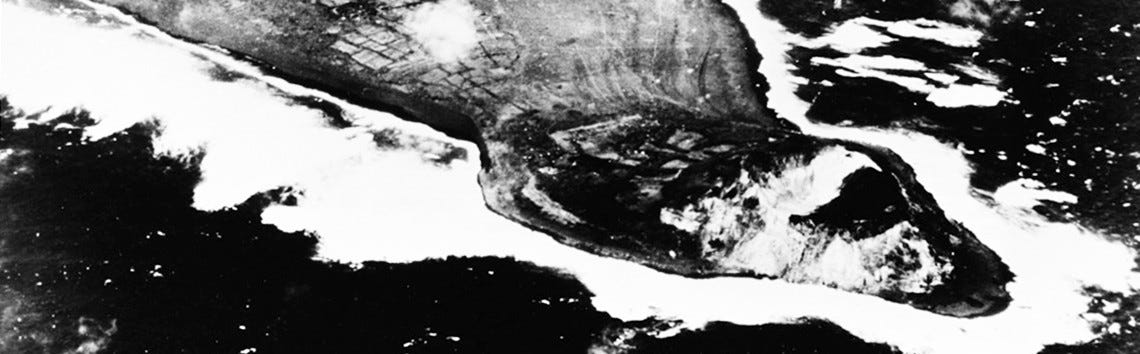
By late 1944, the Japanese had carved two airfields into the volcanic rock and were working on a third, shielded by an interlocking maze of tunnels, trenches, and fortified gun positions, especially around Mt. Suribachi, the island’s iconic peak.
It was atop Suribachi, on February 23, 1945, that Marines raised the American flag in a moment immortalized in history.
The first flag was too small to be seen by all; a second, larger flag was raised soon after, prompting Secretary of the Navy James V. Forrestal to remark, “the raising of the flag on Suribachi means a Marine Corps for the next 500 years.”
Yet, even as that image circled the world, desperate resistance continued, and victory was only declared weeks later—a testament to the island’s fierce defenders and the indomitable will of the Marines who took it.
Battleships at Iwo’s Gate
In February 1945, a formidable armada—eight battleships, five heavy cruisers, three light cruisers, and ten destroyers—gathered off a small volcanic island just 650 miles from Tokyo: Iwo Jima, the crucial link on the bomber route between Tokyo and the Marianas.
The Allies needed this rugged outpost as a base for fighter escorts and a lifeline for battered B-29s limping home from raids over Japan. But waiting for them were 22,000 Japanese defenders, dug deep into a labyrinth of caves and tunnels, determined to fight to the last man to deny the Allies a foothold.
Let me give you a quick rundown of the B-29, one of the birds involved in the Battle for Iwo Jima
Armament: Eight .50-cal. machine guns in remote controlled turrets plus two .50-cal. machine guns and one 20mm cannon in tail; 20,000 lbs. of bombs
Engines: Four Wright R-3350s of 2,200 hp each
Maximum speed: 357 mph
Cruising speed: 220 mph
Range: 3,700 miles
Ceiling: 33,600 ft.
Span: 141 ft. 3 in.
Length: 99 ft.
Height: 27 ft. 9 in.
Weight: 133,500 lbs. maximum
Serial number: 44-27297
Meanwhile, let us take a closer look at the anatomy of this battleship, USS Arkansas (BB-33)
Displacement: 26,000 tons Length: 562 ft. Beam: 93.1 ft. Draft: 28.5 ft. Propulsion: 12 Babcock and Wilcox coal-fired boilers with oil spray, 4-shaft Parsons direct-drive steam turbines Speed: 20.5 knots Complement: 1,063 men Armament (as built): 12 × 12-inch/50 caliber Mark 7 guns; 21 × 5”/51 caliber guns; 2 × 21” torpedo tubes
The Legacy of the Hardest Beach
The legacy of Iwo Jima is often reduced to one famous photograph—but its lasting impact is really about access, airpower, and the brutal price of seizing (and holding) forward positions.
Militarily, Iwo proved that a small island could be a strategic switchyard: in U.S. hands, its airfields became a refuge for damaged or fuel-starved bombers and a platform for extending fighter reach. A disabled B-29 made the first emergency landing in March 1945, and by war’s end the island’s fields had logged more B-29 landings.
It is a concrete measure of how “one more divert airfield” can translate into saved crews and preserved combat power. Iwo also served as an emergency landing field and as a base enabling fighters to escort B-29s—helping protect the strategic air campaign’s tempo and survivability.
Operationally, Iwo Jima hardened U.S. doctrine on amphibious assault against a prepared, subterranean defense—a fight defined by caves, tunnels, and fortifications that demanded relentless combined arms and combat engineering under fire. It also became a benchmark for the human cost of forcing entry: the battle ended in the same month of 1945 after staggering casualties on both sides.
Iwo’s lesson isn’t only about taking ground. It’s about protecting the routes, bases, and people that make airpower possible, a reminder that “access” still has a cost even in today’s long-range, networked wars.
In Case You Missed It
Photo Outlet
Every issue of Hangar Flying with Tog gets you a free image that I’ve taken at airshows:
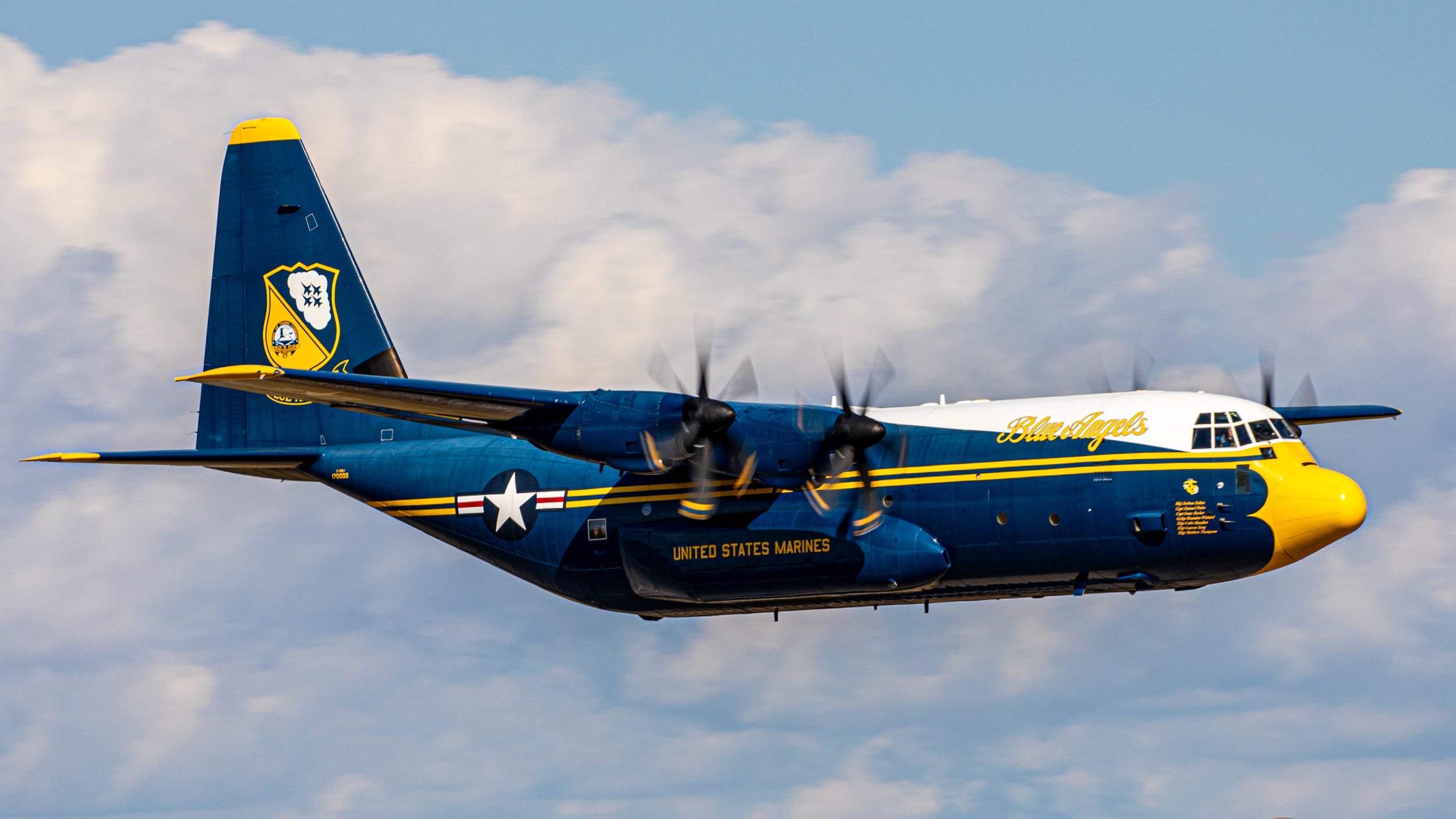
Feel free to use these photos however you like, if you choose to tag me, I am @pilotphotog on all social platforms. Thanks!
Post Flight Debrief
Like what you’re reading? Stay in the loop by signing up below—it’s quick, easy, and always free.
This newsletter will always be free for everyone, but if you want to go further, support the mission, and unlock bonus content like the Midweek Sortie, consider becoming a paid subscriber.
Your support keeps this flight crew flying—and I couldn’t do it without you.
– Tog