

Exporting Airpower through Training the Allied Cockpit and Looking Back at USMC's First Combat Mission
From VMF-124 proving the Corsair under fire to today’s contractor-built pipelines, airpower keeps teaching the same lesson: aircraft are hardware—combat capability is trained, scaled, and sustained.
Training will have to meet international flight regulations and Federal Aviation Administration flight rules. Instruction will be at the industry partner’s facilities, utilizing their aircraft and infrastructure
—Air Force Request for Information
Mission Briefing
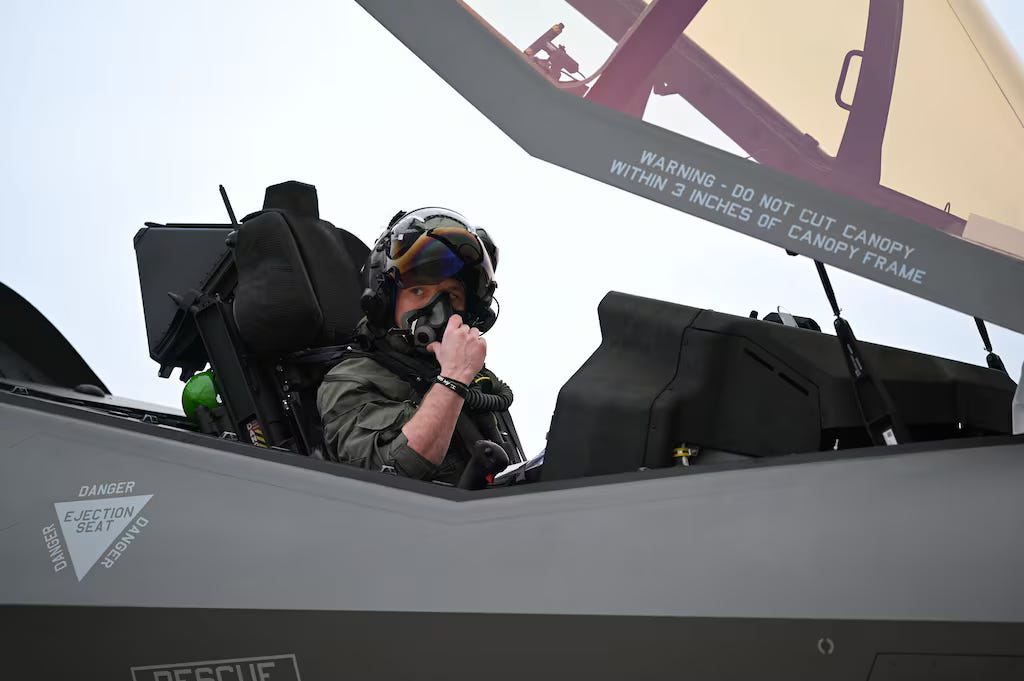
At the end of January 2026, a quiet ripple ran through the aviation world: the U.S. Air Force was on the hunt for skilled hands to shape the next generation of foreign pilots, right here on American soil. Demand for these training programs was soaring to new heights, outpacing even the boldest projections. Beyond the gleaming promise of fighter jet sales, a subtler challenge loomed; a bottleneck that could determine the future of air power.
Airpower’s Bottleneck: Solving the Training Gap
As the last days of January 2026 slipped off the calendar, a subtle but telling signal emerged from the heart of American defense aviation. Defense News broke the story: the U.S. Air Force was quietly seeking companies ready to take on a vital mission—training foreign pilots on American soil.
Not with grand contracts just yet, but with a Request for Information, a kind of feeler, a call into the wind to see who might answer, how quickly, and at what cost.
Now, to the untrained eye, this might seem like just another bit of administrative paperwork. But in aviation, the fine print often carries more weight than the headlines. Behind every new jet rolling off the assembly line—be it the cutting-edge F-35 or the venerable F-16—lies a more complex, and frankly, more stubborn challenge: transforming a sale into real-world capability.
See, ramping up a factory floor is one thing. Machines work to schedule, day and night, if you feed them parts and power. But cultivating a combat-ready aviator? That’s a different league.
You can’t rush hundreds of hours in the cockpit, nor can you mass-produce the wisdom that seasoned instructors pass down, one sortie at a time. This isn’t just about filling cockpits. It’s about building muscle memory, judgment, and the kind of cool-headed decision-making that separates a pilot from a passenger.
That’s why this move toward outsourcing training isn’t just a business decision; it’s a sign of the times. The pipeline that feeds both U.S. and allied squadrons is being stretched to its limits. Demand from abroad is now pulling on the same resources the U.S. relies on, and that pipeline, no matter how you look at it, only has so much room.
There’s another layer here, too. The Air Force is looking to outsource the basics: instruction on demilitarized or commercially derived aircraft. Think of it as teaching a pilot to walk before they run; mastering instrument procedures, crew coordination, and unclassified mission profiles on simpler platforms, before moving on to the front lines.
The goal? Free up the most advanced jets and instructors for the training that truly demands them.
And this isn’t just about fighter pilots. The call extends to all corners of military aviation—surveillance, maritime patrol, medevac, search and rescue, even elements of electronic warfare. Washington wants to expand its training throughput, but not at the expense of its most precious resources.
The irony is almost cinematic: while flashy jet sales make the evening news, the real story unfolds behind the scenes, in briefing rooms and on training ranges. Without a robust training chain, gleaming airframes become little more than expensive lawn ornaments; capable in theory, but grounded in practice.
There’s a sovereignty angle, too. Nations that rely on U.S. training schedules accept a degree of strategic dependence. When tensions rise, the waiting game for qualified crews can become a vulnerability all its own.
And the numbers don’t lie. Lockheed Martin is set to deliver a record 191 F-35s in 2025, swelling the global fleet to nearly 1,300 aircraft across a dozen countries.
The F-16, too, is experiencing a renaissance: over a hundred new Block 70/72 models on order, dozens already delivered. Modernization isn’t a one-time wave. It ripples through generations of aircraft, each requiring its own cadre of trained pilots, instructors, and ground crews.
A new fighter jet is a promise, yes. But capability, that elusive blend of availability, safety, and operational excellence; depends on people as much as machines. An F-16 Block 70/72 boasts a robust lifespan and impressive thrust, but none of that matters if it sits idle, waiting for a crew.
In plain terms, handing over a jet without the training pipeline to support it is like parking potential on the ramp, waiting for the day it can finally take flight.
Beyond the Headline: The AETC and the ENJJPT
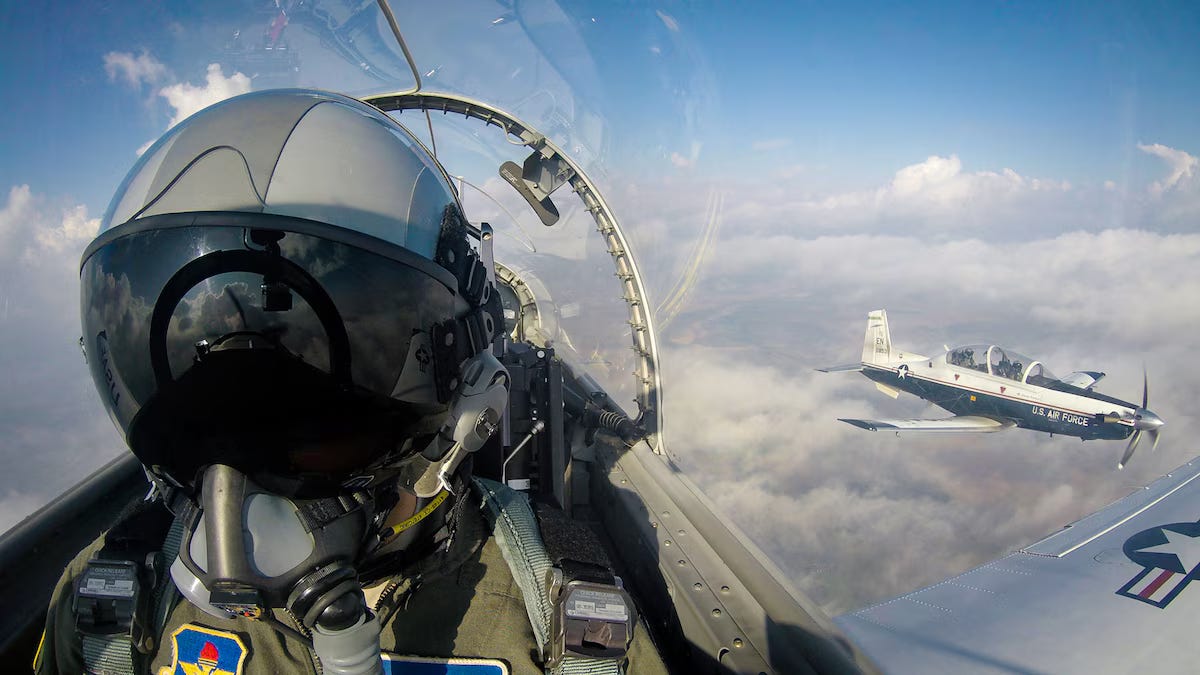
For decades, the international training web has run quietly and efficiently, much of it orchestrated by the Air Education and Training Command—the nerve center of pilot production and the gateway for allied aircrew.
Each year, more than 9,000 students from some 142 nations pass through America’s security assistance program. And it’s not just pilots—mechanics, systems techs, all the men and women who keep a jet combat-ready day after day join the ranks, learning more than just how to turn a wrench or handle a stick.
Here’s why that number matters: the United States isn’t simply shipping aircraft overseas. What’s really being exported is a whole operational language—procedures, safety protocols, standards, interoperability, and the disciplined methods that make a modern air force tick. You can’t download that overnight; it has to be taught, absorbed, and practiced.
At the heart of this process is the Air Force Security Assistance Training Squadron, quietly aligning the needs of partner nations with America’s own security priorities, matching training slots to base availability and industry timelines.
But when several allies ramp up their programs at once, the strain is real; on instructors, on simulators, on training fleets, and even on the airspace itself.
That’s the backdrop for the Air Force’s latest move: seeking outside providers to create extra capacity fast, especially in the less-sensitive stages of training, before pilots step into the classified world of combat operations.
The goal is ambitious: 1,500 new pilots a year by 2026. But targets don’t conjure more flight hours, billets, or training aircraft out of thin air. Some bases are already pushing to graduate over 350 aviators a year, while others are hampered by maintenance woes or limited accommodation.
Even with Euro- NATO’s joint jet pilot training program sharing the load, its output is finite. If demand swells across multiple countries at once, the system’s limits become clear. No matter how many jets are waiting on the ramp.
Cleared for Takeoff: Navigating the New Bottleneck in Allied Pilot Training
The U.S. Air Force’s recent Request for Information is more than just paperwork. It’s a candid signal to the aviation world: the flow of training is reaching its limit as allied nations clamor for American aircraft and expertise.
The bottleneck isn’t in the factories, but on the flight lines and in the classrooms, where the journey from “jet on the ramp” to a combat-ready pilot can stretch on longer than any procurement schedule.
For America’s allies, tapping into contractor-backed training offers a way to break free from the logjam. By outsourcing the early, less-sensitive phases—basic flying, instrument procedures, crew teamwork, and unclassified mission profiles, often on commercial or demilitarized airframes—partner nations can field new squadrons sooner. It’s a shortcut, of sorts, that keeps their investments meaningful and ensures deterrence remains more than just a talking point.
From the U.S. perspective, it’s a balancing act. The Air Force must safeguard its own training capacity, even as it honors commitments to partners around the globe. With goals like producing 1,500 pilots a year, every slot counts.
But opening the doors to outside providers isn’t without turbulence. There are questions of standardization, quality control, data security, and, not least, the sovereignty of how each nation shapes its own aviators.
The real story isn’t just about bringing contractors into the fold. It’s the dawning realization that the pilot training pipeline itself has become a strategic lever; frontline infrastructure for coalition airpower.
The next big debate? How much of that pipeline can be scaled up, and which parts must remain tightly held to preserve the sharp edge of readiness?
This Week in Aviation History
February 1943, morning breaks over Guadalcanal as the squadron’s F4U Corsairs touch down, their engines still humming with anticipation. By afternoon, there’s no settling in—these aviators are called straight into the fray.
Their first combat mission isn’t a strike, but a lifeline: nine hours aloft, shepherding a PBY Catalina across 230 miles of restless Pacific, determined to bring home two fellow pilots stranded at Sandfly Bay off Vella Lavella.
In a single day, the squadron trades the dust of the runway for the gravity of rescue, their introduction to combat etched not in gunfire, but in the unwavering resolve to never leave a comrade behind.
The Whistling Death/Wild Aces
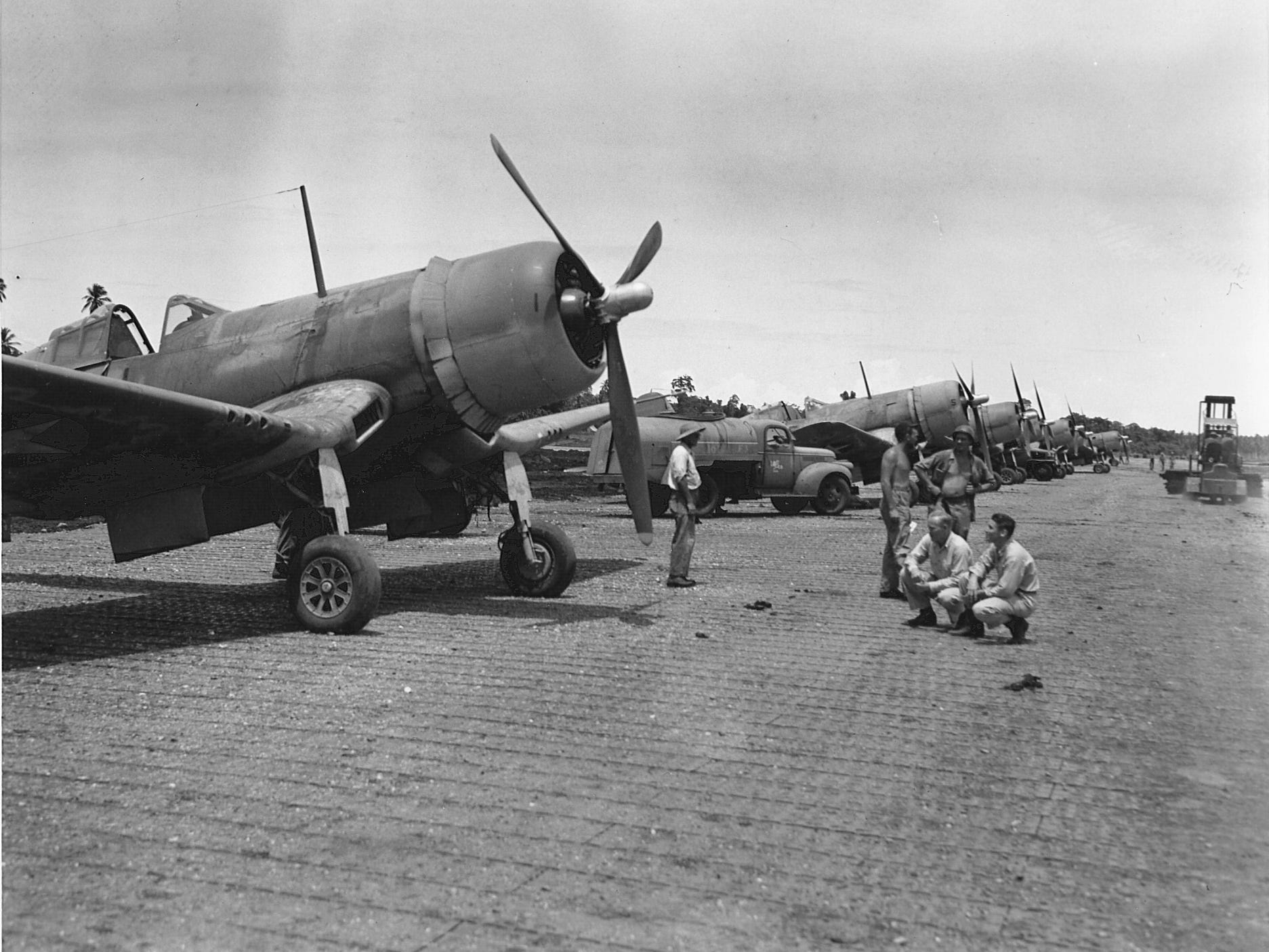
Marine Fighter Attack Squadron 124 (known as the “Wild Aces”) was a name spoken with a mix of awe and respect in ready rooms and on flight lines across the Pacific.
Born at Camp Kearney in San Diego on September 1942, the squadron’s pilots were declared operational by the end of that same year, barely having twenty-five hours apiece in their brand-new F4U Corsairs. Yet, history doesn’t wait for perfect readiness.
By February 1943, the Wild Aces were carving their legend into the South Pacific sky. Eleven Corsairs roared off on their first major combat mission, escorting nine PB4Y-1 Liberators as they hunted Japanese shipping near Bougainville. Here, the Corsair tasted battle for the first time in the theater; facing down Zeros and floatplanes in a deadly ballet of speed and fire.
The next day, the cycle repeated itself: twelve more Corsairs, another high-stakes escort run, and heartbreak etched into the logbooks as two pilots—1st Lt. Gordon Lee Lyon, Jr. and 2nd Lt. Harold Ralph Stewart—vanished into the vast blue, never to return.
The cost of battle would not relent. Weeks later, another Corsair and its pilot, 1st Lt. Walter A. Franklin, Jr., were lost. But the squadron pressed on. March 29, 1943, dawned with a bold joint-service sweep: Captain Tom Lanphier led a handful of P-38 Lightnings and VMF-124 Corsairs into the teeth of the enemy. Weather scattered the formation, but those who found the target struck hard, strafing seaplane bases at Shortland, sending enemy floatplanes up in flames, and even raking a Japanese subchaser as they sped home.
May brought more ferocity. On the 13th, fifteen Corsairs scrambled to intercept incoming Japanese fighters over the Russell Islands, clashing with A6M2 Zeros in a twisting dogfight. Major William Gise, the squadron’s leader, did not come back. The very next day, Captain Brewer stepped up as Commanding Officer, with Captain Quilty as his Executive Officer.
Throughout the summer of 1943, the Wild Aces relieved VMF-213 and continued to fly hard. August 30 saw another escort mission. This time from Barakoma Airfield, guiding B-24 Liberators to Kahilli Airfield. Another name was added to the roll of the missing: 1st Lt. James L. Fowler.
Yet amid the crucible, heroism soared. Kenneth A. Walsh, one of their own, flew with such skill and valor on August 15 and again on August 30 that he became the first Corsair pilot to earn the Medal of Honor. The Wild Aces had written their story in the Russells, New Georgia, and Vella Lavella; etched in victories, sacrifices, and aerial mastery.
By September 7, 1943, their first Pacific tour closed. VMF-124 left the Solomon Islands behind, returning to the United States to regroup and train, their legacy already secured in the annals of Marine Corps aviation.
Under the Hoods of the Birds used by the Wild Aces
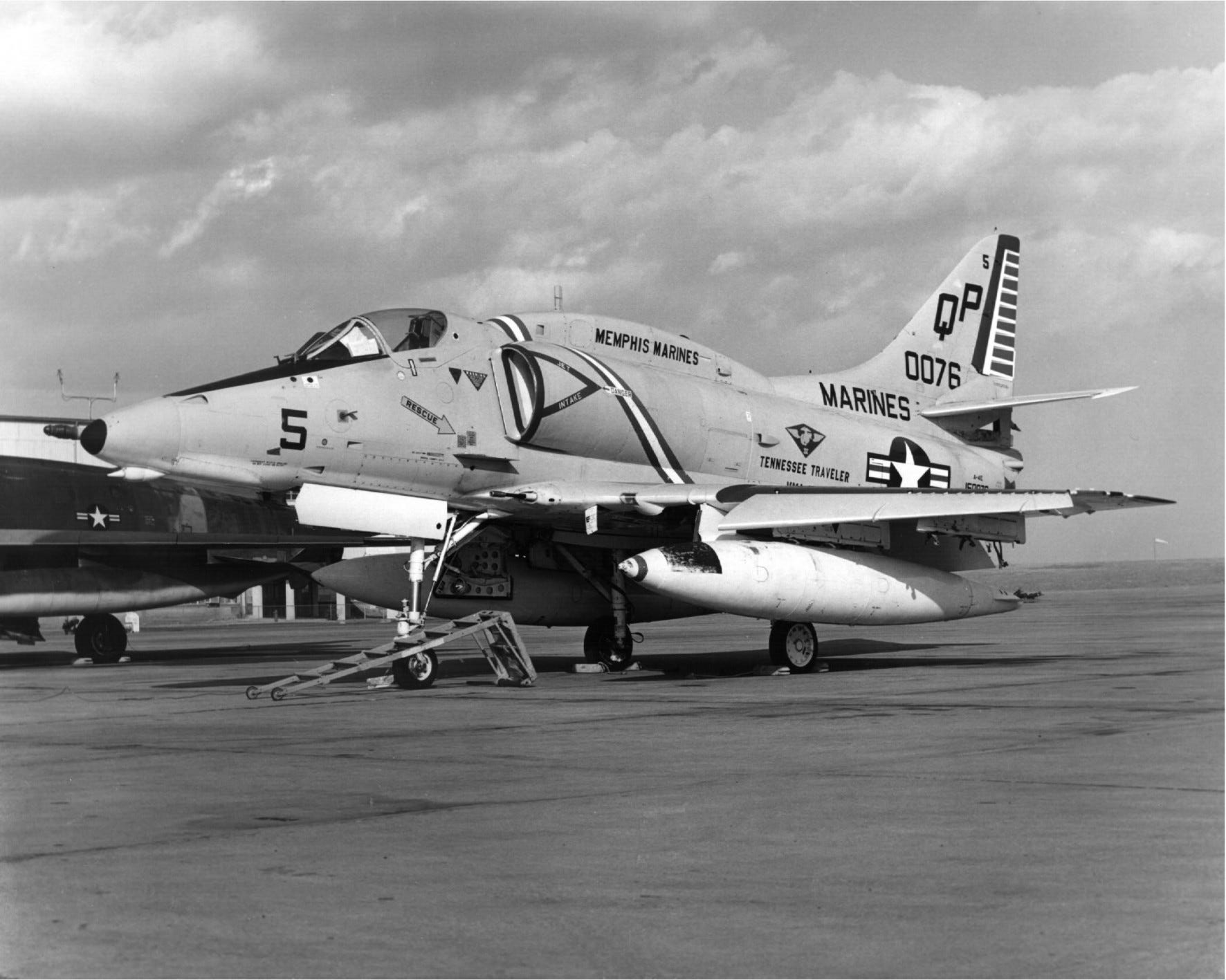
Features of the A-4E
Dimensions & Weights
Wingspan: 27 ft, 6 in (8.38 m)
Length: 40ft 4in (12.29 m) excluding refueling probe
Height: 15 ft, 10 in (4.57 m)
Wing area: 260 sq ft (24.16 sq m)
Empty Weight: 10,800 lb (4,899 kg)
Maximum Takeoff Weight: 24,500 lb (11,113 kg)
Accommodation
One (pilot)
Performance
Maximum speed: 1,040 mph (646 kmh) with 4,000lb (1,814 kg) bomb load
Initial climb rate: 10,300ft ft/min (3,140 m/min)
Range: 2,000 miles (3,220 km) with maximum fuel
Powerplant
One 11,200 lb (5,080kg ) Pratt & Whitney J52-P-408 turbojet
Armament
Fixed: Two Mk 12 20mm cannon with 200 rounds per gun in the wing roots
Disposable: This is carried on one under fuselage hardpoint, rated at 3,500 lb (1,588 kg), and on four underwing hardpoints, the inner pair each rated at 2,250 lb (1,021 kg) and the outer pair each at 1,000 lb (454 kg); a great variety of weapon loads can be carried, including nuclear bombs, the Mk 84 2,000 lb (907 kg) bomb, the Mk 83 1,000 lb (454kg) free-fall or retarded bomb, the Mk 82 500 lb (227 kg) free-fall or retarded bomb, the Mk 81 250 lb (113 kg) free-fall or retarded bomb, the LAU-3/A launcher with 19 2.75 inch (69.85mm) rockets, the LAU-10/A launcher with four 5 inch (127mm) rockets.
Electronics
Communication and navigation equipment, plus Bendix automatic flight control, Marconi AN/AVQ-24 head-up display, Texas Instruments AN/AJB-3 bombing system, ANIASN-41 navigation computer, AN/APN153(V) radar navigation, and electronic countermeasures.
Features of the Vought F4U Corsair
Wingspan: 41 feet
Length: 34 feet, 6 inches
Height: 14 feet, 9 inches
Empty Weight: 9,683 pounds
Max. Weight: 14,106 pounds
Powerplants: 1 Pratt and Whitney R-2800-32
Armament: 4 Wing Mounted 20mm Cannons
Crew: 1
Max Speed: 408 mph
Service Ceiling: 41,400 feet
Range: 1,120 miles
Legacy Written in Transitions
VMFA-124’s story begins with a bold first step. As VMF-124, they became the very first Marine squadron to take command of the Vought F4U Corsair in late October 1942; placing faith in a rugged, temperamental fighter that would soon become a winged legend across the Pacific.
Their pioneering spirit wasn’t confined to the tarmac; in February 1943, the squadron climbed into history, flying the Corsair’s first combat mission from Guadalcanal. The task was simple, escort a PB2Y on a rescue run, but crossing that threshold marked the start of a new era in Marine aviation.
Their legacy didn’t stop at land-based operations. VMF-124 helped shatter old boundaries by bringing the Corsair—and Marine tactical aviation—aboard the USS Essex. No longer just a land-based force, these Marines proved they could surge from the sea, flying real strike operations side by side with the Navy. Archival reports confirm that this was no mere demonstration, but a genuine integration into fleet combat.
After the guns fell silent, the squadron’s significance evolved. Reborn as VMA-124 in the Marine Reserve, the unit kept the torch of tactical excellence burning. Through changing jets and shifting demands, the Wild Aces earned multiple safety and performance awards, a testament to their enduring professionalism and the culture of safe, skillful flying that defined every chapter of their legacy.
In Case You Missed It
From the very early days of the channel:
Photo Outlet
Every issue of Hangar Flying with Tog gets you a free image that I’ve taken at airshows:
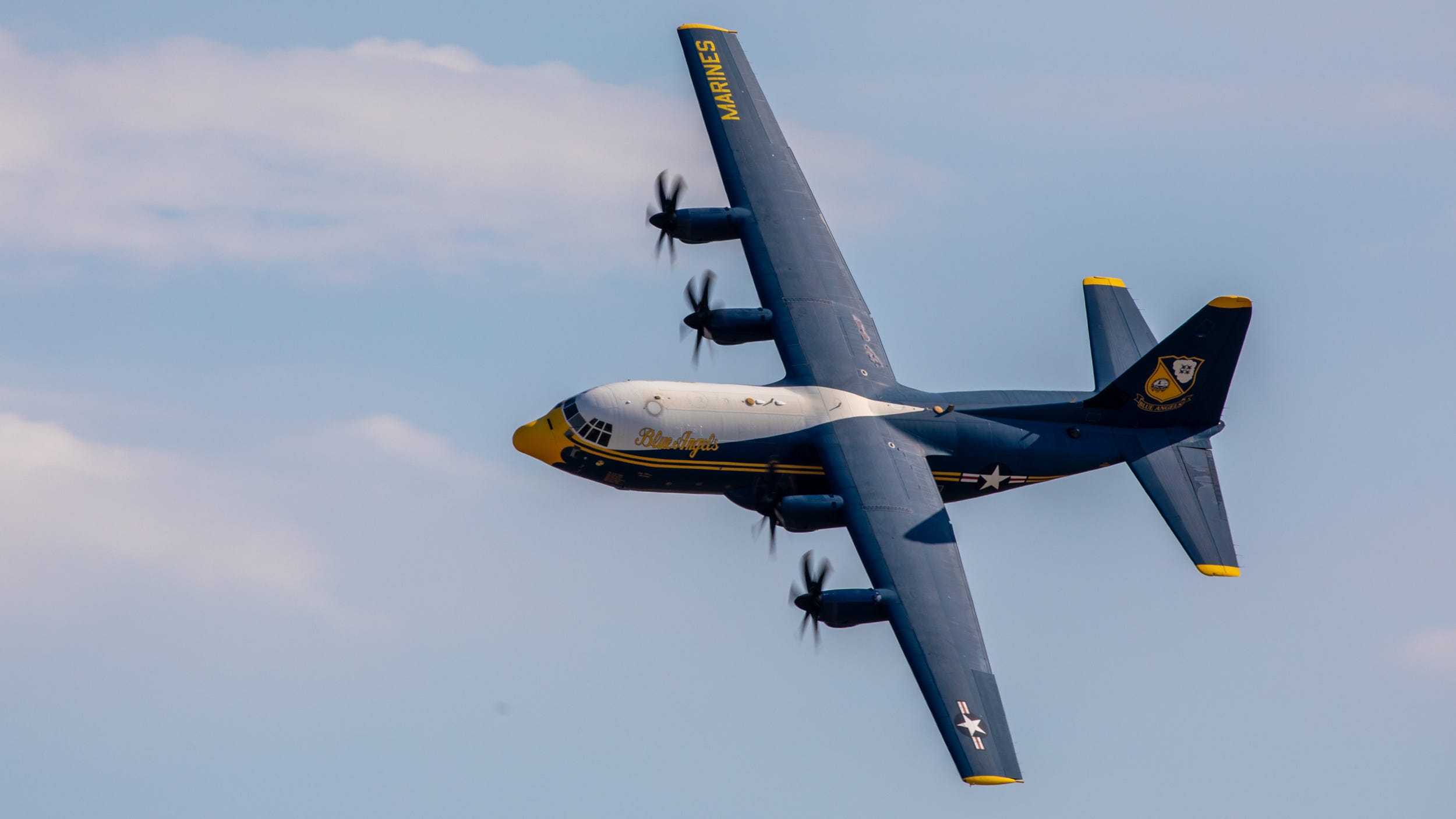
Feel free to use these photos however you like, if you choose to tag me, I am @pilotphotog on all social platforms. Thanks!
Post Flight Debrief
Like what you’re reading? Stay in the loop by signing up below—it’s quick, easy, and always free.
This newsletter will always be free for everyone, but if you want to go further, support the mission, and unlock bonus content like the Midweek Sortie, consider becoming a paid subscriber.
Your support keeps this flight crew flying—and I couldn’t do it without you.
– Tog