

A-10s are now in the Strait of Hormuz and Remembering when the Skywarrior Entered Fleet Service
From the Skywarrior’s carrier-borne strike mission to the A-10’s modern hunt for fast attack craft, both stories show how aircraft work as instruments of sea control and maritime power projection.
A-10s have routinely been equipped with Sidewinders as a last layer of self defence against hostile aircraft, but with the increased use of small uncrewed aerial vehicles (UAVs) like the Shahed 136 as attack munitions, the A-10 can now use them in a more offensive role
—U.S. Central Command
Mission Briefing
The A-10 Warthogs, those rugged workhorses of the U.S. Air Force, have shifted gears in Operation Epic Fury. According to General Dan Caine’s briefing from the Pentagon on March 19, 2026, these jets are now prowling the southern flank, eyes locked on the fast attack boats darting through the Strait of Hormuz. The mission: hunt down threats on the waves with the same relentless precision they’ve always shown on land.
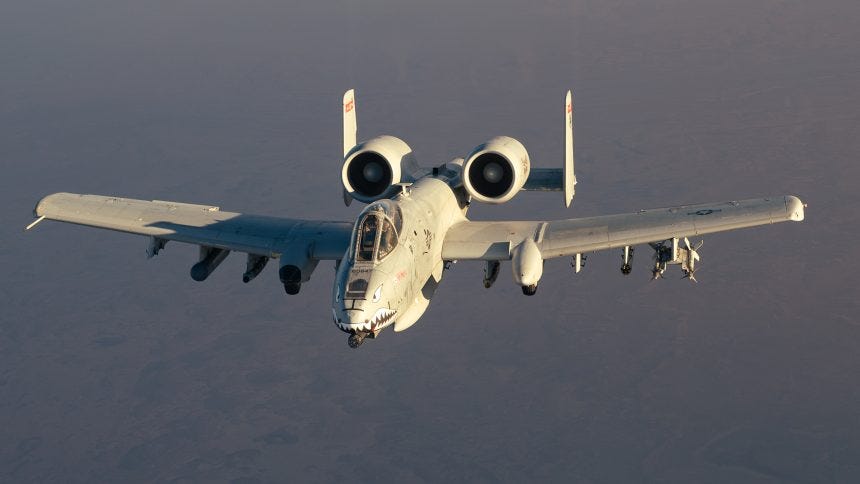
Warthogs are Hunting the Iranian Fast Attack Craft in the Strait of Hormuz
From the very start of Operation Epic Fury, there was no mystery about the A-10 Thunderbolt II’s involvement; CENTCOM made it official within the first 48 hours. But the story deepened when U.S. Central Command released new images: the unmistakable silhouette of the Warthog, bristling with both anti-air and anti-surface weaponry.
Outfitted with a LITENING targeting pod, a pair of Maverick missiles, Sidewinders, a centerline fuel tank for extra range and loiter time, and an APKWS rocket pod, these jets looked ready for any mission the battle demanded. Until now, though, the A-10 had never been confirmed flying missions over Iran itself.
Traditionally, the Hogs had been deployed to Muwaffaq Salti Air Base in Jordan, where their reputation was forged in the classic role of close air support; providing cover for ground troops and hammering Iran-backed Popular Mobilization Forces in Iraq.
But with the escalation of Epic Fury, the A-10s made a leap from the familiar desert theater to a new domain: the open waters and contested straits of the Persian Gulf.
It’s a transition that makes perfect sense to those who know the type. Over the past decade and a half, the A-10 has quietly expanded its resume beyond tank-busting and battlefield support.
In 2011, during Operation Unified Protector, a Warthog teamed up with a P-3 Orion to take out a patrol boat and several small attack craft in Misrata, Libya—a harbinger of things to come.
More recently, faced with escalating asymmetric threats in the Red Sea and the Black Sea; where swarms of unmanned surface vehicles (USVs) and small boats have challenged even the most advanced navies. The Warthog has become a familiar sight at maritime exercises, training to counter these fast, elusive foes.
By the 2020s, the A-10 was a regular participant in Maritime Surface Warfare drills, including a notable 2023 exercise where two Hogs joined the USS Stethem in the Gulf of Oman to engage simulated surface threats.
The logic is clear: with high-value warships and tankers vulnerable to massed attacks by USVs, the ability to loiter low and slow, deliver precise, flexible firepower, and operate in tight quarters is more valuable than ever.
The A-10’s legendary maneuverability, robust payload, and unflappable accuracy make it a nightmare for fast-moving targets; on land and now, increasingly, at sea.
So, as Epic Fury unfolds, the Warthog writes a new chapter in its storied legacy, proving that an old warrior with the right tools and the right crew can adapt to any battlefield—from the dust of Iraq to the blue of the Persian Gulf—wherever the mission calls.
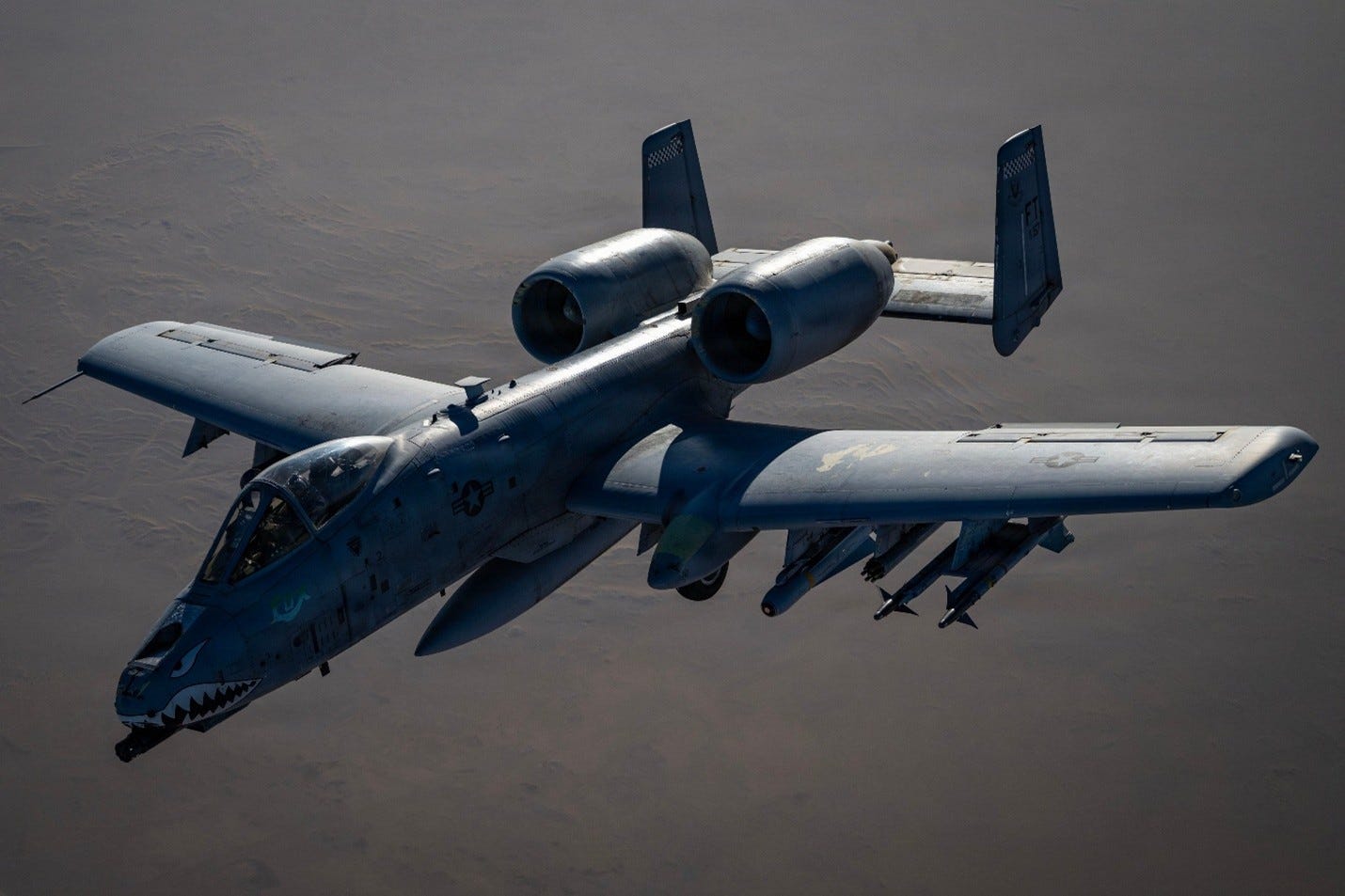
Anatomy of the Warthog
The A-10 Thunderbolt II is a pilot’s dream when it comes to low and slow maneuvering; hugging the terrain with uncanny precision and delivering its arsenal with unrivaled accuracy.
Built to linger over the battlefield, the Warthog can take off from short, rough strips close to the front, operate in lousy weather or low visibility, and keep watch for hours, ready to strike at a moment’s notice; even in the dead of night, thanks to night vision goggles and NVIS-compatible cockpits.
The all-around bubble canopy offers panoramic views, while titanium armor cradles the pilot and vital systems, letting the jet shrug off hits that would down lesser aircraft.
Redundant controls, self-sealing fuel cells, and manual backups mean the A-10 can keep flying even when wounded, surviving direct fire up to 23mm and still bringing its pilot home. In the chaos of close air support, the Warthog is more than a machine—it’s a steadfast guardian, engineered to endure the toughest fight and turn the tide for those on the ground.
General characteristics
Primary function: close air support, airborne forward air control, combat search and rescue
Contractor: Fairchild Republic Co.
Power plant: two General Electric TF34-GE-100 turbofans
Thrust: 9,065 pounds each engine
Wingspan: 57 feet, 6 inches (17.42 meters)
Length: 53 feet, 4 inches (16.16 meters)
Height: 14 feet, 8 inches (4.42 meters)
Weight: 29,000 pounds (13,154 kilograms) Maximum Takeoff Weight: 51,000 pounds (22,950 kilograms) Fuel Capacity: 11,000 pounds (7,257 kilograms)
Payload: 16,000 pounds (7,257 kilograms)
Speed: 450 nautical miles per hour (Mach 0.75)
Range: 2580 miles (2240 nautical miles)
Ceiling: 45,000 feet (13,636 meters)
Armament: one 30 mm GAU-8/A seven-barrel Gatling gun; up to 16,000 pounds (7,200 kilograms) of mixed ordnance on eight under-wing and three under-fuselage pylon stations, including 500 pound (225 kilograms) Mk-82 and 2,000 pounds (900 kilograms) Mk-84 series low/high drag bombs, incendiary cluster bombs, combined effects munitions, mine dispensing munitions, AGM-65 Maverick missiles and laser-guided/electro-optically guided bombs; infrared countermeasure flares; electronic countermeasure chaff; jammer pods; 2.75-inch (6.99 centimeters) rockets; illumination flares and AIM-9 Sidewinder missiles.
Warthogs on Watch: Guardians of the US and Allies
When the United States unleashed its A-10 Thunderbolt IIs against Iranian fast attack craft in the Strait of Hormuz, it was more than just a change in tactics. It was a declaration that this critical maritime artery would be defended with every tool in the arsenal.
In Operation Epic Fury, the Warthogs left their traditional close air support roles behind, taking to the skies over one of the world’s most volatile chokepoints to hunt the nimble boats that could threaten warships, tankers, and global commerce alike.
The Strait of Hormuz is no ordinary waterway; it’s a flashpoint where a handful of small boats, if left unchecked, could have global consequences.
For America’s allies—especially those with stakes in Gulf stability—the sight of A-10s loaded for both air and surface threats brought reassurance. These jets, equipped for drones and fast craft alike, can loiter for hours, maneuver at low altitudes, and strike with surgical precision, bringing a new layer of deterrence beyond what surface ships alone could offer.
Perhaps most striking, the mission underscored why the A-10 still matters, even as retirement looms. The Warthog’s adaptability for modern, networked, and maritime missions proves that legacy aircraft can still find new purpose.
As the Gulf’s battlespace evolves, the A-10 shows that old legends don’t fade quietly. They simply find new horizons to defend.
This Week in Aviation History
The first A3D-1s rolled off the production line and joined the fleet on 31 March 1956, arriving not long after the Navy welcomed the jet-age carrier USS Forrestal. Almost from day one, these new birds proved their mettle, showcasing what the future of carrier aviation could truly be.
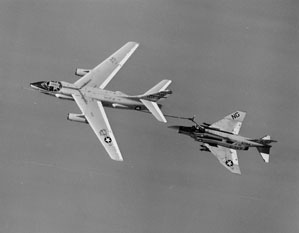
Skywarrior Rising: The Navy’s Atomic Age Answer
The world and the future of warfare changed in an instant when atomic bombs fell over Japan in August 1945. Naval aviators, fresh from the triumphs of World War II, knew the aircraft carrier’s mobility had been the key to victory in the vast Pacific, allowing swift, devastating strikes across a scattered theater.
But in the postwar years, as the smoke cleared, a fierce debate ignited within the ranks of America’s military visionaries. The Army Air Forces, soon to become the independent U.S. Air Force, argued that nuclear-armed heavy bombers would render both sprawling armies and mighty fleets obsolete; air power alone, they claimed, would decide the next great conflict, and thus, all strategic air should be under the control of the new Air Force.
The Navy, unwilling to surrender the oceans or the skies above them, answered with conviction and innovation. Their answer was the A3D Skywarrior, an aircraft that would become synonymous with versatility and endurance at sea.
In 1947, the Navy issued a challenge: design a jet-powered bomber capable of delivering a 10,000-pound atomic weapon over 2,000 nautical miles, launched from the decks of the planned super carrier United States. Douglas Aircraft, led by the legendary Ed Heinemann, took up the call.
Heinemann’s team engineered an aircraft with an impressive gross weight of 68,000 pounds (significantly lighter than rival proposals), powered by twin jet engines tucked into nacelles beneath high-mounted wings, leaving ample space for a cavernous internal bomb bay.
Though the super carrier United States was abruptly canceled just weeks after Douglas received the contract for two prototypes, the Skywarrior project pressed on. In its final form, the A3D boasted a pair of Pratt & Whitney J57-P-6 engines, each producing 9,700 pounds of static thrust and pushing the bomber to speeds exceeding 600 miles per hour.
Heinemann’s relentless focus on weight reduction meant the Skywarrior could launch from modified Essex-class carriers, relics of World War II reworked for the jet age. But the quest for lighter flight came with a price: no ejection seats. Instead, the crew relied on an escape chute—a risky prospect that led to the aircraft’s unforgettable nickname among aviators: “All Three Dead.”
31 March 1956 marked a new era as the first production A3D-1s joined the fleet, just months after the USS Forrestal, the Navy’s first jet carrier, was commissioned. The Skywarrior wasted no time proving its worth. On July 31, 1956, one of these bombers flew nonstop from Hawaii to New Mexico; a staggering 3,200 miles in just 5 hours and 40 minutes, without a single refueling.
The following year, a pair of A3Ds made history with a carrier-to-carrier transcontinental flight, launching from the Bon Homme Richard off California and landing on the Saratoga steaming off Florida, cementing the Skywarrior’s place in the legend of naval aviation.
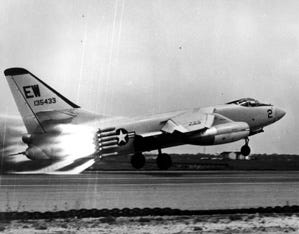
Under the Hood of the Skywarrior
Dimensions: Length: 74 ft, 5 in.; Height: 22 ft., 8 in.; Wingspan: 72 ft., 5 in.
Weights: Empty: 35,999 lb.; Gross: 70,000 lb.
Power Plant: Two 9,700 lb. static thrust Pratt & Whitney J57-P-6 turbojets
Performance: Maximum Speed: 621 M.P.H.; Service Ceiling: 39,000 ft.; Range: 2,990 miles
Armament: Two 20mm cannon in tail and provision for 8,700 lb. of ordnance, including nuclear weapons
Crew: Pilot, bombardier/navigator, gunner (attack configuration)
Skywarrior: An Enduring Callsign
The Douglas A-3 Skywarrior redefined what a naval aircraft could be. Conceived in the tense dawn of the Cold War, it gave the U.S. Navy a jet bomber capable of hauling big payloads over long distances. All from the moving deck of an aircraft carrier. For its day, that was an engineering marvel, the result of Ed Heinemann’s team stripping away every ounce they could, creating the heaviest bird to ever launch regularly from a carrier.
But the Skywarrior’s legacy soared well beyond dropping bombs. As strategy shifted and new threats emerged, the Whale adapted. It became a tanker, a reconnaissance platform, an electronic warfare workhorse, and a testbed for the Navy’s changing technology.
The National Naval Aviation Museum pays special tribute to the KA-3B’s vital refueling missions and credits later EA-3B and NEA-3B variants with keeping the Skywarrior relevant deep into the late Cold War.
That kind of adaptability is rare. The Skywarrior wasn’t just a bomber; it was a bridge from the Navy’s early nuclear ambitions to the modern age of versatile, multi-role carrier aviation.
Even after its attack days were over, the A-3 found new missions; proving that the greatest warplanes aren’t just built for one fight, but for every challenge that follows as the world and the mission change.
In Case You Missed It
Photo Outlet
Every issue of Hangar Flying with Tog gets you a free image that I’ve taken at airshows:
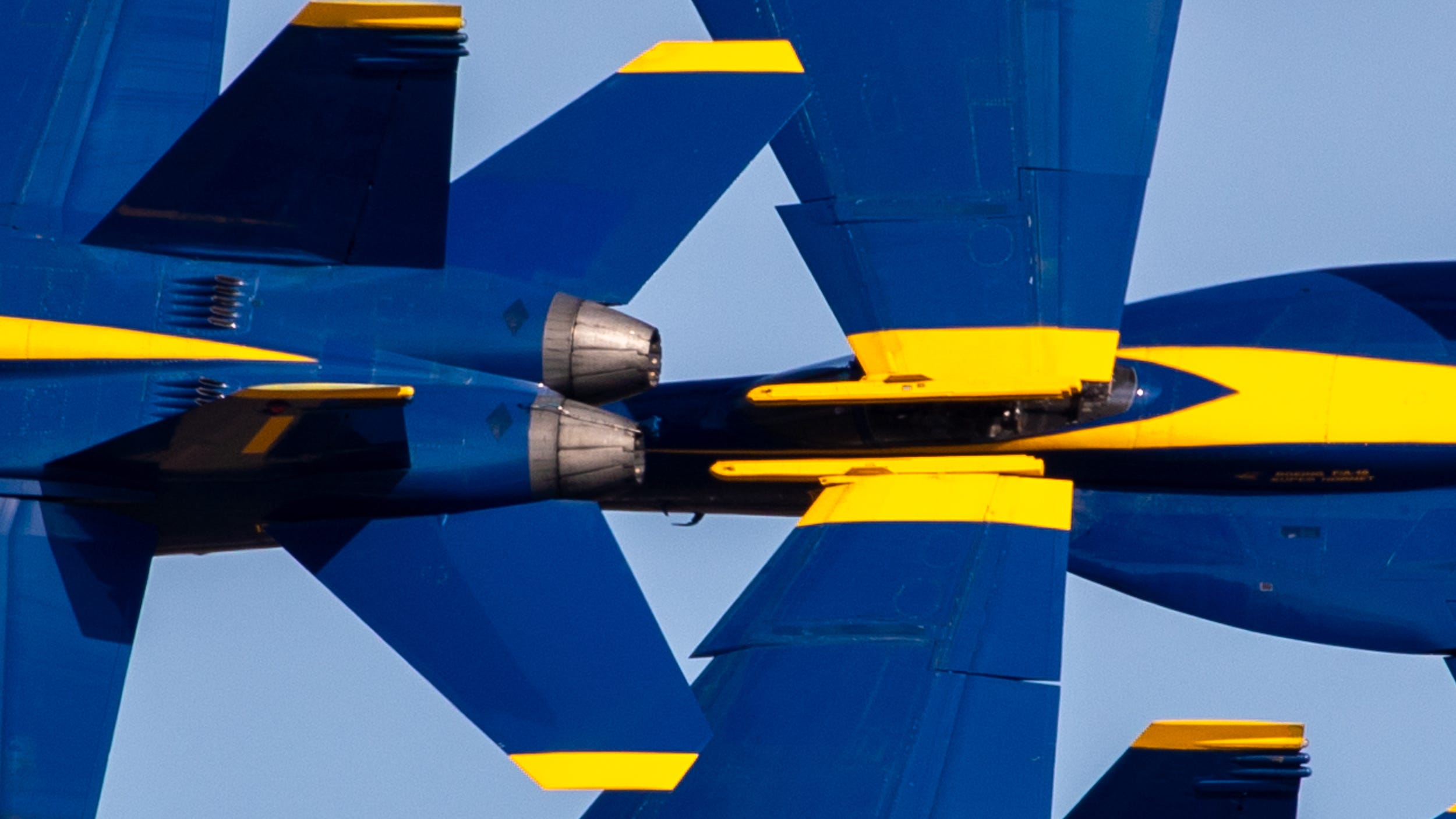
Feel free to use these photos however you like, if you choose to tag me, I am @pilotphotog on all social platforms. Thanks!
Post Flight Debrief
Like what you’re reading? Stay in the loop by signing up below—it’s quick, easy, and always free.
This newsletter will always be free for everyone, but if you want to go further, support the mission, and unlock bonus content like the Midweek Sortie, consider becoming a paid subscriber.
Your support keeps this flight crew flying—and I couldn’t do it without you.
– Tog