

“This project demonstrates that AATC can serve as a rapid response mechanism when combatant commanders face urgent capability gaps.”
—Col. Daniel Wittmer, AATC commander
Mission Briefing
Now, imagine this scene. There’s a new gadget on the block: the Probe Refueling Adapter. Born out of battlefield urgency, this little invention lets the A-10 break free from always waiting for the KC-135, opening up a whole new world of refueling possibilities for our sky-hardened aviators.
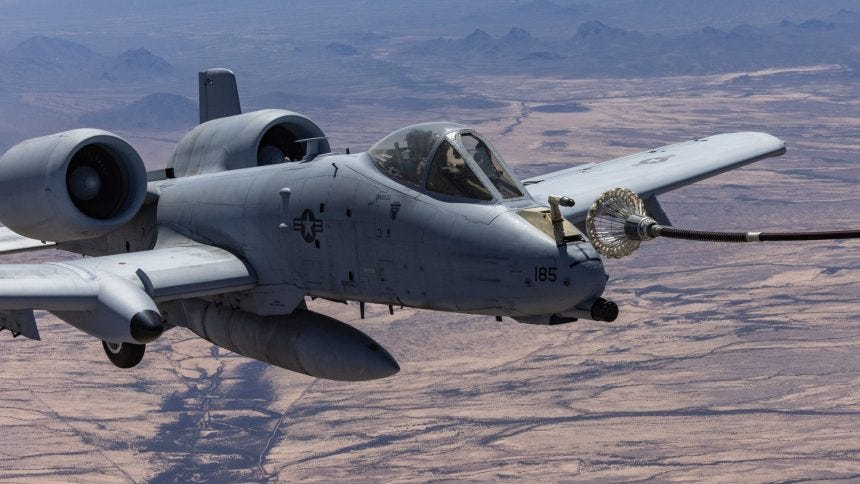
A-10C Can Now Use Probe and Drogue Refueling
Just days after a shadowy photo of the A-10 sporting some unfamiliar hardware made its rounds online, the Air National Guard Air Force Reserve Command Test Center, AATC, for those in the know, decided to pull back the curtain.
They revealed a game-changing upgrade for the venerable A-10C Thunderbolt II. No longer just the tank-busting hero of the battlefield, the Warthog now sports a sleek probe and drogue air refueling capability. It is a transformation that could alter its future in the fight.
Traditionally, the A-10C has been fueled in-flight via a refueling receptacle right on the nose, just ahead of the cockpit, where the boom operator from a tanker would plug in that flying boom.
With the retirement of the KC-10 and the KC-46 still waiting in the wings for certification, the A-10’s options for a mid-air sip of gas were looking slim. Basically, it was stuck relying on the KC-135. But when the situation downrange started getting dicey, commanders put out a call: they needed an answer, fast.
That’s when the magic happened. Multiple organizations leapt into action, compressing timelines and tossing red tape out the hangar doors. The result? The A-10 can now tank up from C-130-based refuelers like the KC-130J Super Hercules, the MC-130J Commando II, and the HC-130J Combat King II.
The AATC became the maestro, coordinating the effort across a whole constellation of units and partners. The probe itself was cooked up by a mystery industry player, while the A-10 System Program Office made sure every bolt and wire met strict standards.
ARCWERX—the innovation engine for the Guard and Reserve—kept contracts flying through the pipeline, while the techs at Luke Air Force Base bent metal and made sure the supporting parts were ready on the double. The 418th Flight Test Squadron even provided a Combat King and crew to test out the new setup.
According to Lt. Col. Luke Haywas, the A-10 Combined Test Force director, everyone moved with a sense of urgency, but never at the expense of safety or technical rigor. They didn’t cut corners. They just put the pedal down on every process.
Here’s the kicker: the adapter slips right into the A-10’s nose refueling port, converting it from the old-school boom method to the probe and drogue setup. It’s field-configurable, meaning flight line crews can swap it in or out in just a few hours: no depot visits, no waiting around.
The Warthog can now morph between refueling modes to fit whatever the mission demands. For the A-10 and its crews, that’s not just a technical upgrade. It’s a lifeline, and a testament to what happens when airmen and innovators rally for the mission.
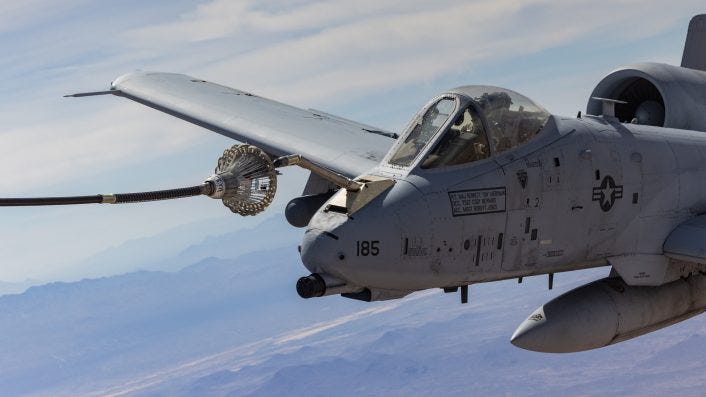
Warthog’s Probe and Drogue
The A-10 Warthog, that legendary beast of the battlefield, is still waiting for a green light to cozy up for a drink with the Air Force’s shiny new KC-46 Pegasus tanker. Testing is ongoing, suspense in the air, and for now, the Warthog’s only lifeline in the sky is the tried-and-true KC-135 Stratotanker.
The problem is, that’s a single point of failure—one hiccup, one unavailable Stratotanker, and suddenly, a mission could be hanging by a thread.
So, what’s the holdup? Turns out, all eyes are on the boom; specifically, the actuator tucked inside the KC-46’s refueling boom. The A-10C just can’t push hard enough to stay latched on, especially at the lower speeds it calls home.
Unlike its faster, slicker jet siblings, the Warthog isn’t built for breakneck sprints. Top speed? About 420 miles per hour, if you’re asking the Air Force. But when it’s time to refuel, the A-10C is crawling along at a leisurely 200 knots; far below the 300 knots where most fighters get their top-off. That leaves the KC-46 lumbering at the edge of its flight envelope, heavy and slow, just to keep pace.
Now, if you’re thinking, “Why not use something a little more laid-back, like a C-130 tanker?”—you’re onto something. C-130s are naturals at low-and-slow, with altitudes and airspeeds that play nice with the A-10’s style. The Air Force itself points out that these tankers are a better match for close air support and combat rescue missions, too. Problem is, there’s no C-130 with a flying boom out there. At least, not yet.
What we do have are C-130s equipped with the probe-and-drogue system, and they’re already out in the wild. Enter the new Probe Refueling Adapter: simple, clever, mounted right atop the old refueling port. With a little training, A-10 pilots could be cleared for this new system in no time.
Refueling Flexibility, Renewed Relevance
The U.S. and its allies are looking for an edge, and suddenly, the trusty A-10C gets a clever upgrade. It’s not just a quick hardware fix; this new Probe Refueling Adapter is a game-changer.
Instead of being stuck waiting for a giant KC-135 tanker, the A-10C can now refuel from nimble, drogue-equipped C-130s. That’s a big deal because A-10s fly low and slow, just like the C-130s: making them a perfect match.
This tweak means more A-10s can stay in the fight, supporting troops on the ground, swooping into dangerous search-and-rescue ops, and handling missions where tanker access is scarce or risky.
For American planners and coalition partners, it’s a breath of fresh air. Now, they can shape flexible air packages, mixing old legends like the A-10 with newer jets. No need to depend on a single tanker type.
Even better, this fix happened fast; it didn’t get bogged down in endless red tape. The message? Small changes can make a massive difference. It’s about resilience, adaptability, and squeezing new potential from veteran aircraft in modern conflict zones.
And here’s the closing shot: if a quick upgrade can make the A-10 so much more versatile, what other classic warbirds might be waiting for their own revival?
As tanker access shapes tomorrow’s air battles, the future of aviation is looking more like a team sport. Where the right support, not just the flashiest fighter, wins the day.
This Week in Aviation History
Flashback to the Korean War, when Navy pilots faced the harsh reality that their strike aircraft just couldn’t cut it against well-defended targets in any weather. Enter the Grumman A-6 Intruder—a marvel engineered to soar low, slip past enemy radar, and hunt down even the smallest targets, rain or shine.
First taking to the skies in 1960, the Intruder quickly became a fixture on aircraft carriers, joining the Navy in ‘63 and the Marines a year after. By 1968, the “A” model was officially in Navy hands, earning its stripes over the jungles of Vietnam and later in the electrified opening hours of Desert Storm. With more than 7,500 hours in the air, over 6,500 landings, and hundreds of dramatic carrier launches and recoveries, the Intruder’s story reads like a blockbuster saga of grit, innovation, and sheer flying nerve.
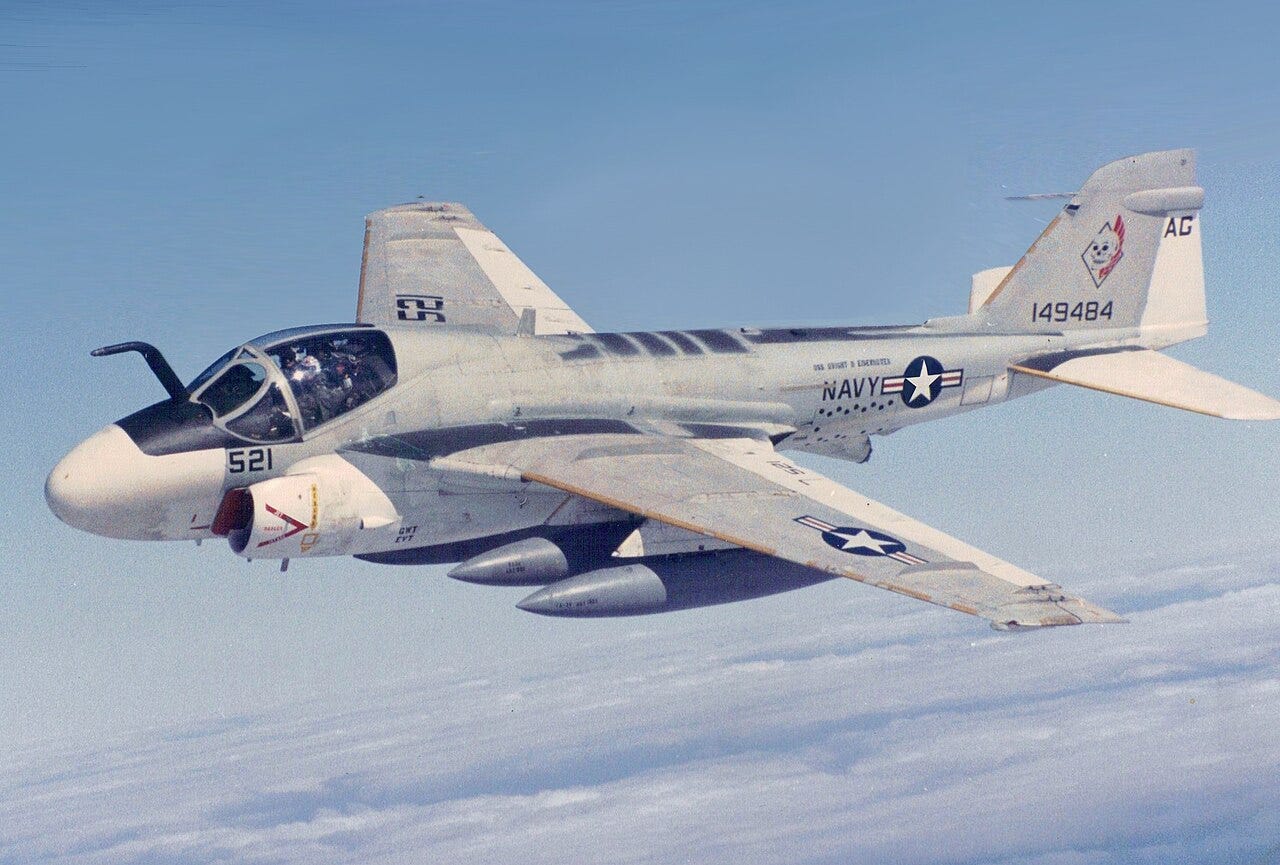
The Origins of the Intruder
It’s the late 1950s, and the U.S. Navy needs a new workhorse for the skies. Their trusty Douglas Skyraider, a prop-driven legend, is showing its age. Meanwhile, the Marines are clamoring for a close air support jet that can leap off short runways.
Lessons fresh from the Korean War add urgency; a new attack aircraft needs to fly long, fly low under the radar, and strike with precision, whatever the weather throws at it.
The brass drafts up a wish list in 1957: Speed, range, payload, short takeoff, plus a twist. Instead of patching together airframe and weapons from different shops, this time the winning design must seamlessly integrate the whole system from day one. It’s a tall order, and the competition is fierce.
Enter Grumman, already carving its name in aviation lore. Their answer: the A2F Intruder (later rebranded the A-6 in 1962). Picture this: a twin-jet beast with engines tucked into its wings and a crew of two sitting side-by-side, the Bombardier/Navigator riding a bit lower and further back so the pilot can see right.
Up front, a bulbous nose crams in a powerful radar suite: big for targeting, smaller for hugging the terrain. All this feeds into a cutting-edge nerve center called DIANE (Digital Integrated Attack and Navigation Equipment). Thanks to DIANE, the A-6 could fly blind through clouds and storms, its CRT screens (a first for combat jets) guiding the crew to their mark with all-weather precision.
The Intruder’s oddball looks quickly earned it nicknames including “Flying Drumstick,” “Iron Tadpole,” and, affectionately, “Double Ugly.” But there was beauty in its function. The Navy placed its first order in 1959, and by April 1960, the prototype was airborne.
Early experiments—like jet tailpipes that could tilt for shorter takeoffs—were scrapped after tests, but innovations like beefed-up nose gear for the Navy’s new catapult launch system stuck. The Intruder even beat out most other jets in adopting this new tech.
By 1963, the A-6A was rolling off the line for the Navy, and a year later for the Marines. VA-75, the first operational squadron, took Intruders to Vietnam in 1965, unleashing the aircraft’s true potential: flying at night or through monsoon squalls, zeroing in on targets without ever having to see them out the window. DIANE did the seeing for them.
The story didn’t stop there. As technology raced ahead, so did the Intruder. Some A-6s became specialized Iron Hand B models, hunting enemy missiles. Others (the C models) packed heavy, high-tech sensor pods for night interdiction; though these were eventually replaced by sleeker, more reliable laser targeting pods.
The Intruder’s punch was legendary: in one mission, a pair dropped two dozen bombs on a North Vietnamese power plant so silently, the enemy thought a squadron of B-52s had paid a visit. That raid earned a Navy Cross.
The saga’s final chapter arrived with the A-6E, first tested in 1970. This upgrade brought state-of-the-art avionics, radar, and navigation, with hundreds of older Intruders rebuilt and new ones rolling off the line.
The Intruder, in all its rugged, cinematic glory, became the backbone of Navy and Marine attack squadrons for decades. It is a true legend born from a blend of wartime necessity, technical audacity, and the relentless drive to own the night.
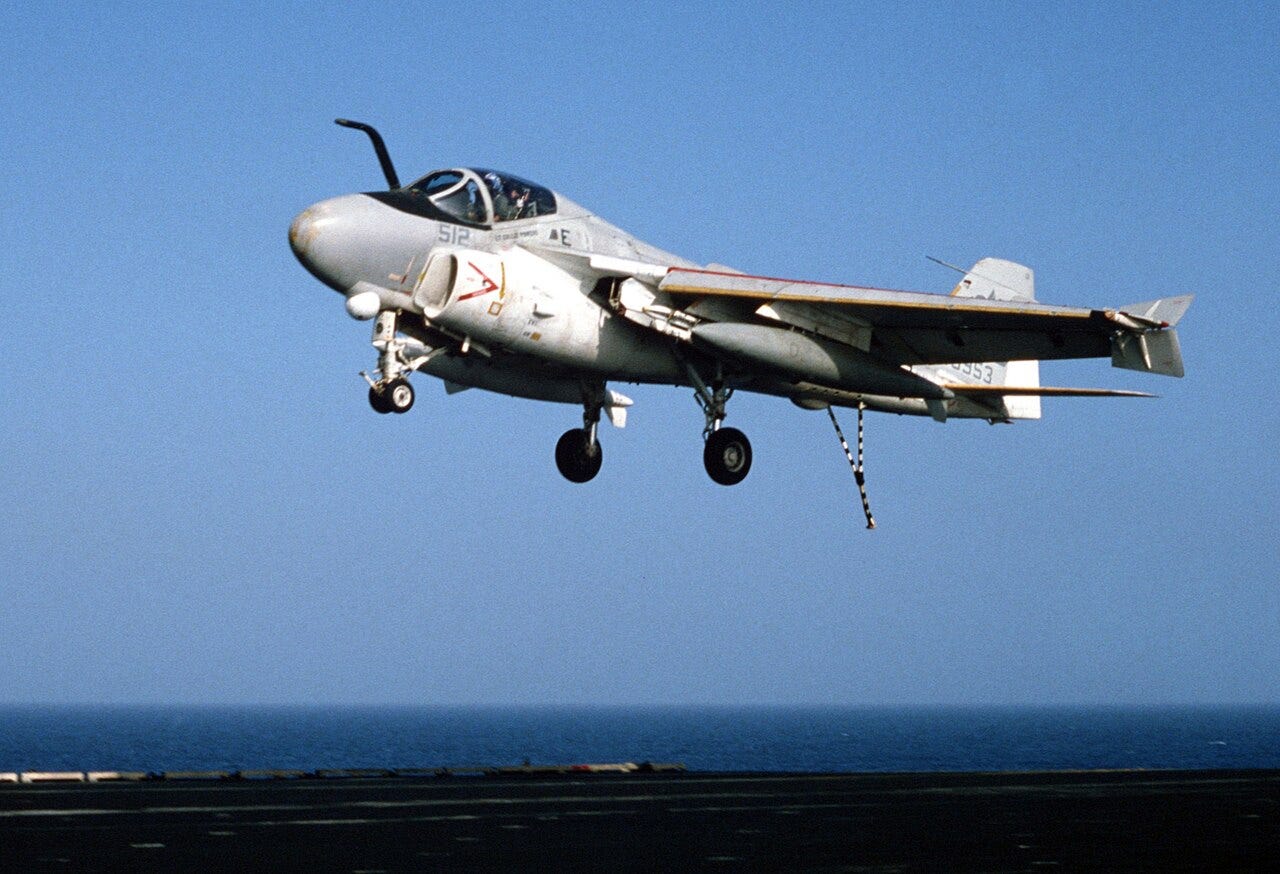
A Closer Look at the Intruder
The Grumman A-6A Intruder—a burly, all-weather attack bomber, tough as nails and powered by not one, but two roaring turbojet engines. Its cockpit? Side-by-side seating for the dynamic duo: the pilot and the “b/n”—that’s bombardier/navigator for the uninitiated. They sat shoulder to shoulder, ready to take on whatever the skies (or the sea) threw at them. The wings? Slightly swept, just enough to let you know this bird means business.
Now, let’s set the stage with numbers that matter: The A2F-1, as the prototype was first called, stretched out a solid 53 feet, 3 inches from nose to tail, and those wings spanned 53 feet even.
Just about the wingspan of a DC-3, if you’re counting. Standing on the deck, it measured over 15 feet tall, with wings that covered more than 500 square feet. Those wings swept back at a cool 25 degrees, giving the Intruder that predatory look.
She was no lightweight, either. Empty, she tipped the scales at over 23,000 pounds, but fully loaded and ready to launch, she could weigh in at a beefy 53,000 pounds.
Under the hood—or, more accurately, under the fuselage—were two Pratt & Whitney J52-P-6 turbojets.
These weren’t just any engines; they’d already proved themselves pushing the AGM-28 Hound Dog cruise missile. Each J52 had a 12-stage compressor, a two-stage turbine, and could kick out 7,500 pounds of thrust at normal power, or crank it up to 8,500 pounds for those “hold my beer” moments.
The exhaust nozzle could even dip down 23 degrees to help the Intruder leap off short runways. because sometimes, you just need a little extra kick.
What about performance? The A-6A could settle into a cruise at 429 knots, high above the world at 44,000 feet, or scream across the deck at sea level at 566 knots. She could claw her way up to nearly 50,000 feet and stretch her legs for over 2,000 nautical miles; enough range to make any adversary nervous.
In short, the Intruder was a cinematic marvel of engineering: rugged, reliable, and always ready for action—rain, shine, or the darkest night over the open sea.
The A-6’s Enduring Flightpath
The A-6 Intruder, the legend born from a bold idea, gave the Navy an attack jet that could hit its mark, rain or shine, day or night, no matter what the clouds or the enemy had to say about it.
When the Intruder first took to the sky on April 19, 1960, it wasn’t just another airplane on the flight deck. This beast could pack a heavy punch and deliver it through the worst weather, thanks to its groundbreaking DIANE navigation and attack system (and later, the TRAM suite on the A-6E).
Vietnam was where the Intruder’s legend really took off. While other jets waited for clear skies, A-6 crews launched into the murk, flying solo or in tight pairs, threading through flak and dodging missiles.
Their accuracy in the soup was the stuff of squadron legend. And the A-6 didn’t retire with Saigon’s fall. It kept coming back, from Lebanon’s chaos to the Libyan coast, over Bosnia, and during the fireworks of Desert Storm and Operation Praying Mantis.
What’s the true legacy? The A-6 proved that a combat jet’s worth isn’t just about speed or looking pretty. It’s about how far it can reach, how sharp its sensors are, how tightly the crew works together, and—most of all—how it performs when the weather turns ugly and the stakes are sky-high. That’s a lesson modern airpower still takes to heart.
In Case You Missed It
Photo Outlet
Every issue of Hangar Flying with Tog gets you a free image that I’ve taken at airshows:
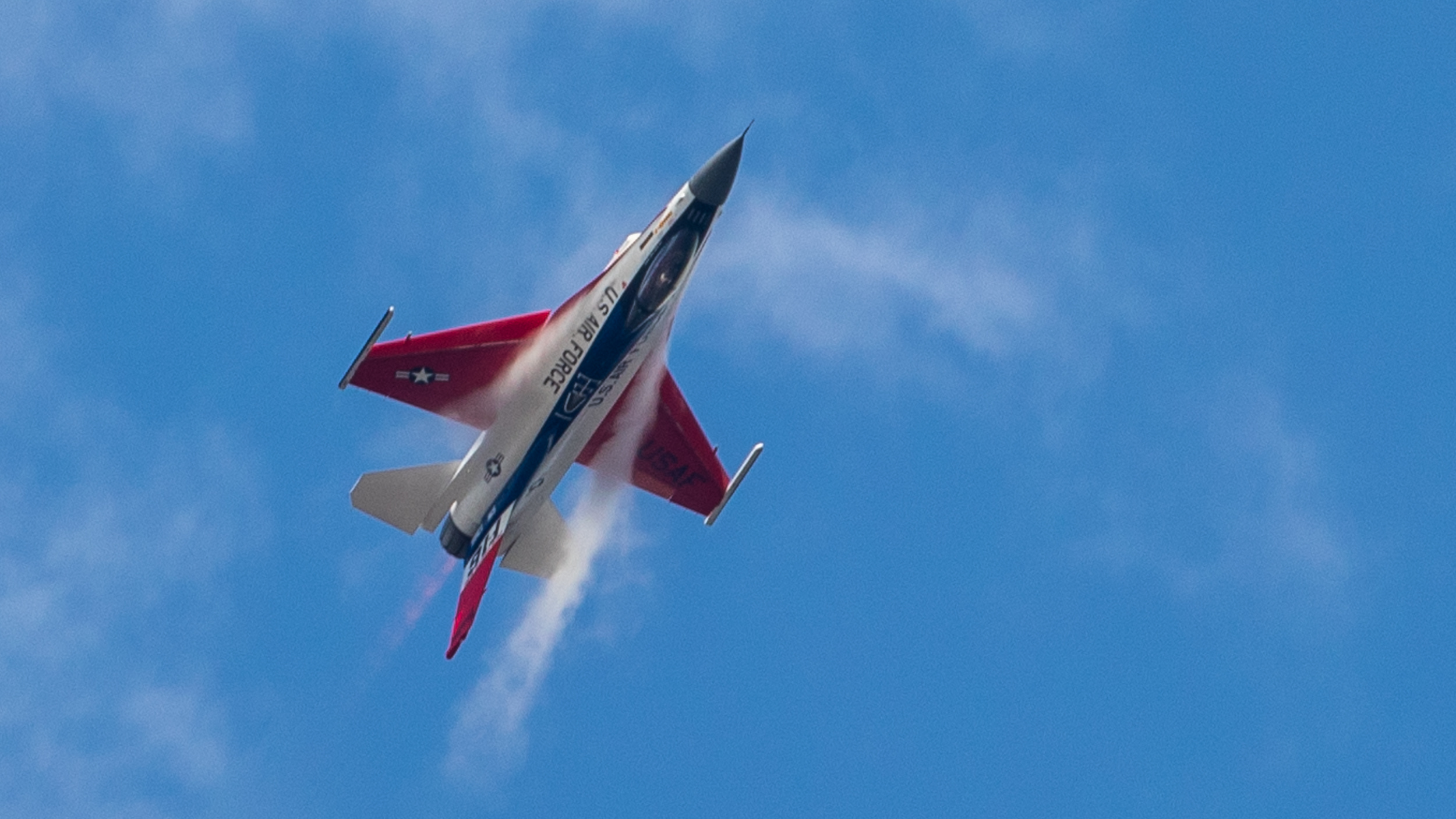
Feel free to use these photos however you like. If you choose to tag me, I am @pilotphotog on all social platforms. Thanks!
Post Flight Debrief
Like what you’re reading? Stay in the loop by signing up below—it’s quick, easy, and always free.
This newsletter will always be free for everyone, but if you want to go further, support the mission, and unlock bonus content like the Midweek Sortie, consider becoming a paid subscriber.
Your support keeps this flight crew flying—and I couldn’t do it without you.
– Tog